
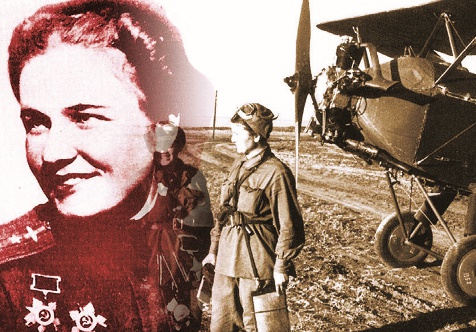
In collaboration with PASSIONS, VOICE OF ASIA is proud to present timeless articles from the archives, reproduced digitally for your reading pleasure. Originally published in PASSIONS Volume 54 in 2013, we present this story on Nadezhda “Nadia” Popova, the queen of the skies, and a “witch” to her enemies.
It is the late 1940s, and the world is troubled by war. The norm is pushed to the side temporarily as women took on an active role in the jobs arena, doing work that had only been previously assigned to men. PASSIONS remembers Nadezhda Popova, also known as Nadia, and her contribution to the movement as a leading member of the elite corps of women pilots sent by the soviet union to Germany in World War ii, and her accomplishments as one of the best fighter pilots of her time.
In the dead of the night, in the midst of peaceful silence, there is a new sound – a whoosh of air against plywood and canvas. Very soon after, there are bombs and explosions. These were the ‘Night Witches’, as the Germans called them, 2-women crews in P0-2 biplanes who dropped bombs on them, shutting down their engines at the last minute as they approached their targets. After a few of these successful stealth attacks, Germans were so fearful of the Russian female fighter pilots that the Luftwaffe were promised Iron Cross awards if they could shoot down one of them. The nickname seemed more a compliment on their excellence, than an insult.
Surviving At War
Comprising women from 17 to 26 years old, the night bombers were the most feared regiment out of the three that Joseph Stalin deployed, the other two being fighters and dive bombers. They went on nocturnal missions and flew vintage 1920’s Polikarpov planes with no parachutes, guns, radios, or radar – only maps and compasses. Compared to the German Messerschmitts that were fast and deadly, the night bomber biplanes were easy to manoeuvre and had a maximum speed slower than the German planes’ stall speed, making them difficult to shoot at. They had a distinctive advantage during the night.
Nadezhda “Nadia” Popova was one of the best women pilots of that regiment. One of its first volunteers, and with 852 missions under her belt, she was promoted to be Deputy Commander of the 588th Regiment. To several authors who wrote about that period, she talked extensively about her experiences during the war, recalling the unfortunate conditions they had to live through as female pilots – looked down on and harassed by their male counterparts, very bad living conditions, given male-pilot hand-me-downs, and then post-war, being regarded as loose women. On top of all of that were the dangers of combat.
It was all about survival inside the aircraft, she said. Because there were no parachutes, ‘giving up’ and not pressing on to accomplish a mission meant being burned alive or getting shot down. “If you give in, you don’t become a hero,” she said.
Flying Colours
Popova first became interested in flying when, as a little girl, a pilot landed near her home in Shabanovka, Ukraine. She was fascinated by the idea that “a simple man could get on a plane and just fly away.” She later joined a flying club, and eventually became a flight instructor.
“I was inspired by patriotism,” she said, and then also admitted, “but also my desire for revenge.” She could not forget the image of Nazis killing innocent women and children.
“I think I was born lucky,” Popova once said. Her aircraft had been forced to crash-land many times after being shot at, but she was always unharmed, and once, after a crash landing, she met another fighter pilot who would later become her husband.
Another time, she noticed 42 bullet holes in her side of the plane, prompting her to turn to her navigator and say, “Katya, my dear, we will live long.”
Nadia was a good tactician, and she led her regiment efficiently. She was awarded the highest honour as a Hero of the Soviet Union, as well as the Gold Star, the Order of Lenin, the Order of the Red Star, and the Order of Friendship, all for her bravery and skill during the war. When she passed away, Ukraine’s President Viktor F. Yanukovich eulogised:
“Her life is an example of selfless service to [the] Motherland, her feats in the course of the Great Patriotic War will never be forgotten.“
When asked about how she survived that traumatic part of her life, she said it was all just part of being in a war, and that someone had to “do the job that needs doing”. and Nadia Popova happened to be the kind of person who, if she must do something, she must do it well. she is an example to women who have ever been told that only specific career paths exist for females to take and be good at, who have been boxed neatly into a traditional gender role by society.
A pilot at a time when only men were considered good for the job, she channelled her energy and her anger at the murder of so many innocent people, into fighting back at the enemy. and winning.