

|
The National University Centre for Digestive Health heralds a new era of care through quicker cross-referrals to surgical specialties, strengthened community partnerships and patient-friendly treatment delivery
SINGAPORE, Jan. 16, 2026 /PRNewswire/ — Digestive health is central to overall well-being, influencing nutrition, immunity, and quality of life. Yet common conditions, such as ulcers, liver disease, and colorectal disorders, often go undetected until they lead to serious complications. To address this, the National University Hospital (NUH) has officially opened the National University Centre for Digestive Health (NUCD), a facility dedicated to early detection, advanced treatment, and seamless patient care for digestive diseases.
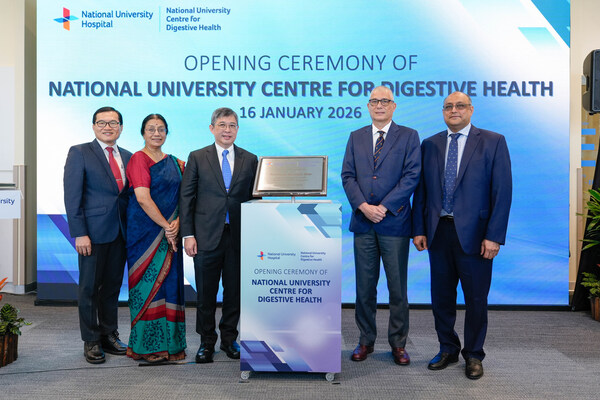
At the official opening of the National University Centre for Digestive Health, officiated by Professor Kenneth Mak, Director-General of Health, Ministry of Health (third from left).
Since its concept launch in 2024, NUCD has focused on consolidating NUH’s digestive health services under one roof to provide greater convenience for patients. Its reach extends beyond NUH, serving as a referral hub for complex cases from other hospitals within the National University Health System, including Ng Teng Fong General Hospital and Alexandra Hospital, ensuring patients receive specialised care when needed.
With its official opening, the Centre is strengthening the entire care pathway by accelerating access from initial digestive consultation to surgical expertise in Upper Gastrointestinal, Hepatobiliary and Pancreatic, and Colorectal, so patients can see the right specialists on the same day. This streamlined approach reduces waiting times, minimises repeated visits, and enables faster treatment decisions for better outcomes.
Strengthening prevention: From community collaborations to clinical excellence
NUCD has contributed significantly to the clinical validation and implementation of the Fibrosis-4 (FIB-4) score and fibroscan to screen for liver fibrosis, or scarring of the liver, in high-risk patients with fatty liver and other chronic liver diseases[1]. Since September 2022, a chronic liver disease screening programme for high-risk individuals has been launched in partnership with National University Polyclinics and General Practitioners (GP) clinics. Through consultations and routine health assessments done at these clinics, asymptomatic individuals identified as potentially high-risk are referred to NUCD for comprehensive screening. To date, the Centre has screened more than 12,000 high-risk patients, facilitating earlier detection and interventions. With continuing medical education and engagement, NUCD continues to expand this network to enhance preventive care for liver health.
Another key focus of the Centre is improving the detection of colorectal cancer, often called a ‘silent killer’ because symptoms usually appear only in later stages. According to the Singapore Cancer Registry Annual Report 2022[2], colorectal cancer is the second most common cancer and the second leading cause of cancer-related deaths locally. To tackle this, the Centre is improving colonoscopy quality by increasing the Adenoma Detection Rate (ADR), a measure of how often doctors detect and remove precancerous polyps during the procedure.
Studies[3] show that every 1 per cent increase in ADR lowers colorectal cancer risk by 3 per cent, making these improvements a vital step in prevention. Put simply, a higher ADR means that more polyps are removed early, reducing cancer risk. New initiatives such as AI-enabled and image-enhanced colonoscopy, an automated ADR calculation system, and a dashboard displaying critical quality indicators for endoscopists have helped boost ADR at NUCD from 33.5 per cent in 2022 to 42.4 per cent in 2025, well above the American Society for Gastrointestinal Endoscopy guideline of at least 25 per cent[4].
Making IBD care more convenient and precise
Established in 2016, the Inflammatory Bowel Disease (IBD) Centre of Excellence is now a cornerstone of NUCD, delivering advanced care across all ages – from paediatric to adult patients. Among its key innovations is the home administration of intravenous biologics, reducing the need for frequent hospital visits and improving convenience.
Others include point-of-care intestinal ultrasound, which enables real-time, non-invasive assessment during clinic consultations, and a translational precision medicine programme that personalises treatment and provides access to clinical trials and novel therapies, such as faecal microbiota transplantation. The IBD Centre of Excellence also aims to play a leading role in regional education, having hosted IBD training programmes for over 100 healthcare professionals from ASEAN countries in the past five years.
“The launch of NUCD marks a significant step forward in how we care for patients with digestive conditions,” said Adj A/Prof Lee Guan Huei, Centre Director, National University Centre for Digestive Health. “By bringing together advanced diagnostics, specialist expertise, and cutting-edge technology, we aim to deliver care that is faster, more precise, and patient-focused. At the same time, we are driving research into new detection methods and innovative therapies, such as blood-based diagnostic tools that reduce the need for invasive procedures while maintaining accuracy. Our goal is simple – to detect problems early, treat them well, and help our patients live healthier lives.” Adj A/Prof Lee is also Head and Senior Consultant, Division of Gastroenterology and Hepatology, Department of Medicine, NUH.
About the National University Hospital (NUH)
The National University Hospital (NUH) is Singapore’s leading university hospital. While the hospital at Kent Ridge first received its patients on 24 June 1985, our legacy started from 1905, the date of the founding of what is today the NUS Yong Loo Lin School of Medicine. NUH is the principal teaching hospital of the medical school.
Our unique identity as a university hospital is a key attraction for healthcare professionals who aspire to do more than practise tertiary medical care. We offer an environment where research and teaching are an integral part of medicine, and continue to shape medicine and transform care for the community we care for.
We are an academic medical centre with over 1,200 beds, serving more than one million patients a year with over 50 medical, surgical and dental specialties. NUH is the only public and not-for-profit hospital in Singapore to provide trusted care for adults, women and children under one roof, including the only paediatric kidney and liver transplant programme in the country.
The NUH is a key member of the National University Health System (NUHS), one of three public healthcare clusters in Singapore. For more information, visit www.nuh.com.sg
Follow us on
Facebook | Instagram | LinkedIn | TikTok | YouTube
|
[1] Chew NWS, Ng CH, Chan KE, et al. FIB-4 Predicts MACE and Cardiovascular Mortality in Patients With Nonalcoholic Fatty Liver Disease. Can J Cardiol 2022 Nov;38(11):1779-1780. |
|
[2] Singapore Cancer Registry Annual Report 2022, September 2024, https://www.nrdo.gov.sg/publications/cancer |
|
[3] Corley DA, Levin TR, Doubeni CA.Adenoma detection rate and risk of colorectal cancer and death. N Engl J Med. 2014;370:2541. |
|
[4] Song YM, Han KS, Kim BC, Hong CW, Kim B, Kim MC, Jin MJ, Sohn DK. Analysis of adenoma detection rate of colonoscopy among trainees. Ann Coloproctol. 2024 Dec;40(6):548-554. doi: 10.3393/ac.2023.00199.0028. Epub 2024 Aug 28. PMID: 39191316; PMCID: PMC11701454. |