

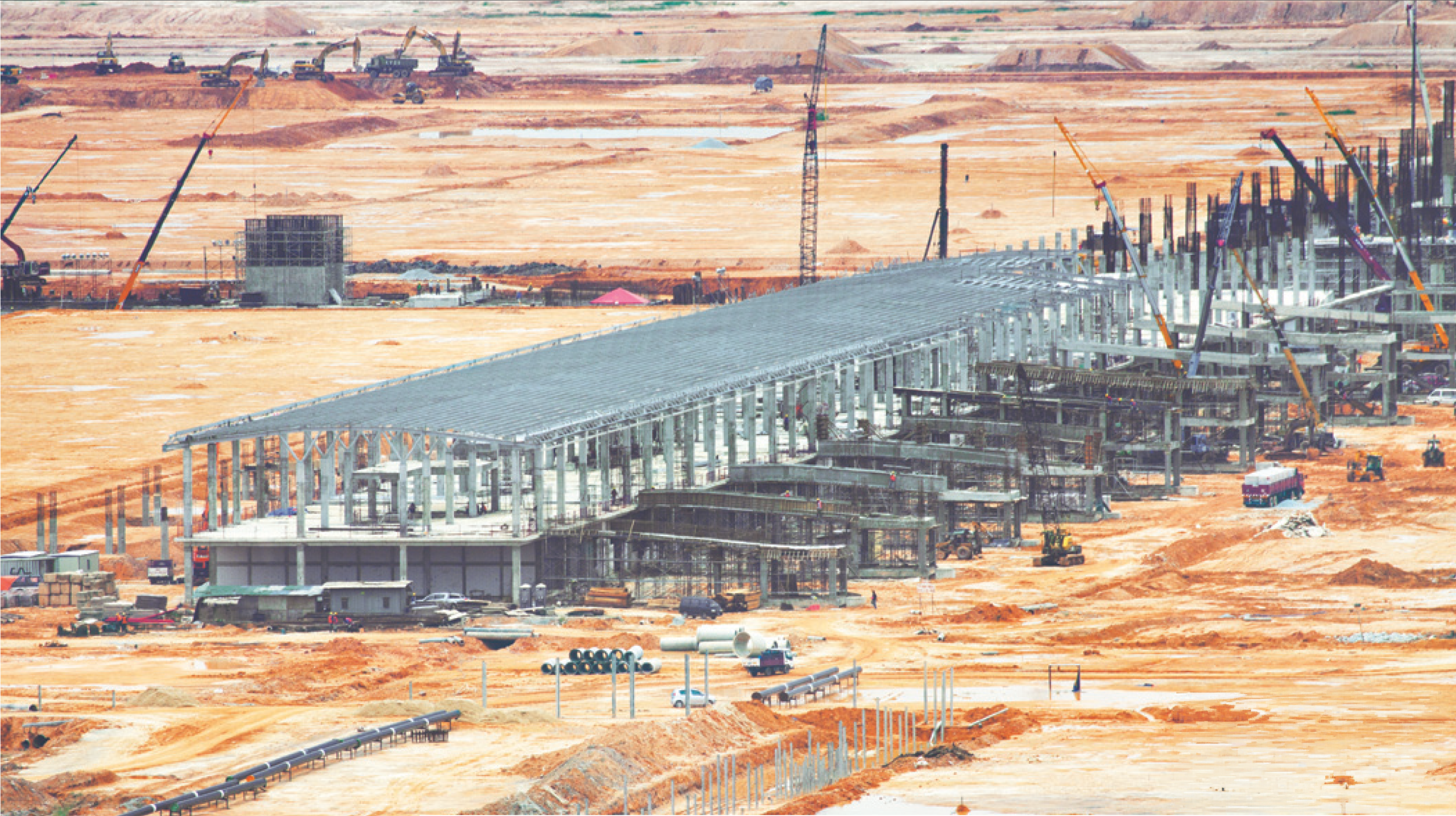
In collaboration with Convergence, VOICE OF ASIA is proud to present timeless articles from the archives, reproduced digitally for your reading pleasure. Originally published in Convergence Volume 9 in 2011, we present this story on the construction of klia2, setting the groundwork for Malaysia’s growth in becoming a regional aviation hub.
Ever since Prime Minister Dato’ Seri Mohd Najib Tun Abdul Razak officiated a groundbreaking ceremony on the 30th of August 2010, massive work has been underway on the site of the new klia2 terminal, When completed, klia2 will supersede the present LCCT-KLIA, and – with its handling capacity of 30 million passengers per year, and seamless connectivity with KLIA’s Main Terminal Building – will help Malaysia realise its dream of becoming the next generation hub for regional aviation. Convergence visited the site recently to gauge the progress of the works.
Taking Shape
Ir Mohd Zaifuddin Idris, the General Manager of Construction for klia2, is a busy man. Leading a dedicated team of architects and engineers, he is involved in a mammoth task involving no less than 44 contractors, and an army of construction workers. Battling against time, weather, and the terrain, they have persevered in constructing the new terminal.
On our way to interview Zaifuddin at the site of klia2, we were able to see how the project has been progressing. While travelling on the road to KLIA, the unmistakable forms of the new terminal complex came into view, just off our right side. As we took the turn on the right to get to the construction site, it was hard not to notice the road work which was underway there.
“That is the approach road to klia2,” Zaifuddin told Convergence later in his office, after we had arrived. “It will be the access way to the new terminal and when airport users take the slip road to the right just before reaching KLIA, they will reach two elevated roads. One will take them to the arrival hall and the other to the departure hall.
”The design of klia2 will also feature a 2-building concept – similar to KLIA whereby it will have the Main Terminal Building (MTB) that will comprise the arrival and departure halls, and a satellite building on the airside for more boarding gates. Incidentally, when we told Zaifuddin that Convergence was at the MTB with the Malaysia Airports Board of Directors in July (you can read more about the visit in our previous issue – Convergence Volume 8), he beamed.
Raising The Roof
It was not long before we saw the reason for the smile, as he took us to the said building. Whereas during our last visit there, the second floor was near completion, with work having commenced on the third floor; this time, both floors were finished. It is quite an impressive feat, and Zaifuddin explained that when the terminal is up and running, the second level would host the arrival hall, with the departure hall one floor up on the third level.
When we were there, Zaifuddin directed our attention to the work which was being carried out on the roof of the structure. “We are working around the clock to install the roof, so that we can shield the inside from the rain and other elements,” he said. “You would probably have seen the work going on when you were approaching the site.”
The Technology Infrastructure
Smiling at the nod we gave him, Zaifuddin went on to reveal that once the roof was completed – which is expected to be at the end of 2011 – the next step will then begin, which is the installation of the electrical and mechanical systems, including the baggage handling system (more about which will be revealed later in this article). Once this very vital exercise is underway, it would not be wrong to say that klia2’s construction would have reached its final stages.
However, even on that late September afternoon, when we visited the site, it was not difficult to imagine the terminal once it was in operation. Of course, one has to applaud the construction team led by Zaifuddin as they not only had to take into account the requirements of the airlines which will be using klia2, but also all stakeholders such as retail and F&B concessionaires.
And of course, there are the passengers. “At Malaysia Airports, we take the comfort and safety of airport users very seriously,” Zaifuddin stated. “So we work fast, but we are also very detailed and precise in what we do. We don’t just simply finish the job for the sake of finishing it, but we also take great care to make sure that everything is done right.”
That commitment to the comfort and convenience of the passengers will be reflected in many forms at klia2, with one of them being the Automated Baggage Handling System (BHS). At present, in LCCT-KLIA, passengers need to wait while screening and checking in their baggage. However, at klia2 – just as it is at KLIA now – passengers will enjoy in-line screening, which will save them a lot of time.
Bigger and Better
Improved technology is just one of the key differences between klia2 and the present LCCT-KLIA. Size is another very obvious one, as klia2 will be – as we can see – the largest purpose built terminal for low-cost airlines, with state-of -the-art services and facilities.. But just to compare the two, the total built-up area of klia2 will be 257,000 square metres, as opposed to 64,000 square metres for LCCT-KLIA.
Stepping out of the MTB with Zaifuddin as our guide, we were taken on a walking tour of the site, including to where a runway is under construction, and which will take the total number of runways at KLIA to three. Other than the runway – for which earthworks had already been completed during our visit – we were also told that a new control tower – measuring 97 metres tall, is also in the pipeline.
Environmental Consciousness
As one of the most visible projects undertaken by Malaysia Airports – a leading GLC in the country – it is only expected that klia2 aims to not only be a world-class terminal but also a world-class Green terminal. And that means complying with sustainable policies and regulation.
Zaifuddin explained that to ensure that klia2 is recognised both nationally and internationally as a bona fide Green building, Malaysia Airports has engaged a team of consultants who are helping klia2 achieve Silver certification under the Malaysian Green Building Index (GBI), and Gold certification under the US-based LEED (Leadership in Energy and Environmental Design). You can read more about this in our interview with the consultants – EAG Consulting, in the article Runway To Sustainability on page 80.
Record Cost Efficiencies
One of the most remarkable features of the ongoing klia2 site-work is that although the project is much bigger in scope, and involves the latest features in airport terminal design and development, it has thus far been extremely cost-efficient. Zaifuddin emphasised that klia2’s development cost would be the lowest for any project of this size, and with the lowest development unit cost in comparison to other airport terminals of similar capacity and facilities.
He also emphasised that this had been achieved through the use of less manpower. He attributed these remarkable cost and labour efficiencies to the fact that the role of middle-men had been removed, leading to a more lean and efficient decision-making and management process. He also paid tribute to the very supportive Board of Directors at Malaysia Airports, who gave his team the power and leverage to act on decisions quickly and in the most efficient manner.
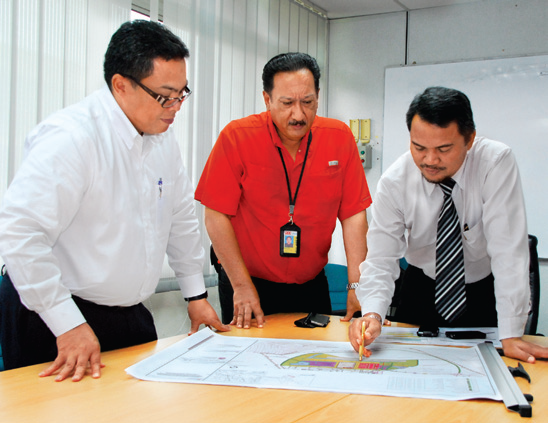
It is difficult not to be impressed with what Ir Mohd Zaifuddin Idris and his team have achieved in the construction of klia2. Responding to our compliment with a mixture of justified pride and self-effacing humility, the General Manager of Construction for klia2 urged us to pay another visit in the near future, with the Integrated Complex being destination of our next tour.
This building will not only act as the transportation hub of the terminal, hosting the ERL (Express Rail Link) as well as bus and taxi stands, but it will also be the retail and dining hub of klia2, thus lending credence to klia2’s identity as A Mall in the Airport, Airport in the Mall. Our next visit will be a highly anticipated one, and we are sure you will be looking forward to reading about it, in our coming issue.

)