
In collaboration with Convergence, VOICE OF ASIA is proud to present timeless articles from the archives, reproduced digitally for your reading pleasure. Originally published in Convergence Volume 13 in 2012, we present this story on the the beautiful game that is football… or soccer, if you prefer.
Gorgeous in the simplicity of its rules yet enthralling with its complexity of emotions, football captures the imagination and spirit of the entire globe. Even though it has evolved into a money-making colossus, there remains that innocent sense of giddy euphoria when the ball bulges the net and a goal is scored.
All you need to play is two jumpers for goal-posts and a ball. Or, as with the 2012 European Championships this summer, two host-countries Poland and Ukraine and eight impressive stadia.
As the titans of Europe commence their quest for the Henri Delaunay trophy and Football Fever once again grips the world, Convergence looks at what gives ‘The Beautiful Game’ its unwavering allure.
The Fabric of Football
The love-affair with ‘soccer’ is a rich tapestry that crosses all borders. Whether your love is for the flair of Brazillian trickery, the ‘total football’ style of Holland or your choice of devotion is your own flawed team, no loyalty is scorned as the game relies upon support from grass-roots who have helped lay down the hallowed turf of the sport’s cathedrals.
“Football is not a matter of life and death. It is far more important than that,” the late Liverpool F.C manager Bill Shankly once mused. If that devotion is enough to whet your appetite to discover more, there are a plethora of moments in history to devour.
Anyone can play the game, but the reason fans surrender hours of personal time to watch the best players is to witness moves that only the few skilled enough can execute, of deft touches to turn defenders that defy possibility.
The Gods of the Game
Purists constantly debate over ranking historical greats of the ilk of Brazilian Pele, Argentine Diego Maradona, Dutchman Johan Cruyff, and in trying to lever new greats such as Barcelona’s Lionel Messi and Portugal’s Ronaldo into the equation. It is not an easy list to compile, as to leave any one of dozens of other legends off is tantamount to sacrilege.
Domestically and internationally, there is no prejudice when compiling the best football has offered. Hungary and Puskas in the 1950’s, a Zinedine Zidane highlight montage including his stunning volley in 2002 UEFA Champions League Final, or a sumptuous team-effort from Brazil in the 1970 World Cup Final are the beginning of an endless list.
It is the outrage, the sheer gall of missed decisions and the cruelty of injustice that drives the frenzy of conversation and the wheels of football arguments.
For every glimpse of glory there is the other side, stung by a miscarriage of justice and of conspiracy plotted against their team, feeling destiny was denied.
With the opportunity to win the European Championships dawning only once every four years, a pivotal penalty decision being awarded to the wrong team or the momentum shifting the wrong way is a fragile line, and can make or break the legacy of a team.
Sweet 16: The Finals
Shared between Poland and Ukraine, and played in key cities such as Warsaw, Wroclaw and Donetsk, ‘Euro 2012’ sees 16 teams try to string together a perfect month of performances to achieve a legacy, and be crowned European Champions in Kiev on the 1st of July.
At this stage, after a two year qualification process, there are no easy games as countries smaller in stature emerge confident and snap at the heels of the elite.
Group ‘A’, the Dark-Horse Race
Hosts Poland are drawn with three previous winners in Russia, Euro 2004 Champions Greece and the Czech Republic to contest a heavily Eastern European affair. Always impressive in qualifying, Poland will look to the energy of home support to propel them into the next round.
With few marquee names among the four teams, Euro 2012 represents a prime opportunity for a player to create a reputation as a star to follow. Team play, that the Greeks themselves rode to glory in 2004, is more likely to triumph over individual excellence. The Russian squad houses Roman Pavlyuchenko, and fellow striker Pavel Pogrebnyak was an inspired shot in the arm for English Premier League team Fulham this campaign. Tomas Necid is on the radar of major European clubs for the Czechs, and parent club CSKA Moscow will be rubbing their hands in glee anticipating an inflated price-tag should the youngster sparkle.
‘Group ‘B’, the ‘Group of Death’
This heavyweight contest will eliminate a real football-power with only two of the Netherlands, Denmark, Portugal and the most successful team in European history, Germany, able to qualify for the next round. The last mentioned are regarded as a football machine, and however their pre-tournament form may have been, they have the guile and player infrastructure to produce when it matters the most.
Portuguese midfielder Ronaldo has been in blistering form this year, and will look to rocket his nation into the next round and beyond. Mesut Ozil and Lukas Podolski were the youth that blended with the experienced German heads that tore apart England in South Africa in 2010. Losing World Cup Finalists from that same tournament, Holland, have plenty of players to prick a thorn in the sides of their rivals. Arjen Robben and emerging goalkeeper Tim Krul will provide the right balance between defence and attack for the ‘Oranje.’
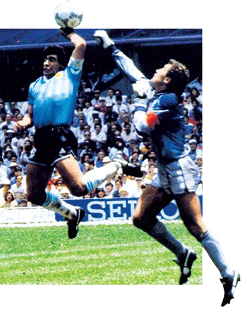
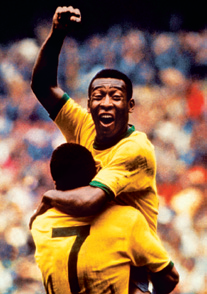
Iconic Moments in Football
Group ‘C’, the Reign in Spain
The reigning Champion of Europe, Spain landed a tricky trio of Italy, Croatia and the Republic of Ireland, a team that can always be relied upon to up-end any team not focused in a major tournament. Should Spain repeat as winners, the players present four years ago in Austria will join an exclusive club as German Rainer Bonhof is the only man with two winners’ medals, such is the gap between the frequencies of titles.
Spain are laden with skilled talent, with Andres Iniesta, Xavi, and a resurgent Fernando Torres hoping for a return of the injured David Villa, who was the top scorer in the 2008 tournament. Luka Modric has had another fantastic season, and will seek to translate club performances for Tottenham Hotspur into Croatia’s first ever foray beyond the Quarter Finals. A new era may dawn for Italy. Should the mercurial Mario Balotelli be included in their squad, the tournament could be an explosive one for them; either with smoking success or spectacular failure.
Group ‘D’, the hosts with the most
Co-hosts Ukraine participates in their first tournament after automatically qualifying as host. Included are perennial underachievers England, who despite their rich football pedigree have always found ultimate success in this tournament elusive. The always lethal France will hope to recapture the form that inspired their past teams to glory, and stubborn Sweden will look to pull off a result with their blend of untested youth talent.
England will have to survive their first two games without the talismanic Wayne Rooney, who serves a suspension from a qualifying game. Seeking a breakout star to lead the front line, the ‘Three Lions’ will hope that Ashley Young and Scott Parker can shrug off the immense pressure that follows England into major tournaments to end over 40 years of hurt. The electric midfield duo of Yoann Gourcuff and Franck Ribery are the spine of the France team. Self-proclaimed spectacle Zlatan Ibrahimovich is the lightning rod for Sweden, and a proud record scorer Andriy Shevchenko will lead the line for the Ukraine.
Meeting each team in their respective group just once, successful countries will land a quarter-final, then a semi-final date before coming one of the two teams who best navigated their course to Kiev and hope to raise the trophy aloft in the glory of the Olympic Stadium.
The Prize Of Success
Fairytales, controversies, and shocks are all chronicled in the history of the ‘Euro’s’. Denmark in 1992 failed to qualify for the tournament and were only allowed entry after Yugoslavia was expelled just weeks before the first game kicked-off Hastily assembled and with little preparation, the Danes triumphed against the odds to be crowned Champions and be written into European folklore.
More recent in 2005, Greece put a woeful record to the sword by shocking hosts and favourites Portugal in the Final. Leading 1-0 from a header, the players gallantly defended their goal from wave after wave of Portuguese pressure until the final whistle.
Goals are what define games, and talking about great goals, it is hard to compile a list without mentioning Czech winger Karel Poborsky’s lob over Portuguese goalkeeper Victor Baia in the Quarter-Finals of Euro 1996. Then there is England’s Paul Gascoigne’s flick and volley against Scotland, in the Group Stages of the same 1996 tournament hosted by England, and Michel Platini’s last-second winner for France against Portugal in the Semi-Finals of Euro 1984 after a see-saw match.
But for sheer skill, beauty and importance, there can only be one winner. It was the Final of the 1988 European Championship, and Holland were a goal to the good against the Soviet Union, when midfielder Arnold Muhren received the ball on the left flank. Turning his gaze to the 18-yard box, he saw striker Marco Van Basten peeling away into space, and crossed the ball into the penalty area. It looked over-hit and over-powered… a chance gone begging. However, Van Basten showed why he was nicknamed ‘the Swan of Utrecht’. Taking tiny, quick steps to set-up his agile frame, he volleyed a looping shot at a seemingly impossible angle.
The ball spiralled over the head of stunned Soviet goalkeeper Rinat Dasayev. Considered one of the best players in his position, Dasayev could do nothing but watch as the ball crashed into the opposite side of the goal. This was skill, a breathtaking piece of it that punctured the confidence of the Soviets and they never recovered, making them seem on a different planet to the man whose example of showmanship is replayed in the montage of every European Championship highlight reel.
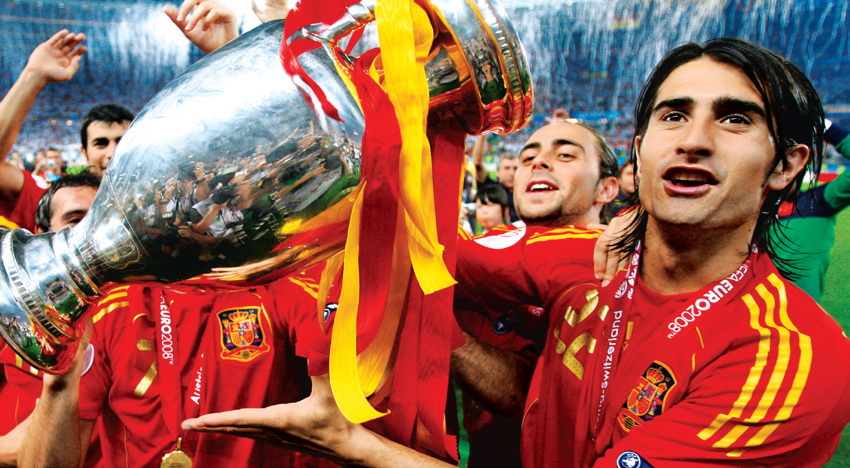
This summer the champions will have to reel off their own string of memorable moments and for those on the brink of defeat, history should remind them that when all seems lost, in football the mere flap of a swan’s wings can dissolve the other teams carefully laid plans into total chaos.