

In collaboration with High Life: Living the Good Life, VOICE OF ASIA is proud to present timeless articles from the archives, reproduced digitally for your reading pleasure. Originally published in High Life Volume 2 in 2013, we present this story on present a compilation of artworks showcasing the many ways artists have depicted spring.
Spring conjures up images of the earth recovering from the dullness of winter, flowers budding, birds tending to their hatchlings, gentle breezes and warmth returning to the land. It does not just describe a season, it epitomises rebirth, rejuvenation, renewal, resurrection and regrowth, and has inspired the greatest artists to create remarkable masterpieces; from Botticelli’s La Primavera to William Blake’s Chaucer’s Pilgrims. HIGH Life looks at some of the most magnificent works of art spurred by the season.
Springtime in the Alps by Giovanni Segantini
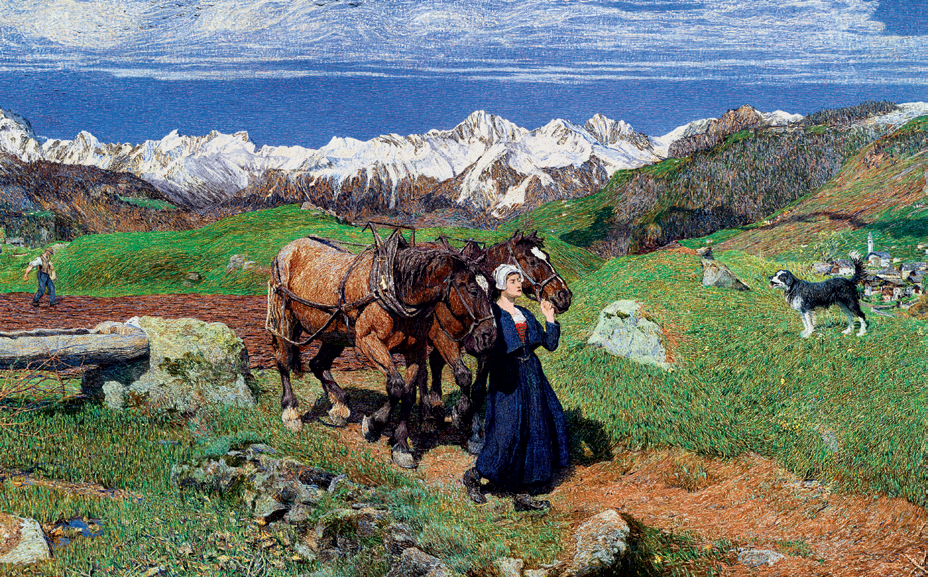
The picture was painted in 1897, in the Bregaglia region of Switzerland. Springtime in the Alps features the high-lying plateau of Plan Ludèr, outside Soglio, with the village houses, the tower of the reformed church of San Lorenzo and, above all, the magnificent snowy mountain peaks in the background. The central theme of the painting is Spring’s reawakening after a long, hard winter. The joyful and expectant ambience is manifest in the brightly glimmering lights and the far reaching vista in the background. The landscape, with its steel-blue sky and banks of white cloud, is distinguished by rich, vibrant colours and an atmosphere filled with piercingly clear light. The main motif is a young peasant-woman who is leading a pair of plough horses along a path away from the freshly tilled field, while a farmer sowing the seed, a waiting dog, and a wooden water-trough, serve as staffage elements, instilling the foreground with life.
Blossoming Almond Tree by Vincent Van Gogh
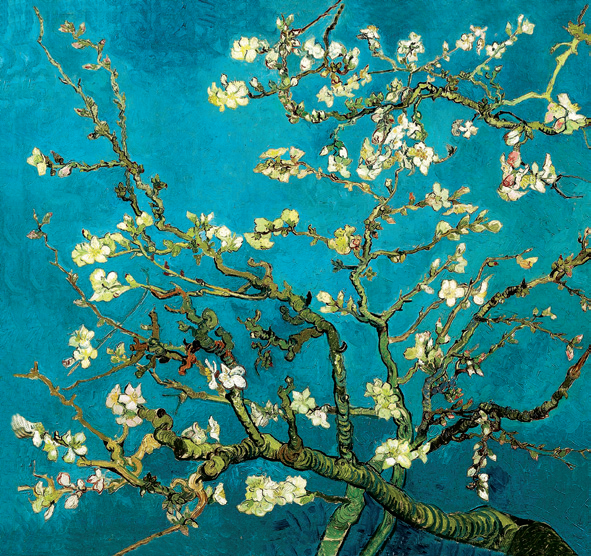
Van Gogh’s Blossoming Almond Tree, also referred to as Almond Tree, represents much of what the artist often pondered – rebirth. The blooming and flowering of a tree is, one of nature’s announcements of the beginning of spring and new life. Painted in February 1890 to celebrate the birth of his brother’s child, this could not have been a more perfect gift. Like many of Van Gogh’s paintings, Blossoming Almond Tree is influenced by Japanese prints, which he collected. He admired Japanese artists and used their ideas of bold colour, dark outlines and the beauty of nature in his work. Similar to the pictures by the Japanese artist Hiroshige, Almond Tree shows the branches of a tree against the backdrop of a blue sky. This Japonisme creates a dynamic and modern composition while still being recognisably Van Gogh.
Spring by Lawrence Alma-Tadema
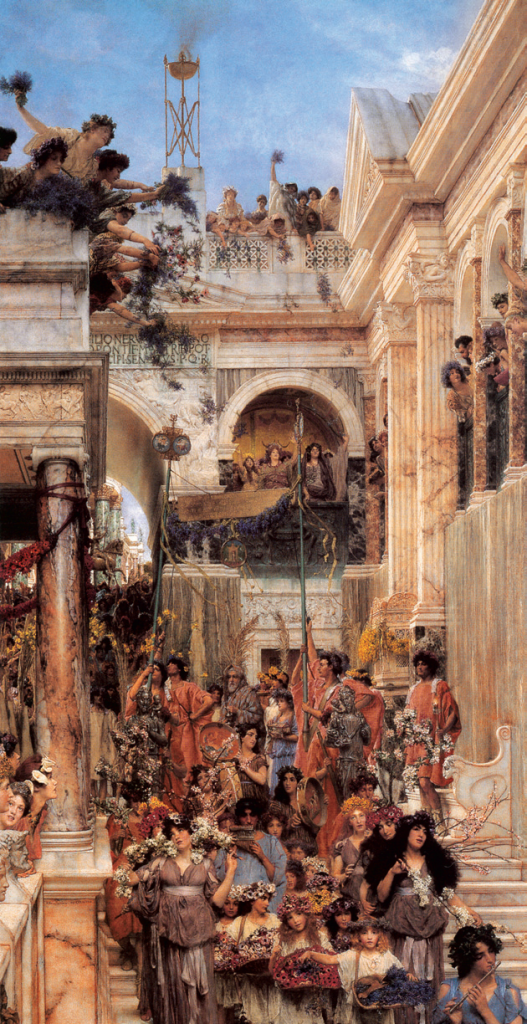
An oil on canvas painting from 1894, Spring depicts a springtime floral celebration set in an ancient world – a procession of women descending marble stairs bearing and wearing brightly coloured flowers, while cheering spectators fill the windows and roof of a classical building. In this painting, Alma-Tadema recalls the Victorian custom of sending children into the countryside to gather flowers on the morning of the 1st of May, or May Day – a notable spring festival in the Northern Hemisphere and a traditional public holiday in many parts of the world. However, in this sentimental evocation, he places the scene in ancient Rome, depicting an imagined world of beauty, order, harmony and the festival’s great antiquity, through architectural details, dress, sculpture, and even the musical instruments based on Roman originals.
May Day in Central Park by Maurice Prendergast
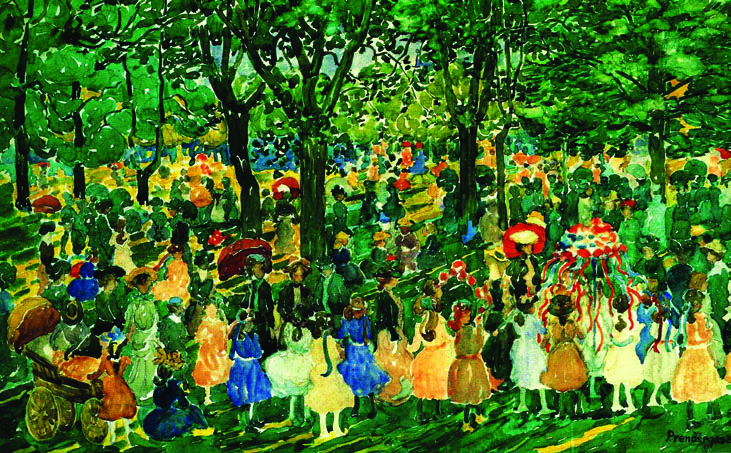
May Day in Central Park was one in a series of paintings by Prendergast that explored the brilliance of life and spring in one of the world’s most famous parks at the turn of the 20th century. It depicts a crowd of people in Central Park dancing around the Maypole on the 1st of May, and the artist plays with the tiniest of details indicating spots of dappled light, shadows and leaves flickering in the sunshine in a glorious celebration of Spring.
Spring Morning in the Han Palace by Qiu Ying
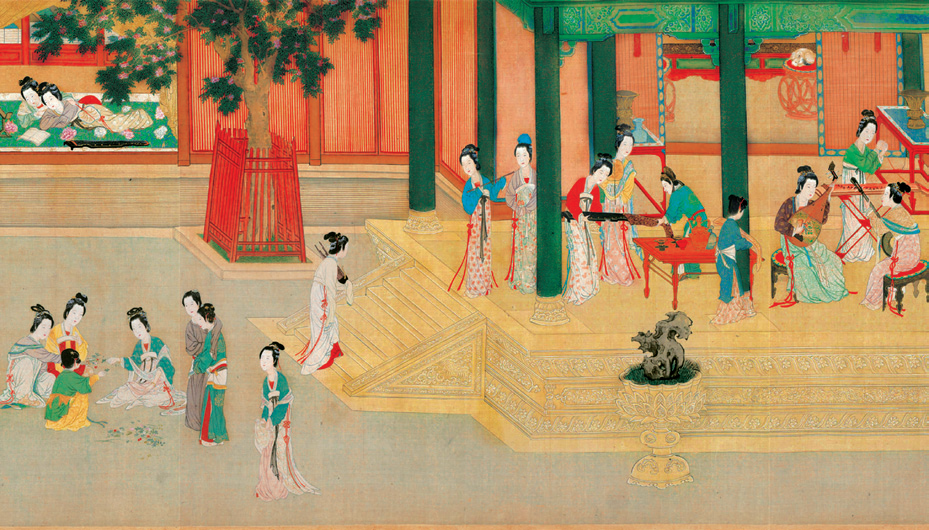
From 17th Century, this long handscroll painting of ink and colour on silk is based on an imaginary representation of various activities in a Han dynasty (206 BC-AD 220) palace on an early spring morning, with its intricate composition leading from right to left rendered with crisp brushwork and beautiful hues. Ying’s strokes are elegant and refined and his depictions of landscapes and figures both orderly and well-proportioned. In this scroll, trees and rocks punctuate the garden scene fronting the lavish palace architecture and Ying depicts several groups of beautiful concubines, enjoying various pursuits, such as listening to the gentle twang of the zither, playing chess, scribing calligraphy, or painting as well as appreciating antiquities and flowers. There are also imperial children adding a playful edge to the scene.
A Sunday Afternoon on the Island of La Grande Jatte by Georges Seurat
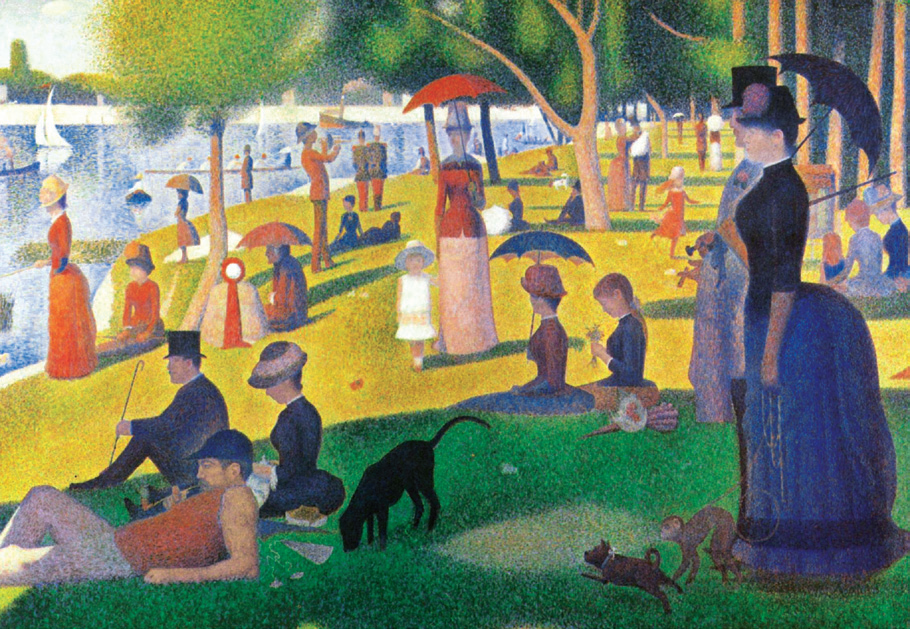
Un Dimanche Après-midi à L’Ile de la Grande Jatte (A Sunday Afternoon on the Island of La Grande Jatte) is one of the most influential paintings in art history. It depicts an afternoon landscape of people relaxing in a suburban park on a picturesque island in the Seine River. Featuring simple lines, vivid colours, and detailed accuracy of light and shadow, the work exudes a feeling of harmony, not only in colour and form, but in the scene itself. While it is quite deliberately a mundane scene of a typical Paris afternoon, it carefully portrays all ages and social classes coexisting peacefully. Seurat worked on the painting over several years, beginning in 1884 with a layer of small horizontal brushstrokes of complementary colours. He later added small dots, also in complementary colours, that appear as solid and luminous forms when seen from a distance. Seurat’s final changes to La Grande Jatte were made in 1889 when he restretched the canvas in order to add a painted border of red, orange, and blue dots to provide a visual transition between the interior of the painting and his specially designed white frame.
California Spring by Albert Bierstadt
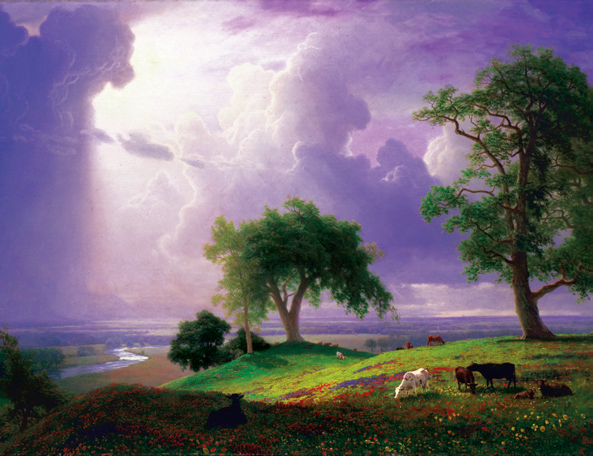
“Truly all is remarkable and a wellspring of amazement and wonder. Man is so fortunate to dwell in this American Garden of Eden.” Bierstadt said of his painting. California Spring captures the freshness of the spring morning colours of nature in the western United States, carefully detailed with a romantic, almost ethereal power. Possibly the most famous and financially successful late 19th-century painter of the American western landscape, Bierstadt created such grandiose, dramatic scenes of the desolate Wyoming Territory that they lured many people to visit those sites.
Poppy Field by Claude Monet
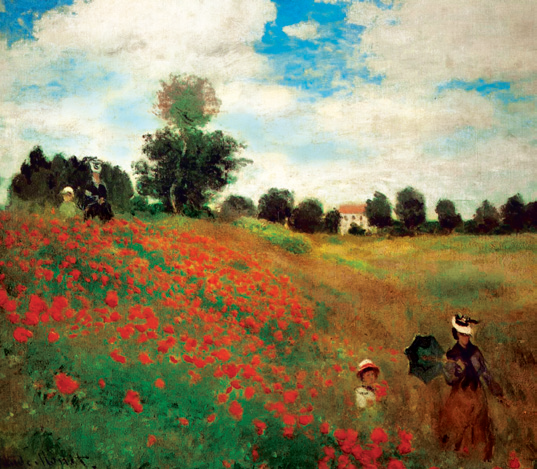
This work is one of four similar views of the plain of Gennevilliers, southeast of Argenteuil, painted in 1873 and exults Monet’s passion for colour. With dabs of red, he scatters the blooms in natural profusion across lush green fields. In the foreground, he sketches in the figures of his wife and son with simple strokes of violet, black, and white. Their figures appear again at the top of the hills in the distance, more a suggestion of colour than an accurate representation. Take away the red and there are no poppies in the field. The poppies and field are equiluminant. The impressionists painted not a landscape but the impression of a landscape. Nothing is exact; rather, everything is suggested. Monet unforgettably evokes a springtime mood through his choice of green and red.
The First Days of Spring by Salvador Dali
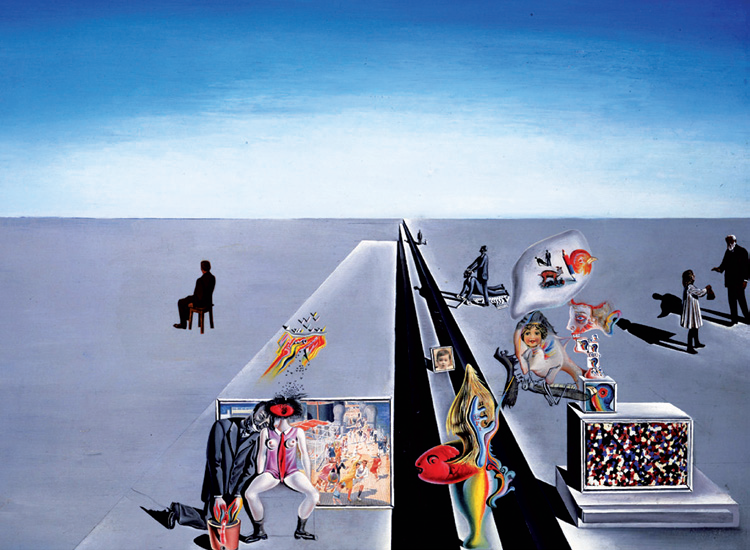
The First Days of Spring stands out because it is very apparent that the artist’s notion of spring is far, far different from that of the rest of the paintings in this spring selection. The painting was created during a time of extreme personal stress for Dali, as his father was becoming increasingly disappointed with his son’s choice of profession and unorthodox behaviour. In the distance is the small shadowy figure of a man holding the hand of a boy and towards the left is a seated figure with his back to the entire scene. It has been speculated that the figure seated in the chair represents the Dali’s father. On the right is a figure of a young girl with an old man who resembles Freud, an object on the foreground combining a colourful jug and a fish with hair and numbers and a dressed man on the back of another dressed man in the distance. What the painting lacks in flowers and bunny rabbits, it makes up for in imagination and symbolism all painted under the blue skies of spring.
La Primavera (Spring) by Sandro Botticelli
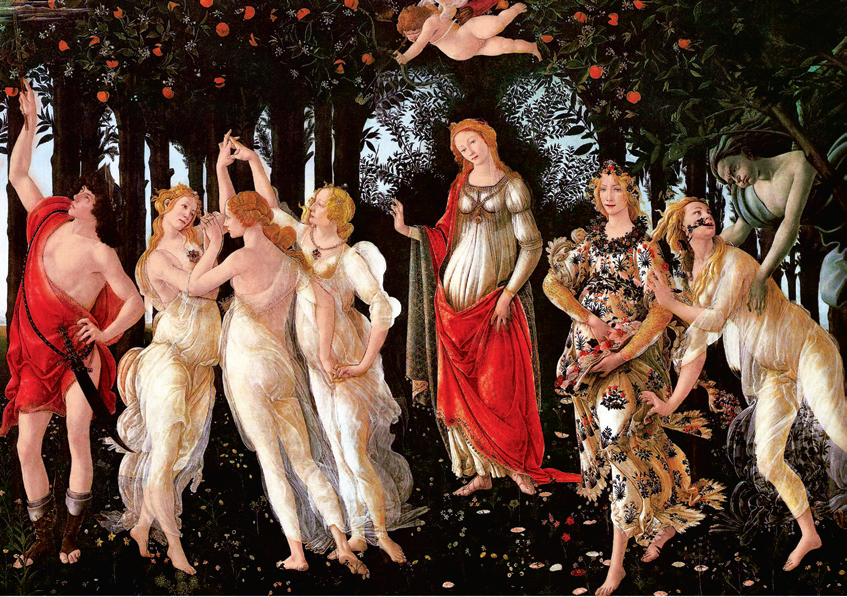
La Primavera is a very refined work of art. The naturalistic details of the meadow with 500 flowers of 170 species, the skillful use of the colour and the elegance of the figures have made this an important and fascinating work celebrated the world over. At the centre of the painting, positioned slightly behind the other figures is Venus, the goddess of Love. A grove of orange trees forms an archway over and behind her and the foliage is shaped to embrace her head and shoulders. These elements emphasise her centrality in the painting. Above Venus, her son Cupid is blindfolded and aims his arrows toward the Graces who stand on the right side of Venus, traditionally part of her retinue. They were the goddesses of charm, beauty, nature, creativity and fertility. On the far left of the painting is Mars, the God of War, while on the far right is Zyphyrus, god of the west wind and the wind of March. Next to him is Chloris, a nymph associated with flowers and spring, while to the left of Venus is Flora, goddess of flowers. Clearly, the painting depicts the power of love and beauty and the coming of spring.
Among the Sierra Nevada Mountains in California by Albert Bierstadt
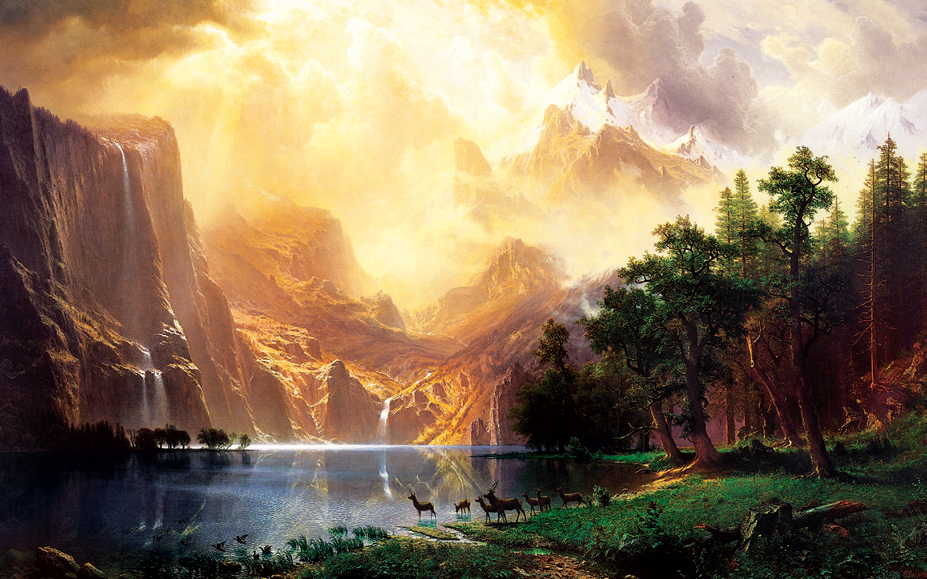
Created in 1868 during the Romantic Era, this oil on canvas scenic painting depicts an awe-inspiring view of the Rockies and Sierras of the American West. It is a photographic-like scene of a lake lapping rocky cliffs that front mountains, as sunlight breaks through the dark clouds and reflects off a glassy lake, with its mirrored images of the surrounding landscape. Imperfections are shown in the crooked shapes of the tree trunks and the fallen tree in the lower right hand corner. This painting also has Spring’s warmness, evident in the yellow hues of the sky back-drop and the small waterfowl and deer by the lake’s edge. In its entirety, Among the Sierra Nevada Mountains in California portrays nature’s beauty in peaceful quiet solitude, enticing the viewer to experience the majestic wilderness first hand.

