

In collaboration with High Life: Living the Good Life, VOICE OF ASIA is proud to present timeless articles from the archives, reproduced digitally for your reading pleasure. Originally published in High Life Volume 2 in 2015, we have a look at the world’s most iconic pieces of art, and the eye-watering figures they have been bought at.
Art-collecting is associated with riches, luxury and investment. Not only is artwork an adornment to a lavish home, they are also a status symbol worth exhibiting. In 2014, art economists reported that the market was worth a stunning US$66 billion. Add in the rarity of the piece, and the performance of the contemporary art market, and you have a recipe that will tantalise any art aficionado. HIGH Life brings you our choice of the most prestigious, highly-acclaimed art works in history.
A Peasant Inspiration
The Card Players by Paul Cézanne
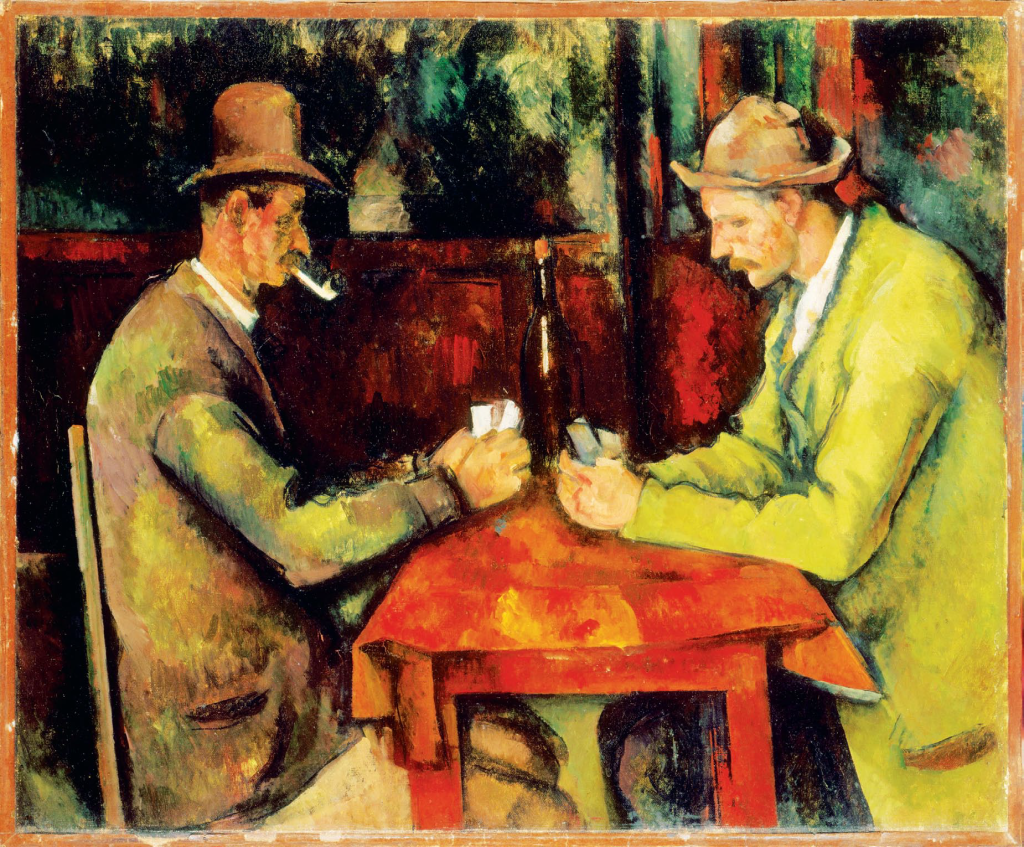
The Card Players is a series of oil paintings made by the famous Paul Cézanne in early 1890. There are five paintings in the original series, and this piece is one of the five that Cézanne started at the beginning of the 1890s while living in Aix-en-Provence. It captured the character the artist admired about the people of the region. All paintings are in different sizes and depict various peasant card players, a subject which proved to be one of his major preoccupations throughout that decade.
Cézanne’s art, which evolved to focus on landscapes and still life, was credited with bridging late 19th century Impressionism, a style in which the artist captures the image of an object as it is literally seen, using a lot of bold colours, and the Cubism, an art which shows how a sense of solidity and pictorial structure can be created without traditional perspective or modelling.
One version of these paintings was sold to the Royal Family of Qatar at a mind-boggling price of US$269.4 million, making it the most expensive painting ever sold. It serves as part of a long term project to transform the nation into one of the world’s most developed intellectual-hubs. The remaining four pieces are displayed in world-class museums which are: the Metropolitan Museum of Art, the Musée d’Orsay, the Courtauld and the Barnes Foundation.
The astronomical value of The Card Players is a result of the inherent value of owning a Cézanne, an illustrator who was considered ‘The father of all artists,’ by Pablo Picasso. There is also the mystique of a masterwork that is rarely seen, which surrounds this series, increasing their value.
The Frenemies
Three Studies of Lucian Freud by Francis Bacon
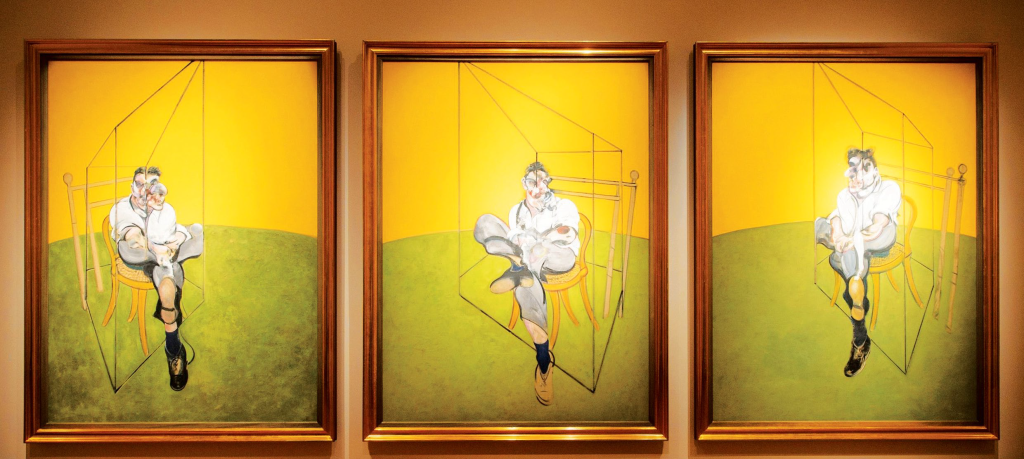
The Three Studies is a three-panel painting, portraying the artist Lucian Freud, a friend and rival of Francis Bacon. It is one of only two existing full-length triptychs of Freud, which shows his face visually taken apart and remade by Bacon’s brush, in a desolate, yet preposterously vital universe. For both artists, who took turns painting portraits of each other, art was an act of cruel love, involving taking someone apart on a canvas to deconstruct them.
Francis Bacon, although belonging to the Cubism era of art, did not paint like an avant-garde follower of the modern age, but rather, his work signified a 16th century style. In the middle ages, numerous-panelled paintings were hinged, to tell a religious story once unfolded. This was the nature of a triptych, which fascinated Bacon, as it gave him ‘something to desecrate.’ Motivated by the temptations of the 20th century, he created ghastly images that dripped with opulent colour and magnificent texture.
The agony and viciousness that punches through Bacon’s art intensifies its strange beauty. The canvas is saturated with energy; rich colour tones and geometrical balance, which when put together are shockingly beautiful. Moreover, from a historical perspective, the piece also has a particular yet essential value. The subject matter gives insight into the well-known friendship and rivalry between Francis Bacon and Lucian Freud.
Francis Bacon’s paintings are rebelliously luxurious, and it is easy to see why anyone would pay millions to have them on their wall. The Three Studies of Lucian Freud is currently owned by Elaine Wynn, former wife of Las Vegas casino owner, Steven A. Wynn, who purchased it for a staggering US$142.4 million in 2013, making it the highest price accomplished at an auction.
Temperament Meets Nature
No.5 by Jackson Pollock
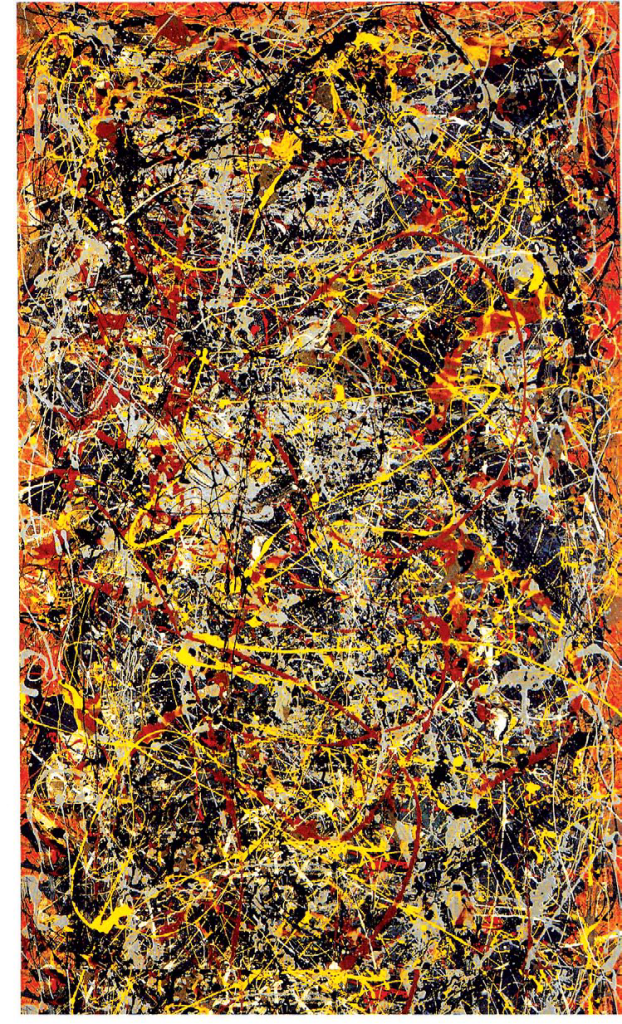
No. 5 is a painting by Jackson Pollock, an American painter known for his contributions to the Abstract Expressionist movement. A rectangle of paper covered with skeins of enamel paint, with thick amounts of brown and yellow paint drizzled on top of it to form a nestlike appearance.
In his time, Pollock sat at the pinnacle of a vast cultural movement, which bore the currently accepted history of American art and culture. Born in 1912, he is seen as the artist who was the prime mover and innovator of a new American style of art. Abstract Expressionism is an artistic movement of diverse styles and techniques, which emphasises an artist’s liberty to convey attitudes and emotions in non-traditional and usually nonrepresentational ways, which flourished in America in the aftermath of the nation’s defeat to the Axis powers in World War II. Pollock was seen as the heroic individual who held the status that was entwined into a media society that built art and culture into a profitable business.
Pollock’s quality of art required to be accepted by anyone who was imaginative enough, as it was not based on what used to be art’s fundamentals. The spontaneous smearing and tossing of liquid paint was the main style that Pollock used for No. 5. He wanted the painting to deliver the culmination of his emotion through this unconventional technique. The painting’s layout has a nest-like appearance and inspires different emotion in those who view it.
Because of this intricacy and dedication, No.5 climbed its way to the top of the art scene. Owning a Pollock art piece commands high prices because of his stature as the American artist who broke the mould set by European artists, and influenced many painters to desert conventional art and encourage limitless creativity. The painting is currently in the hands of a mystery buyer who purchased it for a cool US$140 million.
The Iceman Cometh
For the Love of God by Damien Hirst
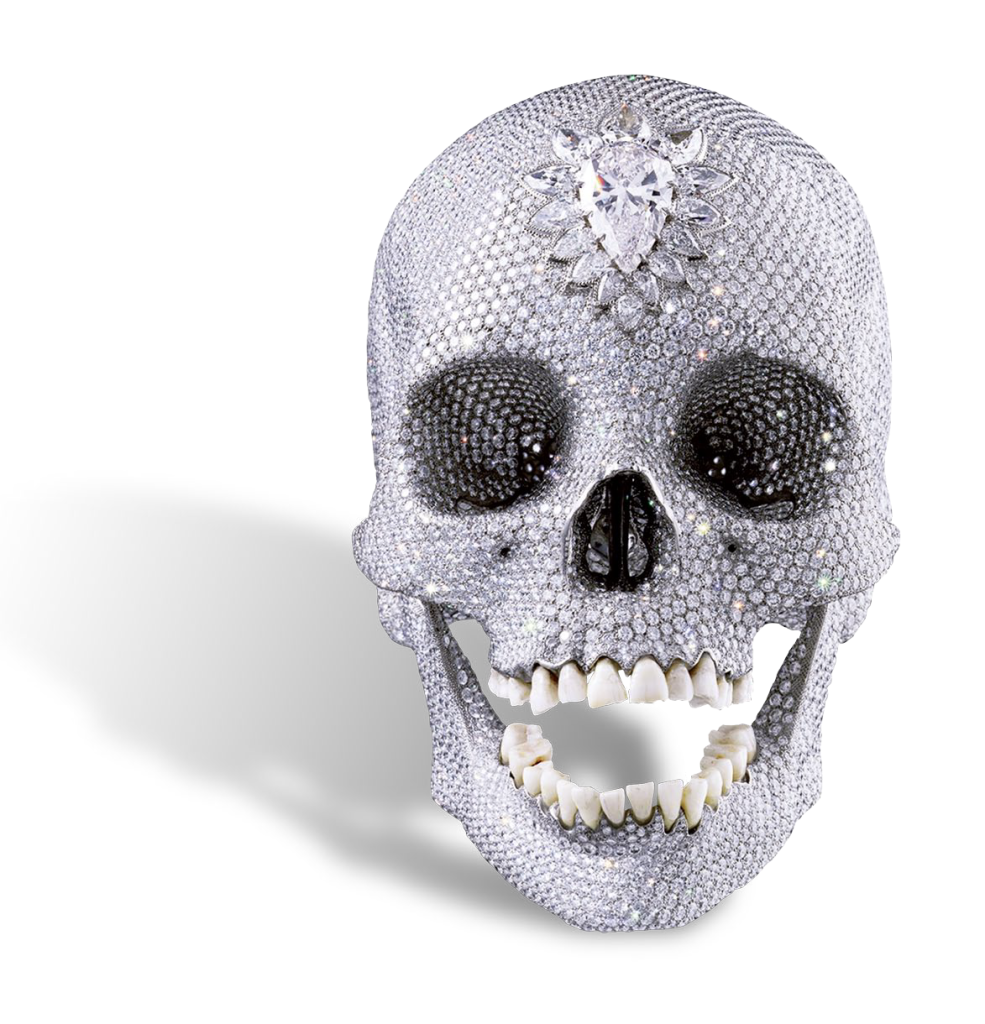
This diamond-dazzled glorification of a human skull by British artist, Damien Hirst, encapsulates the genres of history, art and religion, symbolising the unparalleled totem of death. A controversial piece of art, the title originates from exclamations Hirst’s mother would make on hearing plans for new works when he was a novice artist. The diamond encrusted skull with its luxurious embellishments, acts as a reminder of the evanescent human life.
A model of a skull the artist purchased from a London taxidermy shop, For the Love of God is cast in platinum and covered with 8,601 flawless, small diamonds, including the nostrils and eye sockets. One mega teardrop-shape diamond, surrounded by fourteen smaller ones, and weighing 52.40 carats, sits on its forehead. The original skull was forensically analysed to show that it belonged to a 30-year old European man who lived between 1720 and 1810.
The original teeth were polished and used to complete the art piece. In total, Hirst spent US$21.9 million creating For the Love of God, which then sold for US$75.6 million to a consortium of businessmen including himself, making it the priciest work of modern art ever sold.
The Lady in Gold
Portrait of Adele Bloch-Bauer I by Gustav Klimt
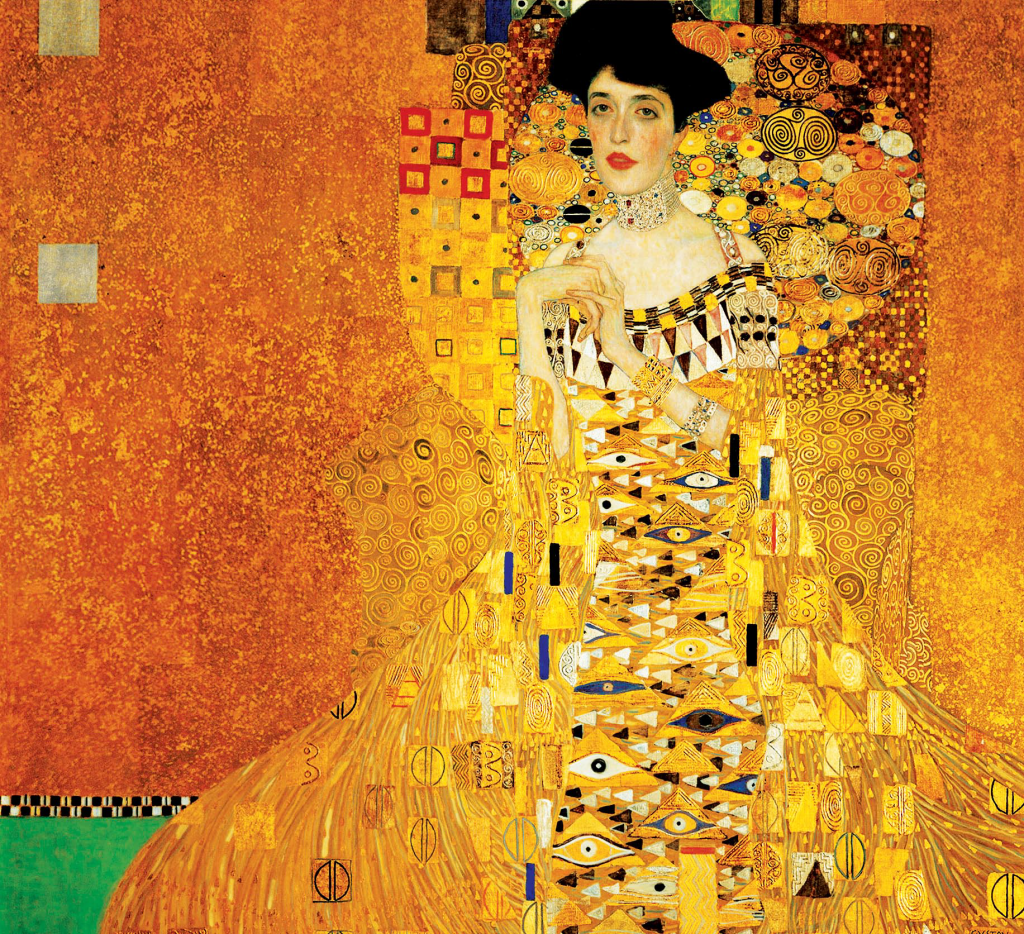
Portrait of Adele Bloch-Bauer I is a 1907 painting by famous painter Gustav Klimt which took four years to complete. The painting, which measures 138 x 138cm, is made of oil and gold on canvas, displaying elaborate and complex ornamentation. The portrait is extraordinary for the mix of naturalism, in the painting of the face and hands, and the ornate decoration used for the dress, chair and background.
The portrait came to be when Ferdinand Bloch ordered a picture of his young wife, Adele Bloch-Bauer. Klimt painted Adele seated on a golden throne, covered in a splendidly decorated golden robe. The artist’s signature decorative elements of eyes, triangles and eggs in the flow of her gown suggest an intimate relationship between him and his model – this painting was the first of two, which made its first appearance in 1912.
This piece of art is famous as it was amongst some of Europe’s greatest artworks which were seized by the Nazi’s during the outbreak of WWII, and one of the few that were recovered. It is a once in a lifetime acquisition and a defining piece to add to any gallery or museum. It was sold to Ronald Lauder, heir to Estee Lauder cosmetics for a record sum of US$135 million, for his Neue Galerie in New York in 2006, who proudly cited that the portrait was the gallery’s ‘Mona Lisa.’
Anxiety of the Artist
The Scream by Edvard Munch
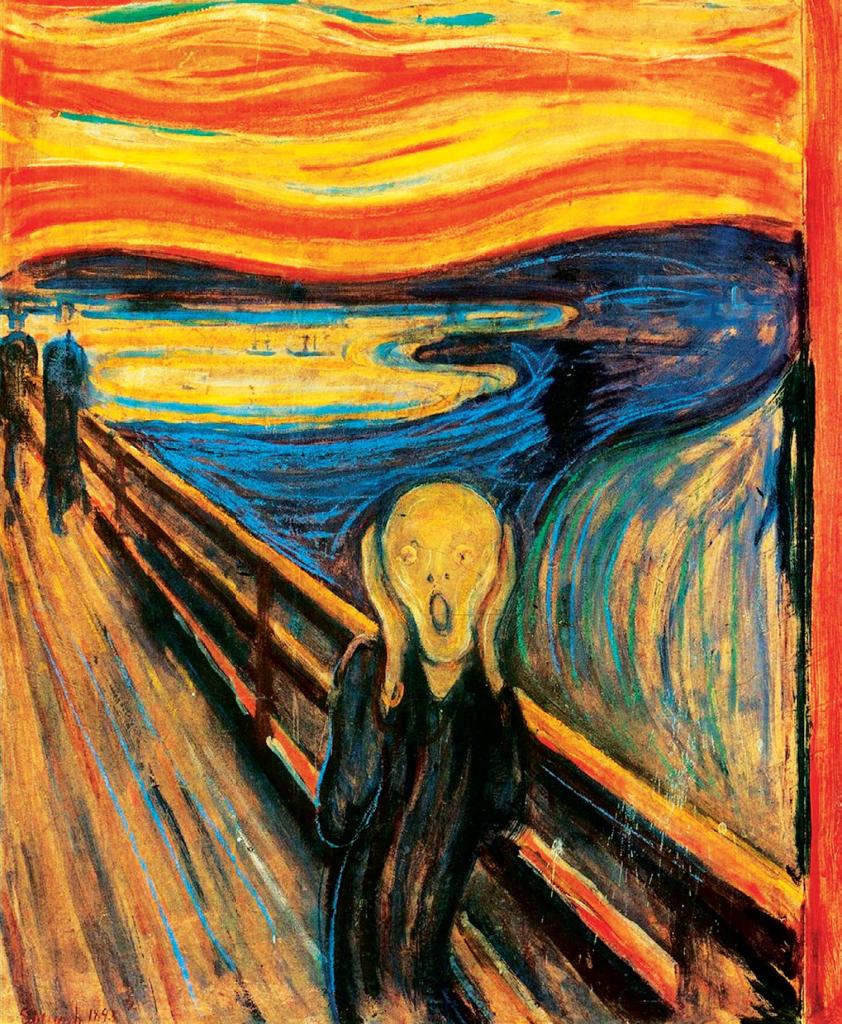
The Scream by Norwegian artist Edvard Munch is one of multiple varieties of this painting, all bearing the same name. This particular version was painted in 1893, during a unique transitional period in art history, where artists used bright exaggerated colours and simplistic figures and shapes. This painting has also been a target of a couple of thefts and robberies, but has always been recovered.
The Scream is believed to be an interpretation of Edvard Munch’s life, who in his diaries admitted that he struggled with angst not only on a personal level but through his family, at the time the first painting was produced, Munch’s sister was hospitalised for insanity. What made him a special artist was his ability to show an honest, even ugly glimpse of his inner troubles through his work, rather than displaying how realistically he could paint an image or object. The Scream is a haunting rendition of a hairless figure on a bridge under an orange sky and has captured popular imagination since its production.
Besides being the most vibrant piece left in private hands out of the four versions, this auctioned painting had its frame hand-painted by the Norwegian expressionist to include a poem, which detailed the work’s inspiration. The inscription read, ‘I was walking along the road with two friends. The sun was setting – The sky turned a bloody red and I felt a whiff of melancholy – I stood still, deathly tired – over the blue-black Fjord and City hung blood and tongues of fire. My Friends walked on – I remained behind – shivering with anxiety – I felt the great scream in nature – E.M.’
The scream is more than a painting; it is a symbol of psychology as it anticipated the 20th century traumas of mankind. Parodied endlessly in popular culture in recent decades, it has become one of the most recognisable images in art history, rivalling the Mona Lisa. It was auctioned for US$120 million in 2012, at Sotheby’s in New York to American businessman Leon Black.
A Sky-High Buy
Bird in Space by Constantin Brancusi

Constantin Brancusi was preoccupied with the theme of a bird in flight, from the 1920s to the 1940s. Concentrating on the animal’s movement rather than their external appearances, he sculpted his famed Bird in Space figure. This auctioned sculpture is part of a series that included nine bronze and seven marble figurines.
Brancusi, who was more involved in the essence of an object than its physical attributes conveyed what was real to him as an artist. He explored the theme of the soaring bird in more than thirty marble and bronze versions over the course of four decades, with each series appearing simpler and more abstract than the previous. This specific sculpture is his first and smallest polished bronze Bird in Space.
The work of Constantin Brancusi redefined sculpture for a new century as he developed art that looked absolutely modern. He sought inspiration from a mix of exotic, ancient and popular precedents, which brought him to simplified forms with a reduction of details. The extreme decrease of detail that Brancusi evolved for his Bird in Space provoked the most notorious public misunderstanding of the artist’s work. His work was spoken of as simple by critics, but they did not understand that making something look simple is a difficult task.
The dramatically long, slim sculptures which captured Brancusi’s essence of a bird are a work of extreme skill. They represent a sense of grace and balance and an abstracted concept of a bird as it soared in space just right. The figurine was sold in 2005 for US$27.5 million, a record amount at the time.
A Goddess Reigns
Artemis and the Stag
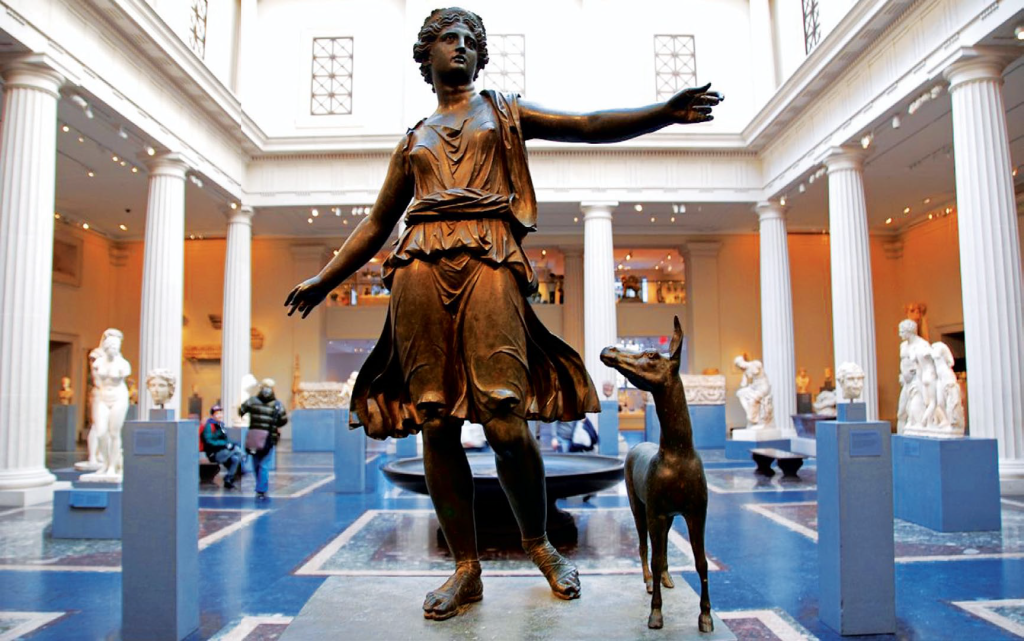
Artemis and the Stag is one of the most conventional products of Roman art. Created by an unknown artist, the sculpture, which was unearthed in Rome in the 1920s, is 2,000 years old and was produced between 100 B.C. and 100 A.D. The rare bronze figure is remarkable for its beauty, size, artist’s attention to detail and excellent state of preservation.
Artemis stands on a platform with a stag on her side, looking at her in awe, and the statue is notable for the dramatic capture of the expression on the Greek goddess’ face. The elegant sculptural figure features elaborately laced sandals on its feet, a short robe, with drapery, floating in the wind and a stance that seems to be a split-second moment the image was captured as soon as she had released an arrow for the hunt.
The exquisite detail is apparent where her silver-overlaid eyes show incised irises and recessed pupils, and her ears are pierced for earrings. The statue is among the most beautiful works of art surviving from antiquity as it was made of the highest quality and exceptionally-refined bronze.
Highly regarded for its exceeding rareness, antiquity and beauty, it was sold at Sotheby’s in New York, in 2007 for a record US$28.6 million. The sculpture was sold by the Albright-Knox Gallery to an unidentified art collector for the highest price ever paid for an antique at auction at that time.
The Desolate Expression
Portrait of Dr Gachet by Vincent Van Gogh
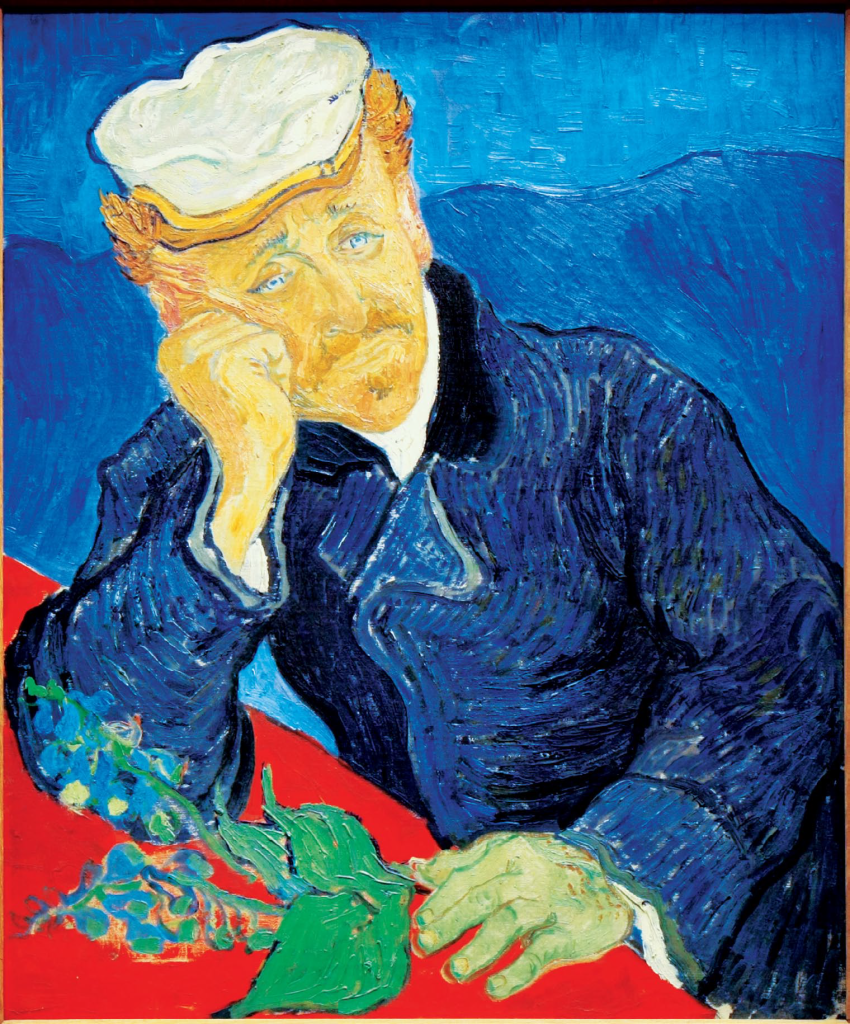
As the name implies, the painting is a portrait of Dr Gachet, who took care of Vincent Van Gogh during the last months of his life. Dr Gachet specialised in psychiatry, and he did his best to help Van Gogh overcome his torment with insanity. There are two different versions of the image, both painted in June 1890, both showing Dr Gachet leaning on his right arm.
Van Gogh was an artist making a transition from the Realistic to the Expressionist era, where illustrators used emotion and feelings as inspiration for their work. He believed Dr Gachet was similar to him in every way and art interpreters suppose the picture doubled as a selfportrait. Portrayed in a downhearted pose, the image reflected the depressed expression of the late 19th century. Despite his devotion, Dr Gachet was unable to prevent Van Gogh’s irremediable act; the artist committed suicide on the 28th of July 1890.
The Portrait of Doctor Gachet remains an iconic masterpiece of modernism, as it was the last major portrait the artist completed before his demise. At the time it was auctioned off, in 1990, to a Japanese businessman, Ryoei Sato, it was the most expensive painting in the world and it sold for US$82.5 million.
Well-chosen art can be a very wise investment as it is now an asset class and a diversification strategy, even for an ordinary buyer. But acquiring the most prestigious and high-selling works is better left to the elite, who bathe in the aura of their exclusivity. Owning these pieces is more than just a sentiment; it is a new state of affairs or perhaps a return to centuries’ old upper-class tradition.