
SINGAPORE, Aug. 28, 2026 /PRNewswire/ — Chris Kelly, Senior Vice President of Data Center Solutions, Asia Pacific, Japan and Greater China (APJC), Dell Technologies, discusses why legacy infrastructure is no longer enough to support today’s hybrid cloud and AI-driven enterprise. As organizations face growing pressure to modernize while controlling costs, meeting governance requirements, and avoiding vendor lock-in, he explains how a disaggregated private cloud approach can help CIOs build a more agile, automated, and future-ready IT foundation.

Chris Kelly, Senior Vice President of Data Center Solutions, Asia Pacific, Japan and Greater China (APJC), Dell Technologies
For most CIOs, the question is no longer whether to adopt hybrid cloud. It is how to make it work as business demands keep shifting. The practical shift is not away from cloud, but toward workload-optimized placement across public cloud, private infrastructure, and the edge. The focus is on building an IT foundation that can absorb change without slowing the organization down.
AI adoption, changing cost models, sustainability pressures, and disruption in the virtualization market have turned infrastructure into a strategic lever, one that shapes how fast a business can respond, scale, and compete.
The Infrastructure Squeeze – Why Old Architectures Struggle to Keep Up
Enterprises now run a complex mix of traditional systems alongside AI, containerized apps, and distributed edge workloads. Architectures built for the older environment simply can’t keep up.
The gap is real. As of 2025, only 30% of organizations have proactively built modernization into their IT strategy, and less than one-third have a clear plan to retire older systems[1]. Leaving this unaddressed carries a cost. A recent IDC report found that excessive technical debt and the cost of keeping older apps running were cited as the second-biggest driver of digital infrastructure overspending in APJC, with 47.8% of organizations identifying this as a factor[1]. Rigid IT stacks, whether traditional three-tier or tightly coupled hyperconverged systems, struggle to adapt without triggering expensive, disruptive refresh cycles.
The answer lies in rethinking the architecture itself. Disaggregated infrastructure takes a different approach: rather than bundling compute, storage, and networking into fixed, tightly coupled systems, it separates these resources so each can scale independently, but combines the management of shared compute, networking, and storage resources with software-driven automation. It brings the flexibility of traditional three-tier architecture together with the operational simplicity of a unified, automated experience. That flexibility is exactly what modern enterprises need, and it raises an important question for CIOs deciding how to put it into practice.
Disaggregated Infrastructure: Practical Choices for CIOs
Put simply, disaggregated infrastructure lets compute, storage, and networking scale independently. CIOs are no longer locked in fixed ratios that force them to overbuy in one area just to get what they need in another. That has a meaningful impact on total cost of ownership by allowing organizations to refresh at the component level instead of replacing the whole stack.
Enterprises can then adapt as needs shift without the architectural and financial lock-in that has long held agility back. An open ecosystem supports multiple virtualization, cloud, and AI stacks, helping organizations preserve choice and reduce dependence on a single proprietary vendor.
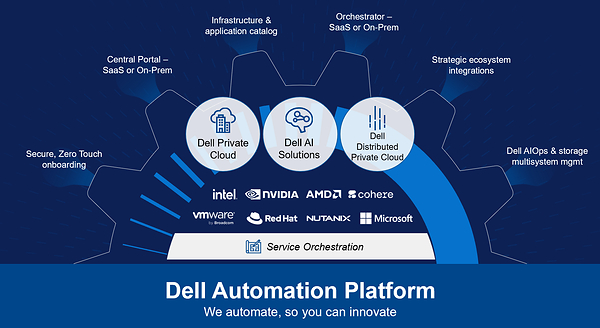
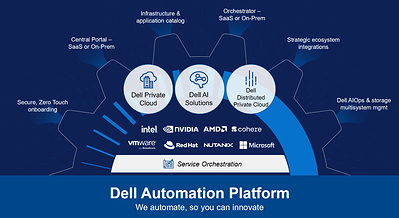
Automation is what makes this manageable at scale. When lifecycle automation runs from initial design through daily operations, deployments become standardized, manual effort drops, and existing IT skills stretch further, a real advantage given the ongoing skills shortage facing infrastructure teams. The Dell Automation Platform provides the orchestration layer, using validated blueprints and lifecycle automation to make private-cloud deployment and ongoing operations more consistent. The result is a private cloud that moves with the business, letting CIOs modernize on their own terms without losing control or adding complexity.
How Omega Healthcare Modernized Its Global Service Infrastructure
Consider Omega Healthcare, which delivers enterprise solutions to leading U.S. hospitals and healthcare providers across 13 global delivery centers. Its IT estate had become fragmented across hyperconverged and standalone servers, making operations harder to manage and less adaptable. The team needed to simplify operations, gain control over virtualization licensing and vendor choices, and build a standardized, repeatable architecture it could deploy anywhere.
Omega selected Dell Private Cloud, delivered through the Dell Automation Platform, as the foundation for a standardized, automated global environment. The platform provides orchestration, automation, and lifecycle management. Its disaggregated architecture, built on Dell PowerEdge servers and Dell PowerStore storage, lets Omega scale compute and storage independently while improving reliability, operational efficiency, and global continuity for 24/7 patient-care operations.
Private Cloud’s Role in the AI Journey
A common barrier in the AI journey is data readiness, including data proximity, quality, governance, and controls. Moving large data volumes to centralized systems is complex and costly, and it can slow down AI projects before they prove their value. Concerns like security, data privacy, and regulatory compliance add further pressure.
A strategic private cloud lets organizations deploy AI closer to where their data already lives: on-premises, at the edge, or connected to public cloud, depending on workload needs. That means faster insights, lower latency, stronger security, and better resource utilization, while supporting the governance requirements of sensitive data.
What makes this more urgent is where AI is heading. As AI moves from experimentation into production, infrastructure must support different requirements for training, inference, data movement, and governance across on-premises, cloud, and edge environments. Agentic AI adds even more complexity. Infrastructure must evolve quickly, not just run reliably. A private cloud built on disaggregated components offers a practical and flexible foundation for making this possible.
Why 94% of APJC Organizations Are Rethinking the Public Cloud
The region’s growth and appetite for innovation are significant, and so is the technical debt. Legacy systems across APJC were never designed for modern hybrid cloud. Today, 38.7% of APJC organizations are actively building a robust hybrid cloud environment[2].
This means organizations are not simply layering new technology onto old foundations. They are combining application modernization with stronger data governance and making more deliberate decisions about where each workload should run. Hybrid cloud integration ranks among the top cloud challenges, alongside integrating with legacy systems and managing multi-cloud environments.
This is fueling a clear cloud repatriation trend. IDC research found that 94%[3] of APJC organizations plan some form of cloud repatriation, with Southeast Asia at 97%[4] and India at 96%[5]. These moves are driven by the need for more controllable, flexible environments, with concerns around governance, compliance, cybersecurity, and performance. Cybersecurity is the top driver for repatriation in India and ANZ, while power and space availability leads in Greater China and Southeast Asia.
Three Must-Knows for CIOs Building Tomorrow’s Infrastructure
Start with architecture, not applications. A shift to disaggregated, open ecosystems helps CIOs avoid the overprovisioning trap and vendor lock-in that fuel technical debt. It lets businesses scale components independently, match resources precisely, and change workloads without constant overhauls.
Get data proximity right. Many AI ambitions run aground when data strategies overlook proximity, leading to stalled projects, poor data quality, weak controls, and rising costs. Getting proximity right can reduce those risks, strengthen security, and improve performance.
Finally, invest in automation as a strategic move, not just an efficiency play. When IT teams are freed from manual work, the private cloud stops being a cost center and becomes a platform for continuous innovation. Automation that spans the lifecycle, from design through operation, standardizes deployments, cuts manual effort, and helps teams focus on the work that matters most. That’s the mindset shift that separates infrastructure keeping pace with the business from infrastructure holding it back.
|
[1]IDC InfoBrief, sponsored by Dell Technologies, Unlocking business agility through private cloud modernization in Asia/Pacific, #AP2425431B, February 2026, pg.10 |
|
[2]IDC InfoBrief, sponsored by Dell Technologies, Unlocking business agility through private cloud modernization in Asia/Pacific, #AP2425431B, February 2026, pg.5 |
|
[3]IDC InfoBrief, sponsored by Dell Technologies, Unlocking business agility through private cloud modernization in Asia/Pacific, #AP2425431B, February 2026, pg.7 |
|
[4]IDC InfoBrief, sponsored by Dell Technologies, Unlocking business agility through private cloud modernization in Asia/Pacific, #AP2425431B, February 2026, pg.29 |
|
[5]IDC InfoBrief, sponsored by Dell Technologies, Unlocking business agility through private cloud modernization in Asia/Pacific, #AP2425431B, February 2026, pg.20 |

