

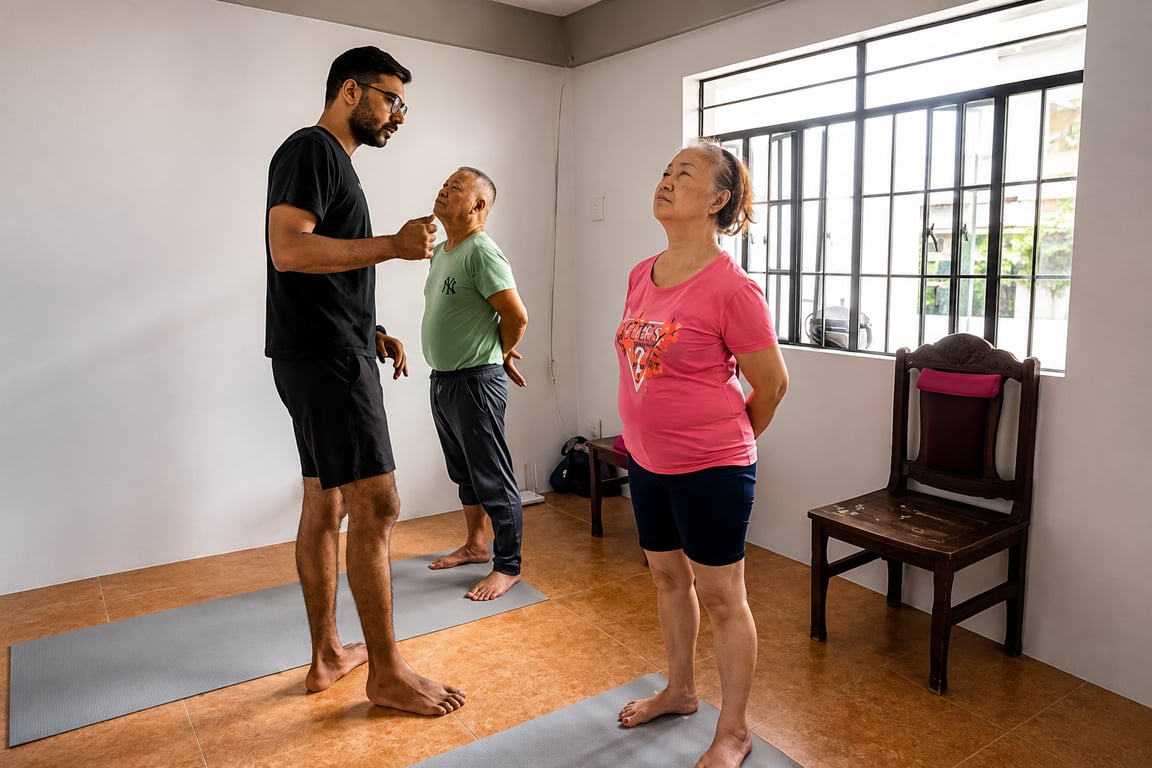
The growth of Indian Yoga School PH’s senior classes comes as the Philippines’ population continues to age. According to the Philippine Statistics Authority’s 2024 Census of Population, approximately 11.42 million Filipinos are aged 60 and above, representing 10.2 percent of the household population. Through adapted yoga sessions focused on accessible movement, balance, strength, and participation, Indian Yoga School PH is creating an environment where older adults can remain physically and socially active regardless of their starting ability.
TAYTAY, RIZAL – When the children of an elderly couple enrolled their parents at Indian Yoga School PH, their goal was relatively simple: they wanted Mom and Dad to have something to do.
They were not expecting yoga to become something their parents would eagerly look forward to.
During one of the grandmother’s first sessions, she required continuous assistance while walking and moving around the studio. After several guided sessions, her instructors and family began noticing changes in what she was able to do independently.
She can now sit herself up without assistance, participates more confidently during class, and is consistently excited to return for her next session. The couple has also progressed to walking back to their nearby home after attending class.
Their experience has become one of the stories emerging from Indian Yoga School PH’s growing senior community as the school welcomes more students aged 60 and above.
While the observed changes cannot be attributed solely to yoga and should not be interpreted as medical outcomes, the couple’s experience illustrates something increasingly important as the Philippines’ population ages: giving older adults accessible opportunities to move, participate, and remain engaged.
A Growing Need for Active Aging in the Philippines
The Philippines is gradually becoming an older country.
According to the Philippine Statistics Authority’s 2024 Census of Population, approximately 11.42 million Filipinos are now aged 60 and above. Senior citizens represent 10.2 percent of the country’s household population, compared with 8.5 percent in 2020.
As that population grows, conversations around aging are increasingly expanding beyond longevity to include mobility, functional independence, social participation, and quality of life.
Regular physical activity plays an important role in that conversation.
The World Health Organization recommends that older adults remain physically active and include activities that emphasize functional balance and strength as part of their weekly routines. These activities can contribute to maintaining physical function and reducing the risk of falls and fall-related injuries.
Yoga can incorporate several elements relevant to active aging, including controlled movement, balance, flexibility, breathing, and strength. Importantly for older practitioners, many movements can also be adapted according to an individual’s existing physical ability.
Yoga That Meets Seniors Where They Are
At Indian Yoga School PH, joining a yoga class does not require a senior student to already be flexible, strong, or independently mobile.
The school’s approach to its older practitioners begins with what each student can safely and comfortably do.
Movements may be modified according to mobility, balance, strength, and confidence. For some participants, the starting point may look very different from what people typically imagine when they think of yoga.
The goal is not to achieve complicated poses.
Instead, instructors focus on helping students participate in controlled, appropriate movement while gradually becoming more comfortable using their bodies.
“With our senior students, it isn’t about how deeply they can stretch or whether they can perform a particular pose. We meet them where they are. What has been especially meaningful for us is seeing them become more confident in movement and, just as importantly, genuinely excited to come back to class.”
That excitement has become particularly noticeable among the elderly couple.
What their children initially intended as an activity to occupy their parents’ time has become part of their regular routine.
The grandmother, who once needed consistent assistance while walking during her first sessions, now arrives eager to participate and show her instructors what she can do.
From a Couple to a Growing Senior Community
The couple is no longer an isolated example at Indian Yoga School PH.
As more families learn that the school can accommodate older adults, its group of senior practitioners has continued to grow.
The development has also changed what a yoga community can look like inside the school.
Students of different ages and physical capabilities can participate in a practice traditionally associated with flexibility and athleticism, while instructors adapt sessions around the abilities of the people actually in the room.
For senior students, the benefits of attending class can extend beyond the physical activity itself.
Regular sessions provide structure to the week, an opportunity to leave the house, interaction with instructors and fellow students, and something new to learn and anticipate.
For families, these seemingly small changes can carry significant meaning.
An aging parent sitting up without help, walking farther than before, participating in an activity with their spouse, or simply becoming excited about leaving the house can represent meaningful changes in everyday life.
Changing the Perception of Who Can Practice Yoga
Indian Yoga School PH hopes its growing senior community can also challenge one of the most persistent misconceptions surrounding yoga: that people need to be young, flexible, or physically fit before they can begin.
For older adults in particular, that perception can become a barrier to trying new forms of movement.
The experience of the school’s senior students demonstrates a different starting point.
Some may arrive already active. Others may require assistance with everyday movement. What matters is that the practice is adapted to the individual rather than asking the individual to adapt to a predetermined level of yoga.
The school encourages older adults and their families to consider existing medical conditions, mobility limitations, and individual circumstances before beginning any new physical activity program and to consult an appropriate healthcare professional when necessary.
Movement, Independence, and Something to Look Forward To
The growing senior program at Indian Yoga School PH ultimately reflects a broader definition of active aging.
Progress does not always mean performing increasingly difficult exercises.
For an older adult, progress might mean sitting up independently. It might mean feeling steadier while moving. It might mean being able to walk home with a spouse after class.
And sometimes, it simply means waking up excited because today is yoga day.
For one elderly couple, what began because their children wanted to give them “something to do” has become a shared routine they now look forward to.
For Indian Yoga School PH, their story has also become part of something larger: a growing community showing that starting yoga does not have to come with an age limit.

