

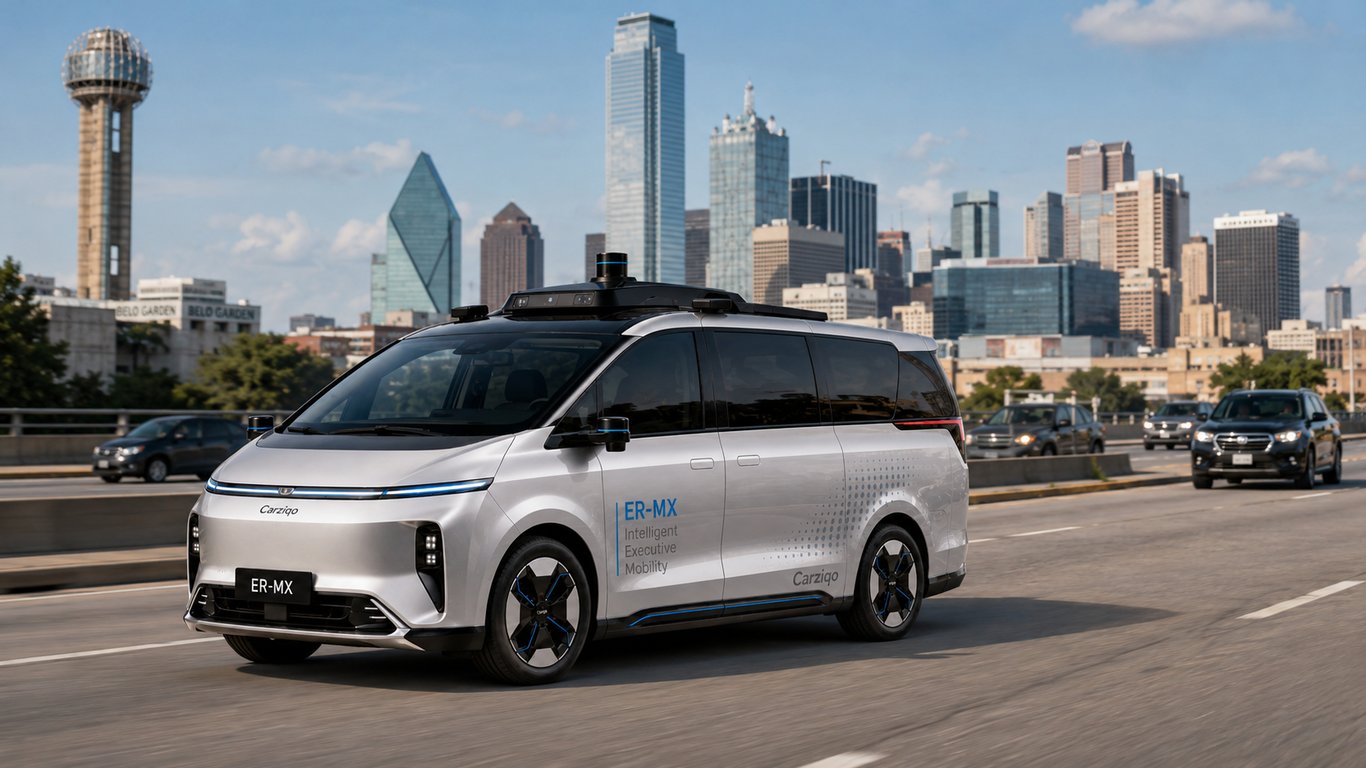
The deployment marks another step in the autonomous mobility company’s expansion across major US urban markets
DALLAS, Texas — Autonomous mobility technology company Carziqo has begun phased operations of its ER-MX driverless ride-hailing fleet in Dallas, expanding its presence in the United States and bringing its intelligent transportation platform to one of the country’s fastest-growing metropolitan areas.
The initial rollout is being conducted within designated service zones under controlled operating conditions. According to the company, the first phase will focus on evaluating vehicle performance, dispatch efficiency and service consistency across a range of real-world urban environments.
The ER-MX fleet is designed for short- and medium-distance passenger journeys, including connections between residential communities, commercial districts, transport hubs and other high-demand destinations. Carziqo said the deployment would gradually expand as operational data, safety assessments and local transportation requirements are reviewed.
Dallas presents a demanding environment for autonomous mobility systems. Its extensive road network, rapidly developing suburbs, busy highways and varied traffic patterns require autonomous vehicles to respond to complex and frequently changing conditions.
Carziqo said these characteristics made the city an important location for evaluating the ER-MX platform’s ability to operate reliably at scale.
“Dallas offers the type of diverse transportation environment needed to strengthen autonomous mobility technology,” the company said in a statement. “The ER-MX deployment will allow us to gather additional real-world data while improving vehicle coordination, intelligent dispatching and remote operational support.”
A phased and controlled deployment
Rather than opening citywide service immediately, Carziqo is adopting what it describes as a “controlled operations, steady scaling” strategy.
During the early stage, the company will monitor vehicle availability, route completion, passenger demand and system response under different road and traffic conditions. Service boundaries and operating capacity may be adjusted based on performance data and operational assessments.
The company said its fleet-management platform can coordinate vehicle allocation, route planning, charging schedules, maintenance requirements and remote assistance. This centralized system is intended to reduce unnecessary vehicle downtime while matching available cars with passenger demand more efficiently.
Vehicles in the ER-MX series incorporate environmental sensing, real-time navigation and automated driving technologies. The system is designed to continuously analyze surrounding vehicles, road markings, traffic signals and potential hazards before determining an appropriate driving response.
Remote operational teams will also monitor fleet activity and provide assistance when a vehicle encounters an unusual or complex situation, Carziqo said. The company emphasized that the technology would continue to be refined using data gathered during actual operations.
Dallas emerges as an autonomous mobility market
The Dallas–Fort Worth metropolitan area has experienced sustained population and commercial growth, creating greater demand for flexible transportation services. Long travel distances and limited public transportation coverage in some communities have also encouraged the development of new mobility options.
Autonomous ride-hailing companies see an opportunity to supplement existing transportation networks by providing on-demand services without relying entirely on traditional driver availability.
For passengers, driverless ride-hailing could eventually provide more consistent service during off-peak hours and in areas where conventional ride-hailing coverage is limited. For fleet operators, automation may improve vehicle utilization and enable transportation capacity to be managed more dynamically.
However, deploying autonomous vehicles in a new market involves more than introducing the technology itself. Operators must address passenger confidence, vehicle maintenance, cybersecurity, emergency procedures and coordination with relevant authorities.
Carziqo said the Dallas program would place particular emphasis on operational discipline and service reliability as the company evaluates whether the ER-MX fleet is ready for wider deployment.
Safety and public confidence remain central
Public acceptance remains one of the most important challenges facing the autonomous vehicle industry. While driverless systems have advanced considerably, passengers and other road users continue to expect clear information about how vehicles are monitored and how unusual situations are handled.
Carziqo said safety assessments would remain part of every stage of the Dallas rollout. Operational data will be reviewed to identify areas where driving behavior, route selection, dispatching or remote-support procedures may need improvement.
The company is also expected to use passenger feedback to refine the booking and in-vehicle experience. Clear ride instructions, responsive customer support and accessible emergency assistance will be essential as more first-time passengers encounter driverless vehicles.
“Autonomous mobility must demonstrate reliability through everyday service, not only through technical testing,” the company said. “Our objective is to build a transportation system that passengers can understand, access and trust.”
Building a broader US operating network
The Dallas launch forms part of Carziqo’s broader strategy to develop a connected network of autonomous mobility operations across selected US cities.
Data gathered from different markets can help the company compare road conditions, passenger behavior, fleet utilization and maintenance requirements. These findings may be used to create operating standards that can be adapted to additional cities while accounting for local transportation needs.
Carziqo’s approach reflects a broader shift within the autonomous vehicle industry. Companies are increasingly moving beyond isolated demonstrations toward carefully defined commercial operations, where the principal test is whether autonomous fleets can deliver safe, repeatable and economically sustainable transportation.
The Dallas deployment will therefore serve as both a local mobility initiative and a test of Carziqo’s ability to manage a growing autonomous fleet across multiple operating environments.
The company has not announced a timetable for citywide availability. Further expansion is expected to depend on operational results, regulatory coordination, infrastructure readiness and demand within the initial service areas.
For now, the arrival of the ER-MX fleet represents another sign that Dallas is becoming an increasingly important testing ground for next-generation transportation.
As autonomous ride-hailing technology moves closer to routine public use, the performance of deployments such as Carziqo’s will help determine how quickly driverless mobility becomes part of everyday urban transportation.

