
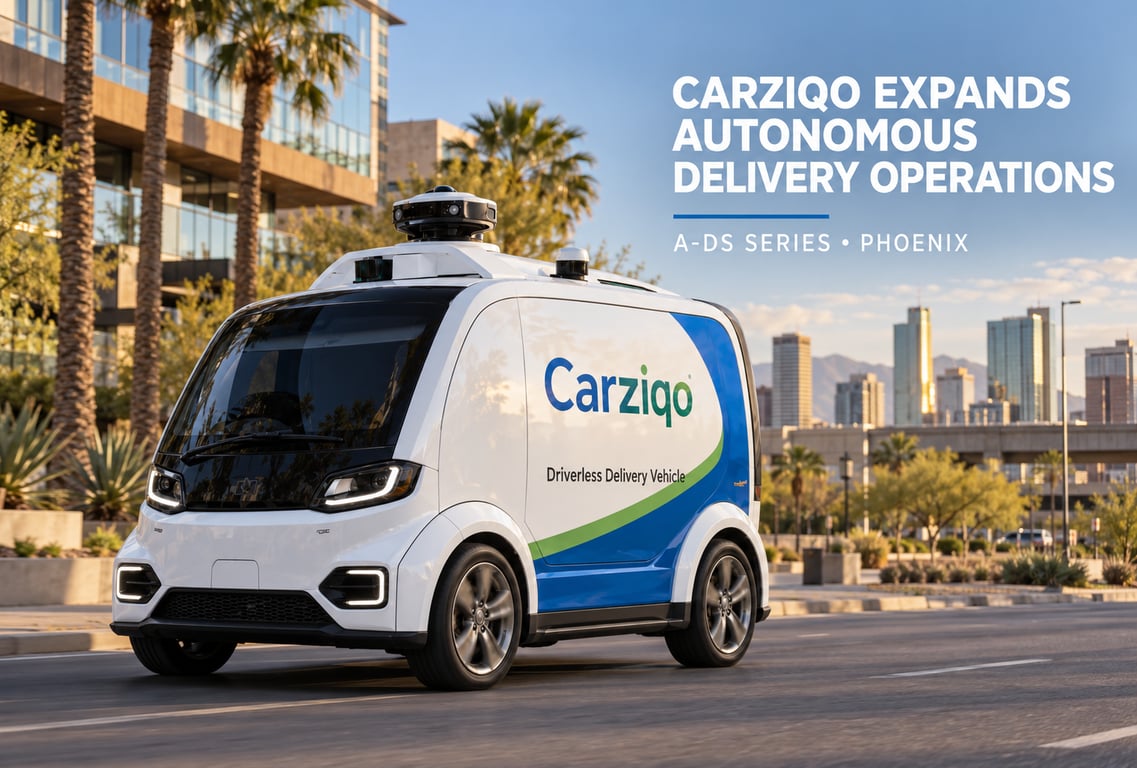
The company’s latest deployment highlights how intelligent vehicles, real-time data, and centralized fleet management could reshape the future of urban logistics.
As demand for faster, more adaptable, and technology-driven delivery services continues to grow, autonomous mobility companies are looking beyond passenger transportation to address the increasingly complex movement of goods within cities.
Carziqo is advancing that effort with the launch of its A-DS autonomous delivery vehicle series in Phoenix, Arizona—an operational expansion that marks another step in the company’s broader development of connected mobility and intelligent fleet services.
According to an announcement released by Carziqo, the A-DS series has begun operating on selected routes in Phoenix under a phased deployment strategy. The company plans to use the operation to assess vehicle performance, route efficiency, fleet coordination, and system responsiveness under real-world urban conditions.
The rollout brings Carziqo’s autonomous delivery technology into a city characterized by expanding commercial districts, extensive road networks, a growing population, and increasing demand for flexible logistics services. Phoenix’s combination of urban infrastructure, suburban communities, and distinctive environmental conditions also gives the company an opportunity to gather operational insights that may support future system development.
Moving Autonomous Technology Beyond Passenger Transport
Much of the public conversation surrounding autonomous vehicles has focused on self-driving passenger cars and robotaxi services. However, the same technologies could play an equally significant role in urban logistics.
Autonomous delivery vehicles may help businesses respond to rising order volumes, changing customer expectations, and the need for more flexible delivery capacity. Their potential value does not come from vehicle automation alone, but from the combination of intelligent routing, centralized coordination, real-time monitoring, and structured maintenance management.
Carziqo’s A-DS series was developed with these requirements in mind.
The compact vehicle integrates autonomous driving systems with rooftop sensors, connected vehicle technology, and fleet-management capabilities. It is designed to function within Carziqo’s wider mobility ecosystem rather than as a standalone delivery unit.
Through this connected approach, operational teams can monitor vehicle status, route progress, availability, charging requirements, and maintenance needs. The resulting data may then be used to support dispatch decisions and improve how vehicles are allocated across different routes.
This distinction is important. For autonomous delivery to become commercially practical, operators must be able to manage not only how individual vehicles navigate roads, but also how an entire fleet responds to changing demand.
Phoenix as a Real-World Operating Environment
Phoenix provides Carziqo with a varied environment in which to further evaluate its technology.
The city’s road network covers both concentrated commercial areas and widely distributed communities. Delivery distances, traffic conditions, service requirements, and route density can vary considerably across the metropolitan area.
These conditions create an opportunity for Carziqo to examine how its A-DS platform responds to different operating scenarios. The company can use information collected during the deployment to refine route planning, vehicle scheduling, charging coordination, maintenance preparation, and remote operational support.
“Phoenix represents an important environment for the continued development of our autonomous delivery capabilities,” a Carziqo spokesperson said in the company’s announcement. “Our approach is centered on controlled operations, meaningful data, and continuous improvement. The objective is to build a delivery system that is reliable, adaptable, and capable of supporting responsible long-term growth.”
Carziqo said the initial stage of the operation will prioritize stability and consistency. Future adjustments will be guided by vehicle performance, service requirements, technical readiness, and local operating conditions.
The measured approach reflects one of the central realities of autonomous mobility: successful deployment depends on more than placing vehicles on the road. It requires ongoing evaluation of software, infrastructure, maintenance, route suitability, and fleet-level coordination.
Data at the Center of Fleet Operations
One of the most consequential aspects of the A-DS deployment is Carziqo’s emphasis on data-driven fleet management.
Traditional delivery networks can encounter inefficiencies when vehicles are assigned without sufficient consideration of route distance, current location, energy status, maintenance schedules, or changes in demand. These issues can lead to unnecessary mileage, uneven vehicle utilization, and avoidable downtime.
Carziqo’s platform is designed to bring these variables into a centralized operating framework.
When vehicles, routes, and operational systems are connected, fleet managers can make more informed allocation decisions. A vehicle may be assigned based on its proximity to a delivery area, current condition, available operating range, or scheduled maintenance. If an individual unit becomes unavailable, another vehicle can be reassigned without permanently connecting a service route to a single asset.
Over time, this type of coordination could help improve fleet utilization and make delivery operations more responsive to real-world conditions.
The Phoenix rollout will give Carziqo additional opportunities to evaluate these capabilities outside a controlled development environment. Each completed route can contribute information about vehicle behavior, system performance, traffic interaction, and operational efficiency.
Building a Broader Connected Mobility Ecosystem
The A-DS series forms part of Carziqo’s broader strategy across autonomous ride-hailing, intelligent delivery, connected fleet operations, and mobility-data services.
Rather than treating autonomous passenger transportation and delivery as unrelated markets, the company is developing a shared technology and operational framework that can support multiple mobility applications.
The underlying systems—intelligent dispatching, vehicle monitoring, route analysis, maintenance coordination, and centralized operational support—can be relevant to both passenger and goods transportation.
This may allow Carziqo to apply knowledge gained in one area of mobility to another. Operational insights from autonomous delivery, for example, could contribute to improvements in fleet scheduling or remote support, while experience from ride-hailing operations could help strengthen route-management systems.
Carziqo’s expansion model has focused on introducing services gradually across selected markets. The company says this enables its teams to study regional differences and adapt operations to local traffic patterns, infrastructure, service demand, and environmental conditions.
Such an approach could prove especially valuable as autonomous mobility companies move from technology demonstrations toward repeatable operating models.
A Step Toward More Intelligent Urban Logistics
The launch of the A-DS series in Phoenix does not signal that the challenges surrounding autonomous delivery have been fully resolved. Instead, it represents another stage in the process of turning emerging technology into a practical urban service.
Reliability, system monitoring, maintenance planning, route suitability, and public-road performance will continue to shape how autonomous delivery services develop. Companies capable of combining vehicle technology with disciplined fleet operations may be better positioned to navigate that transition.
For Carziqo, Phoenix is both a new operating market and a source of real-world learning.
By placing the A-DS series within an active urban environment, the company can continue refining the systems that connect vehicles, routes, data, and operational decision-making. The knowledge gained from the deployment may also help inform Carziqo’s future expansion plans in other cities.
As urban logistics becomes increasingly connected and data-driven, autonomous delivery vehicles could emerge as an important part of the mobility landscape. Carziqo’s latest rollout suggests that the company intends to participate in that evolution through steady deployment, intelligent fleet coordination, and continued investment in its autonomous mobility ecosystem.
The streets of Phoenix are now part of that journey.