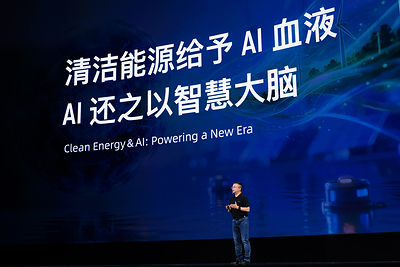
HANGZHOU, China, Sept. 29, 2026 /PRNewswire/ — “Clean energy gives AI the power it needs to thrive, while AI gives clean energy an intelligent brain. The two empower and complement each other.” At the “For the Value Beyond Computation” main forum of the 2026 APSARA Conference in Hangzhou on September 23, David Zhao, Senior Vice President and Chief Scientist of Sungrow Power Supply Co., Ltd. (Sungrow), delivered a keynote titled “Clean Energy & AI: Powering A New Era” outlining 10 technology trends shaping the convergence of clean energy and AI.
David Zhao delivers speech at APSARA Conference
Two Key Data Points: Record Solar Capacity, Vast Room for Energy Storage Growth
David cited two sets of figures to illustrate the scale of the opportunity. By mid-year, China’s installed solar PV capacity had reached 1,286 GW, surpassing coal-fired power capacity for the first time to become the country’s largest source of installed generation capacity. This marks a turning point in China’s energy mix and a milestone in bringing clean electricity to industries, businesses and households across the country. By comparison, global installed capacity of electrochemical energy storage currently stands at just 700 GWh. Against estimated demand of 15 TWh by 2050, today’s capacity represents only 5% of the projected requirement, leaving room for at least a nineteenfold increase.
David expects rapid growth over the next five years in solar, wind, energy storage, electric vehicles and hydrogen, alongside power supplies for AI data centers. At the same time, AI computing is creating a substantial new source of electricity demand, coinciding with a period of rapid expansion in clean energy. Clean energy technologies centered on solar, wind, hydrogen and electric vehicles are projected to account for more than 60% of emissions reductions, while demand for clean energy is set to reach at least three to four times current installed capacity.
Three Key Challenges: From 800V DC to the Engineering Barriers for AI
David identified three major challenges facing the integration of clean energy and AI. The first is powering AI computing centers. China’s data center electricity consumption is expected to reach 800 billion kWh by 2030, while AI computing parks could require hundreds of megawatts or even gigawatt-scale power. Meanwhile, national policy calls for new data centers at designated computing hubs to obtain more than 80% of their electricity from renewable sources. This creates simultaneous constraints on total electricity consumption, power density, bus voltage and the share of renewable electricity.
The second is the solid-state transformer (SST), which can directly convert 10 kV or 35 kV AC into 800V DC, significantly reducing weight and footprint while improving efficiency. However, the technology is still moving from demonstration projects toward large-scale deployment.
The third challenge lies in four engineering barriers to applying AI to power electronics: a shortage of real-world fault data; the inability to rely entirely on AI for microsecond-level real-time control; risks associated with model extrapolation, requiring hard limits based on physical constraints; and the lack of industry standards, which makes accountability difficult to establish when black-box systems fail. David called for the joint development of explainable AI and industry standards.
Ten Trends: From “Computing Shifts Toward Renewable Power” to Coordinated Computing and Power
Focusing on four key areas, power architecture, topology control, operating life, and system coordination, David outlined 10 trends aimed at improving power efficiency, enabling smarter system design, enhancing operational reliability and better aligning computing with energy resources. Key trends include:
- Trend 1 — Computing Shifts Toward Renewable Power: Direct renewable power supply could help secure electricity prices of RMB 0.2–0.3 per kWh and reduce the total cost of ownership for computing infrastructure.
- Trend 2 — DC Architecture for AI Computing Centers: As 800V DC emerges as a new power supply standard, systems are targeting end-to-end efficiency of more than 94%, creating opportunities for SiC and GaN power devices, DC circuit breakers and related technologies.
- Trend 3 — SSTs Move from Demonstration Projects to Commercial Deployment: Data centers are poised to serve as a key catalyst for adoption, with 2027 potentially marking the start of commercial deployment. SSTs can cut footprint by 30% and weight by 50%.
- Trend 5 — Grid-Forming Control Enabled by Edge AI: David forecasts that grid-forming converters will achieve a penetration rate of more than 40% by 2028, as grid-forming capability becomes an increasingly common requirement in tenders for renewable energy and grid connections for AI computing facilities.
- Trend 9 — Long-Duration Energy Storage and Multi-Energy Systems Become Standard: Iron-air and iron-flow batteries could support hundred-hour-scale, multi-day storage; green hydrogen could enable seasonal energy storage; and natural gas paired with solid oxide fuel cells (SOFCs) could serve as a backup for peak demand. Combined heat and power (CHP) efficiency can exceed 90%.
- Trend 10 — Coordinated Computing and Power Dispatch: Energy management systems (EMS) would coordinate resources across three timescales—milliseconds to seconds, minutes to hours, and days to seasons—enabling GW-scale AI computing centers to shift from major electricity consumers to flexible, dispatchable assets that can provide frequency regulation, peak shaving and other grid services.
From Trends to Products: Sungrow Delivers SSTs for AI Data Centers
On July 9, Sungrow launched EnerNeo, its first proprietary SST. Built on an 800V DC architecture and equipped with SiC devices, EnerNeo delivers 99.999% availability, 98.5% system efficiency and a power density of 312 kW/m². The company also signed strategic cooperation and procurement agreements with HEC Group and ZDATA. Sungrow has already delivered SST products to customers, with commissioning scheduled for the fourth quarter. The deployment could be among the first to put an 800V DC SST power supply solution into operation under real-world load conditions in an AI computing environment.
Sungrow has worked with Alibaba Cloud since 2015. In July this year, the two companies jointly established the Green Token Joint Innovation Center to advance technological innovation, joint validation and commercialization of lower-carbon computing infrastructure for AI data centers. The company has also proposed an “AI for ALL” system architecture built around source-load coordination, direct renewable power supply and coordinated computing and power, with applications spanning AI computing centers, large-scale renewable energy projects and virtual power plants.
“Bridge to a sustainable future” is Sungrow’s brand value proposition. David concluded his speech by describing power electronics as a bridge between clean energy and AI. This vision aligns with the company’s mission to make clean power for all while enabling energy systems to operate more efficiently and reliably. Sungrow will collaborate with partners across the industry to deepen the integration of clean energy and AI, helping build a more sustainable energy future.
As carbon neutrality and AI computing continue to reshape the global energy landscape, Sungrow is building on nearly three decades of expertise in power electronics and stepping up investment in innovation. R&D personnel account for 41% of the company’s workforce, while its power electronics equipment has a cumulative installed capacity of more than 1,100 GW worldwide. Together with customers, Sungrow has helped reduce 670 million metric tons of CO₂ emissions globally, contributing to the closer integration of clean energy and AI.