

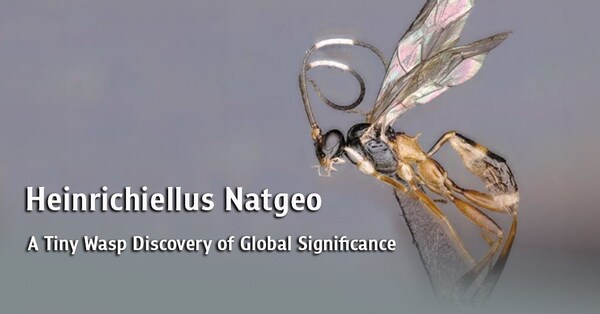
BANGKOK, April 10, 2026 /PRNewswire/ — Small and indispensable! A group of entomologists from Chulalongkorn University discovered a new species of wasp in the Eastern Himalaya, dubbed Heinrichiellus natgeo, the name in tribute to the National Geographic Society. The discovery sheds light on our ecosystem and issues, a wake-up call for biodiversity conservation.
Heinrichiellus natgeo A Tiny Wasp Discovery of Global Significance
“The name natgeo is our way of honoring National Geographic’s long-standing commitment to exploration, conservation and science communication. Their work has inspired generations of researchers, and this felt like a fitting acknowledgment,” said Associate Professor Dr. Buntika Areekul Butcher, from the Department of Biology, Faculty of Science, Chulalongkorn University, and leader of the expedition team.
The discovery of Heinrichiellus natgeo is not merely an addition of a new name to a scientific list. In fact, it is a story of exploration, persistence, collaboration, and a reminder that even the smallest organisms can reshape our understanding of ecosystems, Assoc. Prof. Dr. Buntika reflected.
“In a world that often celebrates the large and the visible, this discovery of the tiny insects is telling us that the biggest lessons sometimes come from the smallest things.”
Into the Heart of a Biodiversity Hotspot
According to Assoc. Prof. Dr. Buntika, during the period of colonial rule in India, a scientific expedition to document the natural history and geography of the Siang Valley of the Eastern Himalayas accompanied a punitive military campaign against the Indigenous peoples of the region in 1911–1912 (Army Intelligence Branch 1911). Originally known as the Abor Expedition, this combined military and scientific effort resulted in extensive collections and observations. The findings of the expedition were subsequently published in several volumes between 1912 and 1922 in the Records of the Indian Museum, significantly contributing to the documentation of the region’s biodiversity, geography, and ethnography. However, despite these early efforts, there remain substantial gaps in the scientific understanding of the region’s flora and fauna.
Supported by the National Geographic Society and Felis Creations, the team of entomologists from Chulalongkorn University embarked on the Siang Expedition with an aim to document the “rich but largely uncharted biological heritage” of this biodiversity hotspot.
Assoc. Prof. Dr. Butcher identified several reasons why the Siang Valley is designated as a primary research site, as follows:
- Uncharted Heritage: As part of the Eastern Himalayas, it possesses a rich but largely uncharted biological heritage.
- Hidden Biodiversity: It serves as a reminder of the vast, hidden biodiversity still waiting to be documented; species like H. natgeo have remained unnoticed there for centuries.
- Ecological Connectivity: Discoveries in this region highlight how habitats in India and Southeast Asia form connected ecological networks, emphasizing the urgent need to protect these fragile ecosystems from threats like deforestation and climate change.
- Ongoing Discovery: Because the region is remote and physically challenging, it remains a primary focus for systematic surveys aimed at uncovering rare and endemic species that inform global conservation strategies.
The Science of Looking Closely
Biodiversity research is often a matter of patience, Assoc. Prof. Dr. Buntika said. To begin with, the fieldwork was physically demanding and often exhausting.
“The focal point of our work was the remote village of Yingku, surrounded by subtropical forests and steep terrain. The site is located far from the nearest town and is connected to the mainland by a wooden bridge. To reach it, we took a long trek through dense vegetation, braving slippery slopes and unpredictable weather, particularly heavy rainfall. During this arduous arduous and adventurous journey to the sampling site, we encountered several challenges, including venomous snakes and thousands of blood-sucking leeches. However, these obstacles did not diminish our passion and eagerness. Every piece of equipment had to be carried over several kilometers, and every sample collected was carefully preserved. Missing any specimen despite their small size, often no more than 10 mm would have caused us great distress and a sense of guilt, as access to this untouched paradise is likely a once-in-a-lifetime experience,” Assoc. Prof. Dr. Buntika recalled.
Fortunately, one of their most effective research tools was light and simple — a yellow pan trap; a shallow container painted in bright yellow and filled with water and a drop of detergent.
“These traps are brilliant because they remove human bias. We’re not choosing what to look for—the ecosystem is,” Assoc. Prof. Buntika explained, adding that the tool worked as many parasitoid wasps were irresistibly drawn to the color yellow, which they mistook for flowers.
Over time, researchers passively collected a wide variety of species—many too small or rare to be noticed otherwise. Among hundreds of insects gathered from one such trap was a tiny wasp.
“It was one of those rare moments in fieldwork when everything seemed to come together. On the very first day, we collected both a male and a female of this remarkable species—something taxonomists can only hope for,” said Dr. Avinjikkattu Parambil Ranjith, researcher in the team from Chulalongkorn University.
Back in the lab, the team commenced their meticulous process, sorting hundreds of specimens.
“The wasp didn’t stand out at first as it was so tiny and easy to overlook,” Assoc. Prof. Dr. Buntika pointed out, “But something about its structure made us pause.”
Under the microscope, subtle differences began to show up.
“The wing venation didn’t match anything we knew. The thorax had features we couldn’t place. That’s when our curiosity turned into investigation.”
The research team checked taxonomic keys used to identify species, but no record was found. “We started flipping through references, checking collections, and comparing specimens. And when everything failed to match, excitement built up.”
Decoding the Genetics
The research team didn’t rely on physical appearance alone. To confirm their suspicion, they turned to the cutting-edge technology of molecular science. By extracting DNA from a tiny tissue sample from the wasp’s leg, they sequenced mitochondrial and nuclear genes to understand its evolutionary lineage.
This genetic deep dive yielded a major scientific breakthrough: it resolved a long-standing confusion regarding the entire genus. While Heinrichiellus was previously thought to belong to the tribe of Platylabini, the DNA evidence proved it belongs to the tribe of Ichneumonini.
“This discovery marked the first time this genus has ever been recorded in India. Previously, it had been known only in Russia and Japan,” said Dr. Avinjikkattu Parambil Ranjith.
The discovery of H. natgeo was a global effort indeed, involving collaboration between institutions in Thailand, the UK, and Germany. This international teamwork allowed researchers to combine local knowledge with global taxonomic expertise and museum collections.
“The species description was led by Dr. Ranjith and Dr. Gavin R. Broad, from the Natural History Museum in London; while the genetic analyses contributing to its classification was carried out with the support of Dr. Bernardo F. Santos from the Museum für Naturkunde in Berlin,” Assoc. Prof. Dr. Buntika related.
Heinrichiellus Natgeo: A Natural Ecosystem Regulator
While detailed biological data on the species is still forthcoming, researchers believe the wasp plays a meaningful role in the local ecosystem.
“H. natgeo acts as a natural regulator, keeping insect populations in balance. Unlike parasites, they target the eggs or larvae of their host species and eventually kill their hosts, preventing outbreaks of species that could damage ecosystems or agriculture.”
To that, Dr. Ranjith added: “The wasp H. natgeo made no dramatic impression. It lacks bright warning colors or conspicuous behavior, but they’re doing essential work quietly and unnoticed. Without them, ecosystems could become unstable.”
More Discoveries Beneath the Canopy
The discovery of H. natgeo was part of a larger taxonomic breakthrough. The same study also documented two additional species new to science: Heinrichiellus brevispinus from Thailand and Heinrichiellus vedani from southern India. Together, these findings represent the first recorded occurrence of the genus Heinrichiellus in the Oriental region, highlighting how many insects remain unknown in Asia. The team published their results in the Journal of Hymenoptera Research.
“Every new species described is a poignant reminder of how much we still must learn. In an era of accelerating biodiversity loss, discoveries like these are not only scientific milestones—they are called to protect the ecosystems and conserve the fragile ecosystems on which all life thrives and depends,” Assoc. Prof. Dr. Buntika concluded.
Tiny wasp and the Future of the Blue Planet
From a simple tool to a significant discovery, the story of Heinrichiellus natgeo is also about the future of science.
“We need more young people entering taxonomy and biodiversity research. This work is foundational. Despite being less visible than other scientific fields, taxonomy underpins conservation, ecology, and environmental policy. After all, it is not about naming species, but succinctly about understanding life on Earth,” Assoc. Prof. Dr. Buntika reminded us.
Continue reading a full article on the website: https://www.chula.ac.th/en/highlight/295159/
About Chulalongkorn University
Chulalongkorn University has made the world’s top 50 university list for employment outcomes, which reflects both the high employment rate and work ability of Chula graduates. The university is also listed as the best in Thailand for the 15th Consecutive Year (since 2009), according to the newly released QS World University Rankings 2024, putting Chula at 211th in the world, up from 244th last year.
Social Media:
Facebook: https://www.facebook.com/ChulalongkornUniversity
Youtube: https://www.youtube.com/chulauniversity
Linkedin: https://www.linkedin.com/school/15101896/

