

In collaboration with PASSIONS, VOICE OF ASIA is proud to present timeless articles from the archives, reproduced digitally for your reading pleasure. Originally published in PASSIONS Volume 52 in 2014, we present this story on Barefoot College, an initiative Sanjit Roy established to provide underprivileged communities the knowledge they need to navigate modern technologies.
People know best what they need. The only thing required is a window of opportunity, and they can accomplish anything they want and this is exactly what Barefoot College provides – an opportunity. Using the lifestyle of Mahatma Gandhi as inspiration, Sanjit ‘Bunker’ Roy founded the centre in the early 1970s in Tilonia, Rajasthan with six areas of focus, all of which addressed an immediate primary need in the surrounding community – alternative energy, the environment, empowerment of rural women, education, drinking water, and traditional communication. The objective was to make every local community self-sufficient and sustainable, and provide the opportunity for the community to make the change.
Disrupting Poverty
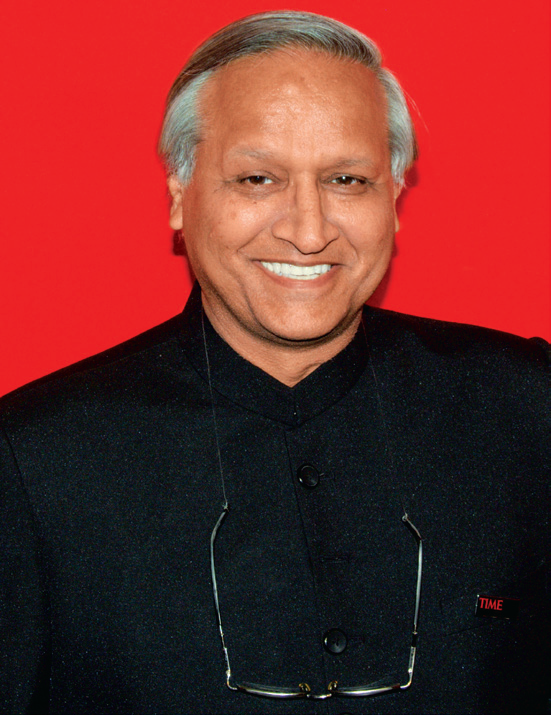
Roy started the Social Work and Research Centre (SWRC) – later known as Barefoot College – in 1972 based on a two-year ground-water survey of 110 villages. The initial focus was on drilling wells and irrigation schemes in the drought stricken area of Rajasthan. But then, in order to help the rural under-privileged people, the mission of Barefoot College moved beyond the pressing issue of water supply, to empowering the villagers to become independent, in the interest of rural stability and sustainability.
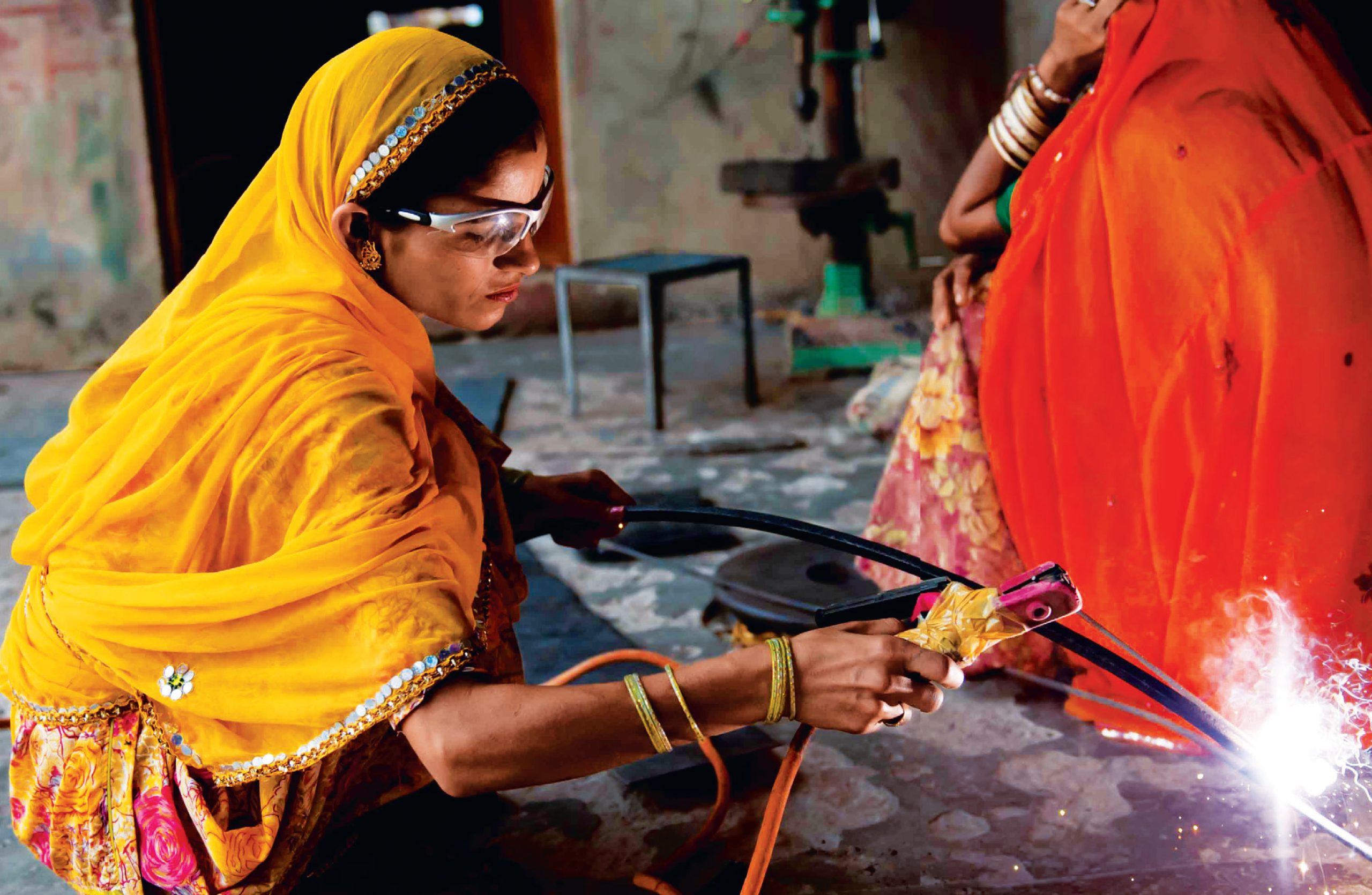
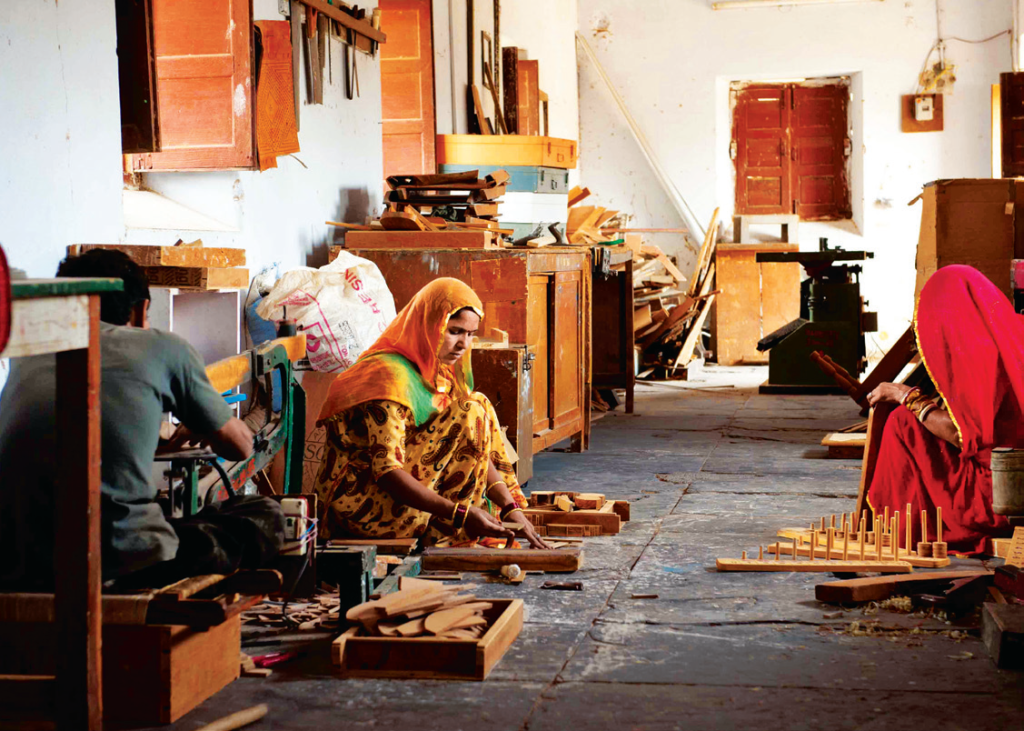
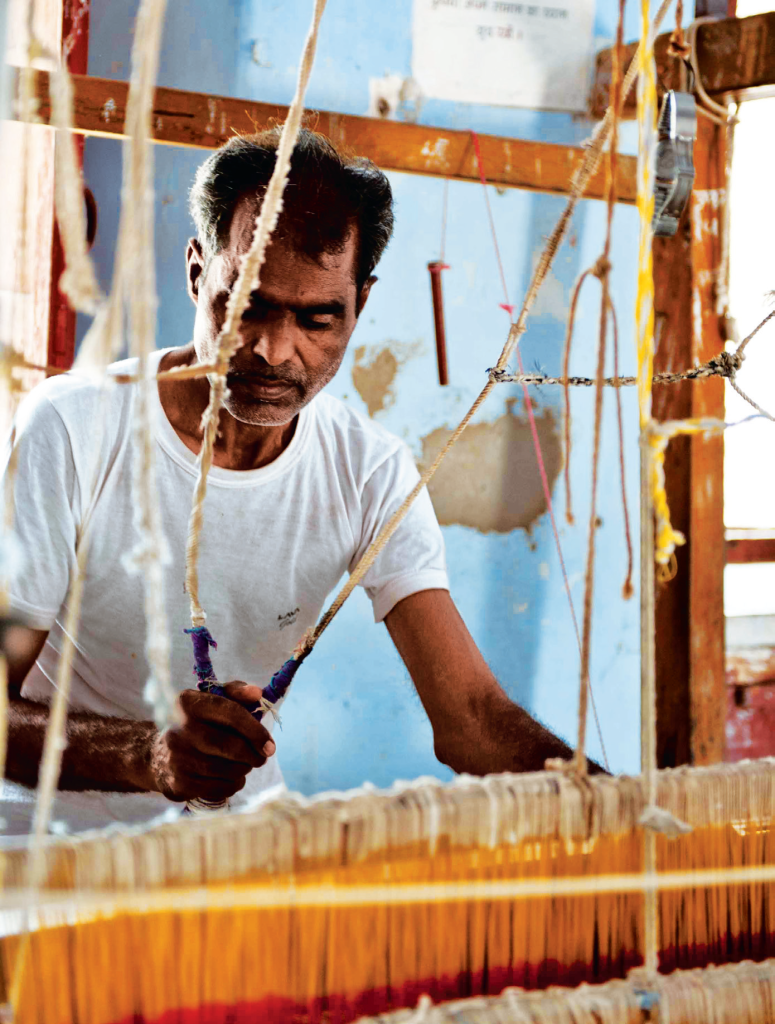
Barefoot College now operates a peer-to-peer learning model cemented in practical knowledge to train people to achieve a professional aptitude in programmes such as Solar energy, Water hygiene, Education, Health Care, Crafts, People’s Action, and Communication. Over three million men and women have been trained and many have then gone on to teach at Barefoot College as teachers, doctors, midwives, dentists, health workers, solar engineers, solar cooker engineers, water drillers and engineers, hand pump mechanics, architects, artisans, designers, masons, communicators, water chemists, phone operators, blacksmiths, wasteland developers, carpenters, computer instructors, accountants and recycling professionals.
Open only to individuals without a formal education, Barefoot College works with marginalised, exploited, impoverished and under-privileged rural communities, and in particular with uneducated, physically challenged mothers and grandmothers. The College is committed to the de-mystification and de-centralisation of sophisticated technology by placing its control with the community.
For 1 Rupee a year, Roy leased an abandoned tuberculosis sanatorium from the government. The idea and vision was to break away from accepted local social-work traditions of urban, middle class and academic orientations. In both the majority Hindu and minority Muslim communities in Rajasthan, girls had traditionally been restricted to household chores – grazing the cattle, goats and sheep – with the general impression that boys should be getting better education. He also succeeded in attracting young urban professionals to come to Tilonia and teach the villagers.
But these educators only spent a few months in the community before leaving for permanent positions in the cities. Roy realised he needed to change his approach, and in 1977 he modified his strategy and asked the local people who had learned skills so far to do the teaching.
The Barefoot Approach
Rajasthan is a semi-arid state in North West India, one of the country’s driest poorest regions with a population of 45 million divided into 58 blocks and 37,890 villages. Illiteracy is a major obstacle, with about 45% of males and 80% of females being illiterate. Schooling is also a major issue, as children are needed to contribute to the economy of their families – mostly looking after cattle or by working on family farms.
Due to the spells of drought, nearly two-thirds of the state suffer from recurrent water scarcity and this was one of the first problems that the Barefoot College tackled because other issues resulted from the unavailability of water, such as the women and girls needing to walk long distances to find it, which in turn meant that their days were long and strenuous. Ultimately their health suffered, and school girls had less time for studies since household responsibilities were more pressing – in places like this, education takes a back seat for survival.
Rather than seek advice from urban or foreign engineers, the college chose to consult locally and apply community intelligence and know-how. The solution reached was the simple and effective system of rooftop rainwater harvesting – a method that catches rainwater using rooftops of schools and other buildings, channeling it to underground tanks.
Since 1986, when the idea was implemented, the Barefoot Approach has enabled over 470 schools and community centres to collect and store over 99 million litres of rainwater at a cost of US$0.10 a litre making it a feasible, cost-effective method that has provided drinking water and sanitation to rural communities. This resulted in more children, especially girls attending school.
Barefoot College has also replicated the Barefoot Approach of collecting rainwater in 901 remote villages of India, Afghanistan, Ethiopia, Mauritania, Senegal, The Gambia, Sierra Leone and Mali, and provided water for drinking and sanitation to 2.8 million rural children. In total, 1,521 rainwater harvesting structures have been built in rural schools and community centres.
Harvesting Solar Energy
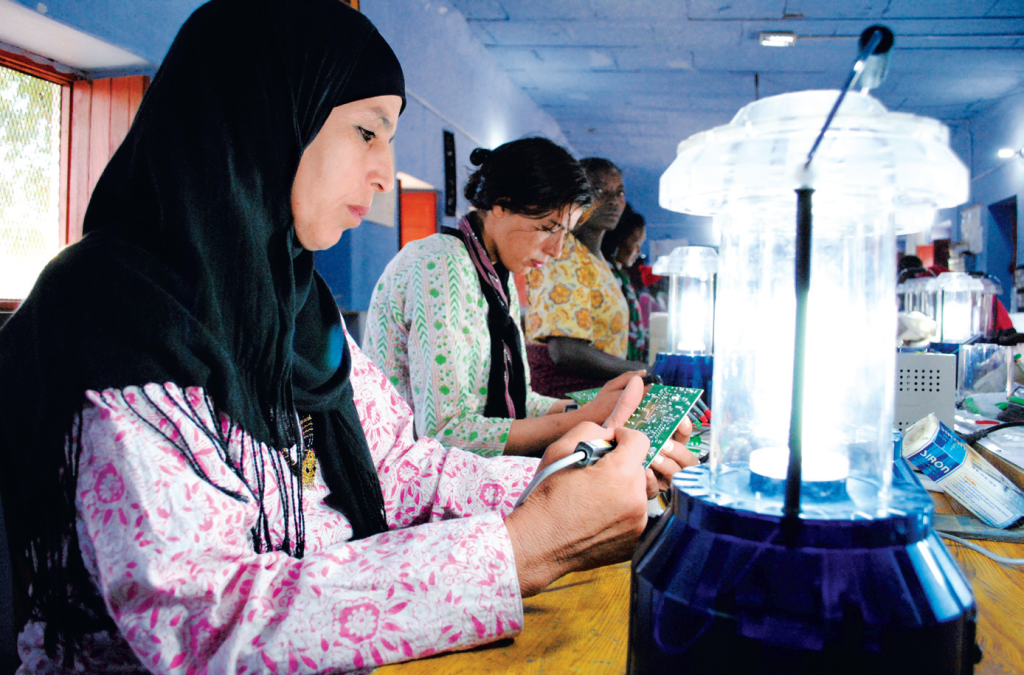
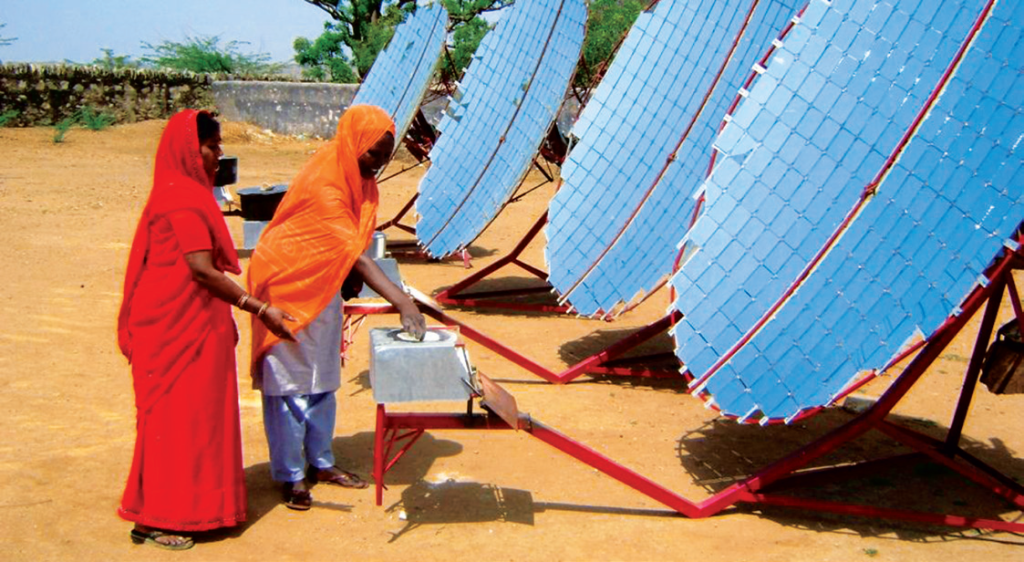
One of the greatest achievements of Barefoot College so far is its application of an alternative energy source. Harnessing the power of the sun, the college powers its campus with solar electricity as well as over 90,000 under-privileged households across India. The College also has a global reach, with more than 340 men and women from eight different countries across Asia, Africa, and South America being trained as Barefoot solar engineers. Apart from making night schools possible, solar electrification is also eco-friendly as it minimises the use of diesel, kerosene and firewood for cooking, heating or lighting.
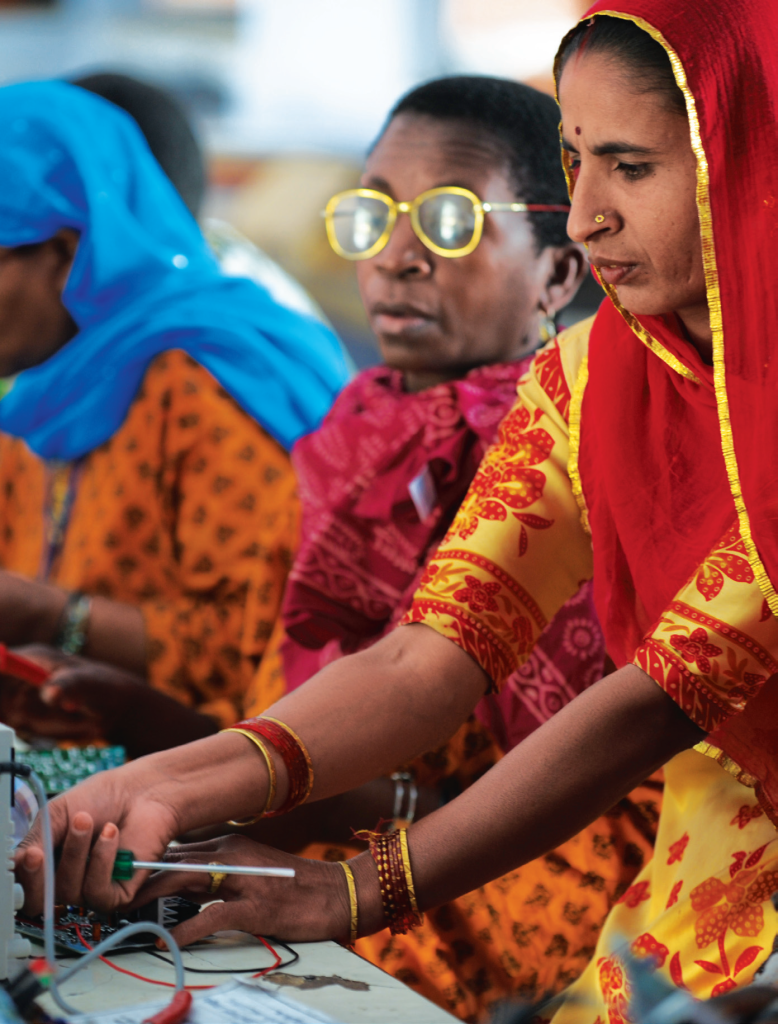
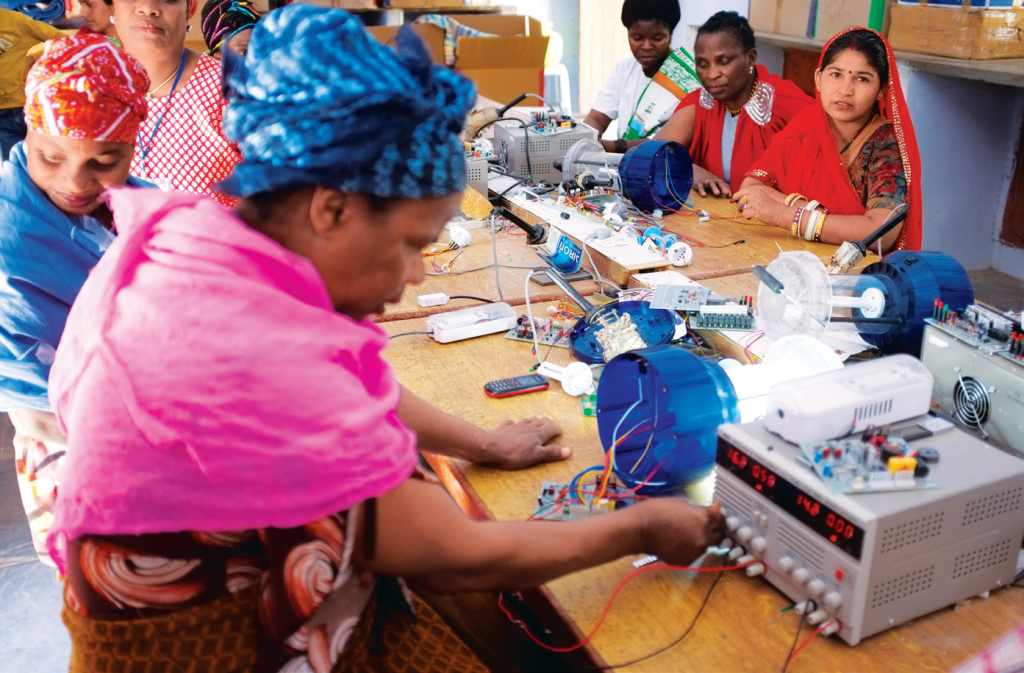
The government of India pays for training expenses, a US$100 monthly stipend that goes to support the women’s families and travel to the college. When they return home, the women will each install and maintain 100 solar light systems; the community will pay for the maintenance and spare parts from money saved by not having to buy kerosene. Because the women are often illiterate, they learn by identifying parts visually using a sequence of colours.
Mothers and grandmothers from villages worldwide have been successfully trained in the fabrication, installation and maintenance of solar lighting systems after undergoing only six months of hands-on instruction without written materials, delivered by their peers. Roy believes that women are easier to train than men because men expect too much too soon and simply want to obtain a certificate and get a job in urban areas, whereas if middle-aged mothers and grandmothers go through the programme, there is less chance of them leaving their rural homes and more likelihood they will contribute financially to their families and their communities.
Simple and Effective
The technologies used on the Barefoot College campus are simple and accessible – nothing more than mobile phones and personal computers. One of the colleges’ projects is testing the quality of water in the region by distributing testing kits and uploading the data, which can then be accessed by villagers on their mobiles.
Another is the Barefoot radio station which, as well as traditional music, broadcasts health and education information. People within 30km can listen on their mobiles, which can be charged using the solar lanterns manufactured on campus.
Its education programmes are vast; The Bridge Courses include lessons prepared in elementary science, geography, social sciences and English and 25-30 boys and girls attend these courses every year. After attending a bridge course, the children take a written test and join class 6 in the formal educational mainstream. Over the past 30 years, 4000 children including 1250 girls have continued attending school in the formal mainstream education system.
Another major innovation in the Barefoot College system is in the simplification of the technology behind solar lighting circuits for charge controllers, solar lanterns and compact fluorescent lamp (CFL) lamp inverters’ fabrication, so they can be tested and repaired by formally-uneducated mothers and grandmothers trained as Barefoot Solar Engineers in a six-month programme at Barefoot College India. The training technique is also innovatively undertaken without the use of oral communication or written materials, only utilising visual and sign language techniques, which allows for participants from different cultures and languages to be taught without understanding the local language.
More than 1.3 billion people worldwide do not have access to electricity and the majority of these people live in rural areas. The Barefoot College is improving the lives of rural underprivileged communities in the least developed countries by providing access to solar energy and training formally-uneducated mothers and grandmothers to become solar engineers, who in turn, apply the knowledge of installing and maintaining solar electricity systems in their villages. The college has successfully trained over 700 Barefoot solar engineers, solar-electrified more than 1015 villages in 49 countries around the world, providing clean energy to over 450,000 people, and saving 5.5 million litres of kerosene annually. Barefoot College has harnessed the power of the sun, which is abundant in these rural communities, and turned it into a ray of hope and opportunity, quite literally giving the power back to the people.

