

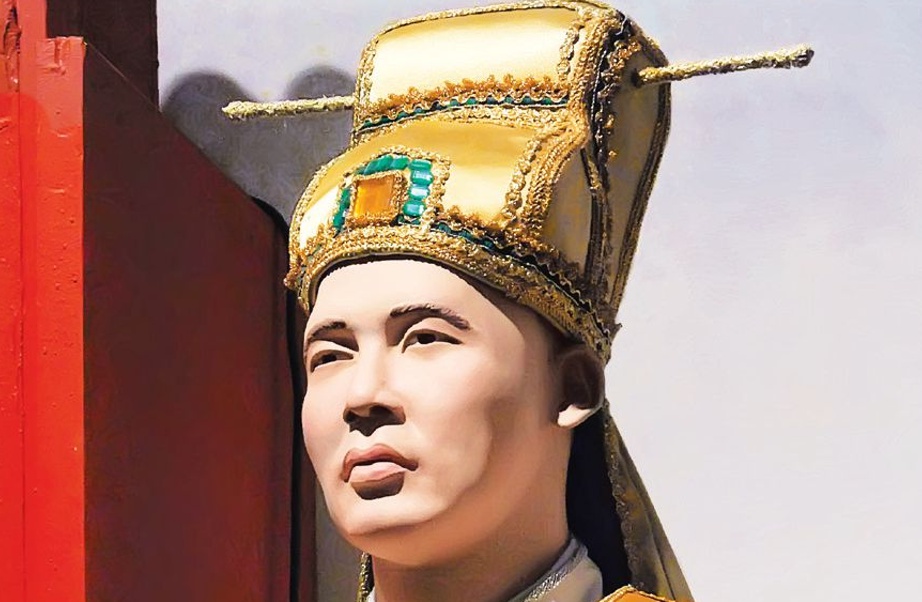
In collaboration with HIGH Life: Living the Good Life, VOICE OF ASIA is proud to present timeless articles from the archives, reproduced digitally for your reading pleasure. Originally published in HIGH Life Volume 4 in 2013, we present this story on the impact of Admiral Zheng He, as he sailed across the world.
Zheng He (formerly romanised as Cheng Ho) was a Hui Chinese court eunuch who rose to become one of China’s most renowned mariners, diplomats, explorers and admirals. Between 1405 and 1433, he commanded seven naval expeditions collectively known as the “Voyages of Zheng He” around Southeast Asia and the Indian Ocean, establishing China as a military and trade power throughout the greater region.
The greatest traveller of his time, Admiral Zheng He was tragically almost forgotten by Chinese historians following his death, with much information about him and his voyages missing from the official records. In 1904, however, the publication of Liang Qihao’s Biography of Our Homeland’s Great Navigator, Zheng He rekindled Chinese and worldwide scholarly interest in the great man. Today, Zheng He is immortalised in monuments erected in the many cities he visited on his expeditions, not least of which was the great Malay sultanate of Melaka.
Rags to Riches
Zheng He was born Ma He in 1371, the second son of a family in Yunnan province. In 1381, the Ming Dynasty, which had overthrown the Yuan, sent an army to conquer the holdout Yunnan province, with Ma He’s father being killed either while resisting the Ming or being caught up in the fighting. Ma He himself was captured by the Ming, who sent him to the court of Zhu Di, Prince of Yan in Beijing.
Ma He spent the following two decades of his life as a soldier on the northern frontier, facing the Mongols. In 1399, Zhu Di revolted against his nephew the Jianwen Emperor, who had usurped the throne. Ma He successfully defended the Beijing city reservoir of Zhenglunba against the imperial armies, an achievement for which he would be later awarded the surname Zheng by Zhu Di, by then the Yongle Emperor, in 1404.
Zheng He, the Admiral
The previous Yuan dynasty and increasing Sino-Arab trade had expanded Chinese horizons during the 14th century, with “universal” maps previously only displaying China and its surrounding seas expanding into the southwest with much more accurate depictions of the extent of Arabia and Africa. Against the stated wishes of the Hongwu Emperor, the Yongle Emperor sponsored a series of voyages to the various kingdoms of South and Southeast Asia, the Middle East and East Africa.
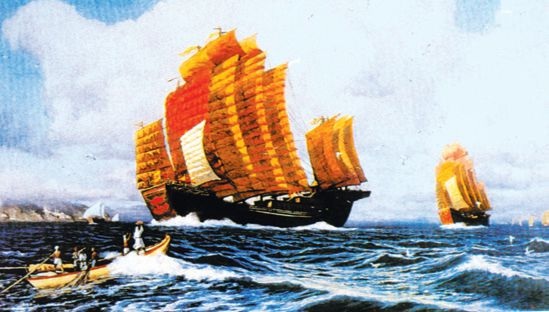
Zheng He was appointed the admiral in charge of these pioneering naval expeditions. Vessels in his 317-ship fleet were equipped to carry a large number of horses, supplies and water and included warships and 28,000 men. The armada was most famous for its treasure ships, which were by some accounts up to 137 m long and 55 m wide with a capacity of 2800 tons, although most historians believe the actual ships to have been a much smaller, more practical size. In addition, so many linguists were required that a foreign language institute was established at Nanjing.
Zheng He undertook seven expeditions during his lifetime, five of which made port calls at Melaka. His visit to the maritime state during his first voyage (1405-1407), then ruled by its founder Parameswara (also known as Iskandar Shah), was instrumental in the creation of strong diplomatic ties between the two kingdoms. The visit heralded the start of bountiful trade between Melaka and China, and helped cement the sultanate’s status as a leading trading hub in the region. To further facilitate Chinese maritime and trade operations with Melaka, Zheng He even constructed a massive warehouse complex, the Guang Chang, covering approximately 10 acres. Its location is not known in the present day, but there is speculation that it corresponds to the site of the current Cheng Ho Cultural Museum.
New Horizons
Admiral Zheng He’s tour, along with a second voyage in 1407-1409, made China’s presence known in Asia and established trade links with its neighbouring kingdoms, as well as building a reputation with the Chinese diaspora in Malacca and elsewhere. He has also been credited with establishing Chinese Muslim communities in the Malay Peninsula, Indonesia and the Philippines. Moreover, on the return leg of his first voyage, Zheng He also defeated the dreaded pirate Chen Zuyi, helping to secure Southeast Asian waters for traders. With a thirst for adventure and a brave curiosity, he went on to lead several more expeditions further afield, continuing to exchange gifts with the numerous rulers he met on his travels.
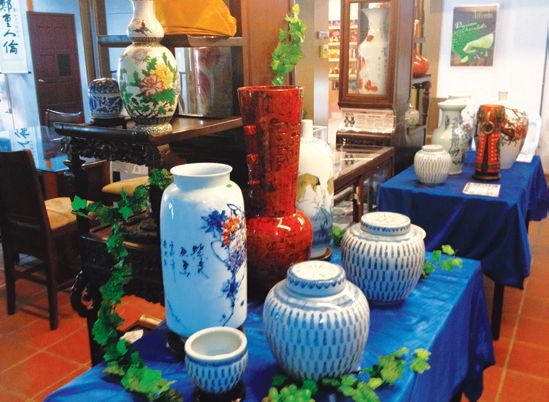
Returning from his third expedition (1409-1411), Zheng He brought Parameswara along with a royal party of 540 people to the Ming court, further strengthening bilateral ties between China and Malacca. This relationship gave Malacca military protection from the growing Siamese threat to the north, and would eventually lead to the emperor sending the princess Hang Li Po to Malacca in 1459 to marry Sultan Mansur Shah (ruled 1459 – 1477). Hang Li Po, along with her entourage of 500 sons of ministers and a few hundred handmaidens, settled in Bukit Cina (Chinese Hill), Malacca. A significant number of them are thought to have married into the local populace, creating the community known in Malaysia today as Peranakan. The honorifics Baba (male) and Nyonya (female) originate from them, and remain in use with the Peranakan to this day.
The Final Voyage
In 1424, the Yongle Emperor died and was succeeded by the Hongxi Emperor (ruled 1424–1425), who stopped the overseas voyages. However, Hongxi was soon replaced by his son, the Xuande Emperor, who sent Zheng He on a final voyage to the “Western Ocean” (Indian Ocean). The expedition lasted from 1430 to 1433, but Zheng He did not live to experience a glorious homecoming. He is thought to have died following the return trip from Hormuz, and was buried at sea.
Zheng He’s death left the Ming dynasty bereft of a fearless explorer, and marked the decline of overseas expeditions. The Xuande Emperor noted that Zheng He’s voyages went against the rules laid down by the dynastic founder, the Hongwu Emperor. The backlash by the displaced Confucian scholar-officials against the Ming eunuch faction – along with the renewed threat from the Yuan Mongols to the north – also prevented any further great expeditions abroad.
Remembered by History
Nevertheless, Zheng He’s legacy lived on. The Southeast Asian kingdoms continued to send envoys to China, sometimes at such frequency that their entry had to be restricted. The association with Melaka outlasted even the sultanate’s conquest at the hands of the Portuguese in 1511, for such was the fury of the Chinese at this transgression that for many years after they would slaughter every single Portuguese who attempted to land in China. Chinese traders also boycotted Melaka, and Chinese in Java even aided Muslim attempts to invade the city.
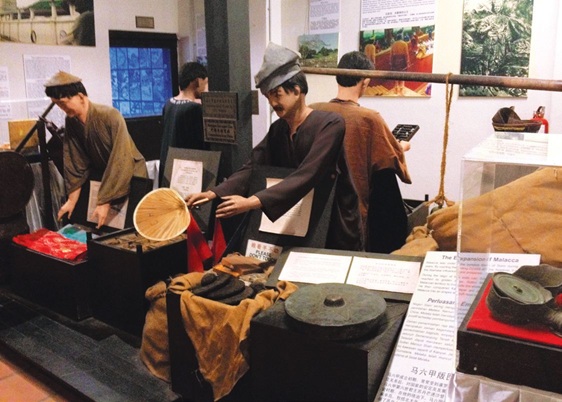
In present-day Melaka, the Cheng Ho Cultural Museum pays tribute to the great admiral’s contributions to the state. Founded and run by the International Zheng He Society, it features a large number of exhibits of the period including a gallery of Sino-Malay cultural and economic interactions and the Li Kap teahouse which gives a glimpse of Chinese life at that time. Zheng He’s name is also venerated by Malaysian Chinese in Melaka, as seen in the widespread celebrations of the 600th anniversary of his fourth voyage in January this year.
As history professor Richard von Glahn describes it, the crux of Asian history in the fifteenth century is essentially the Zheng He story and the effects of Zheng He’s voyages. Today, Zheng He is immortalised throughout Asia through the temples, steles and other artefacts he left, as well as the monuments built to commemorate his travels. His exceptional voyages have influenced the course of the region’s development – particularly in Melaka, which owes to him its early prominence as the region’s premier port, and a lasting legacy of bilateral friendship and cooperation.

