

In collaboration with PASSIONS, VOICE OF ASIA is proud to present timeless articles from the archives, reproduced digitally for your reading pleasure. Originally published in PASSIONS Volume 53 in 2013, we present this story on Bali, and the stunning views it can offer to those who seek respite.
In this PASSIONS exclusive, we take you to the most far-flung corners, exploring the magic, majesty and minute detail that the world has to offer. From people to places and vistas to soaring scenery, photo-journalist Baraba Prinz captures for PASSIONS the most breathtaking elements of landscapes that seem to exist on another planet.
Island of Gods. Island of Love. Island of Hinduism. Morning of the World. Bali, island of many names, is the latest mystical destination visited by German photojournalist Barbara Prinz. She shares with PASSIONS her experience as she explores its culture and its colourful influences.
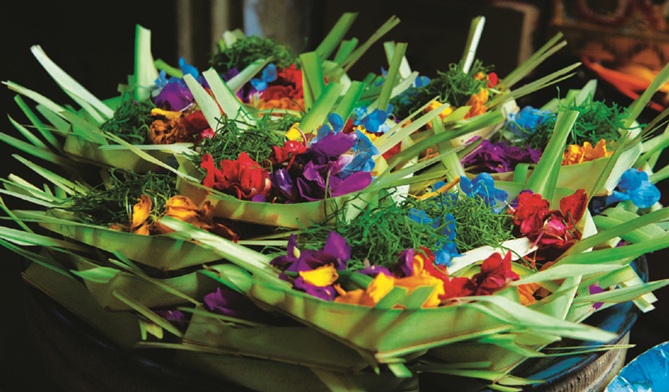
Canang Sari is a daily offering of thanks made by Balinese Hindus.
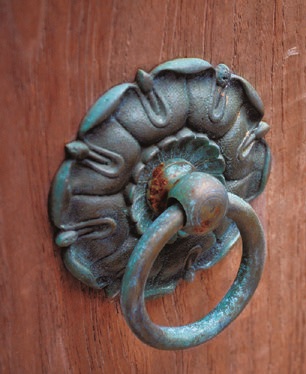
A traditional floral Balinese doorhandle.
The Indonesian archipelago is estimated to have 17,508 islands. Although only 6,000 of those islands are inhabited, Indonesia is still the largest Muslim country in the world, with a population of over 200 million people.
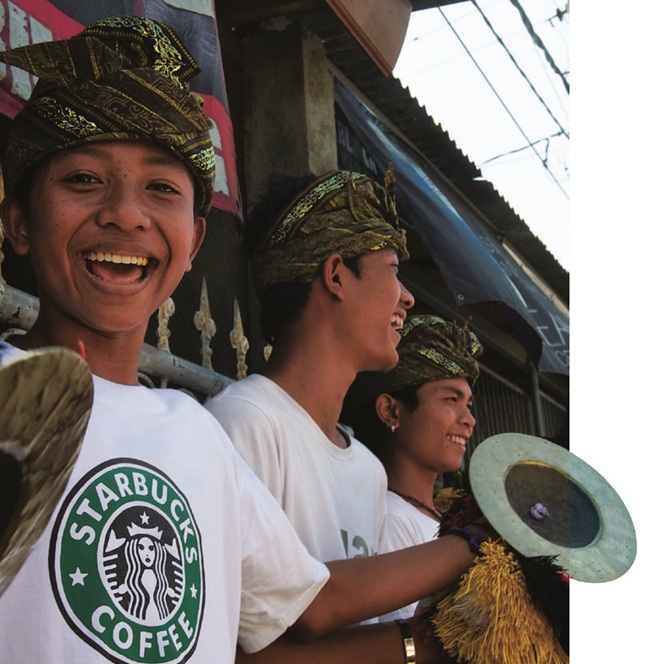
Making noise with instruments such as these ceng ceng kopyak cymbals is a traditional feature of Balinese festivals.
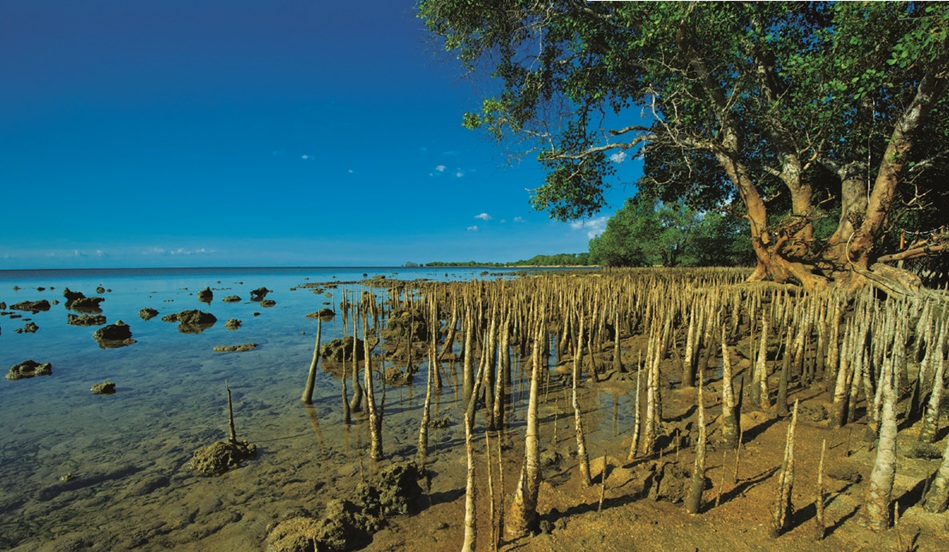
Mangroves at low-tide.
Bali itself is different from the rest of the country – it is home to most of Indonesia’s Hindu minority, and this has had a major influence on the culture of the island. Currently populated with 4.3 million inhabitants, it extends 5,120km from east to west and 1,760km from north to south. The province is embedded between Java in the west and Lombok in the east, with its capital Denpasar situated in the south of the island.
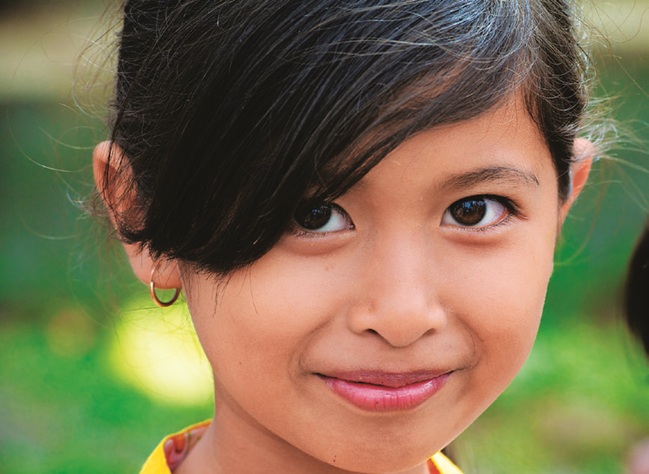
A Balinese smile warms any heart.
The traditional and modern dance, sculptures, paintings, leather, metalworking, and music, are mesmerizing. The island is the largest tourist destination in the country, and indeed, in 2011, BBC Travel named Bali one of the world’s best islands, second only to Greece. The island’s unique character is a result of diverse cultural and linguistic influences. People from different parts of Indonesia, Malaysia, the Philippines, and the Oceanic region have settled here, and there is also a very strong Indian and Chinese influence present. Many religious and cultural traditions in existence today can be traced back to these influences, including the complex rice-growing irrigation system “subak”.
Like most tourists, I came to Bali by plane. The welcoming atmosphere of Ngurah Rai International Airport was enhanced by a cultural snapshot of Balinese music, sculptures, and walls with wooden carvings.
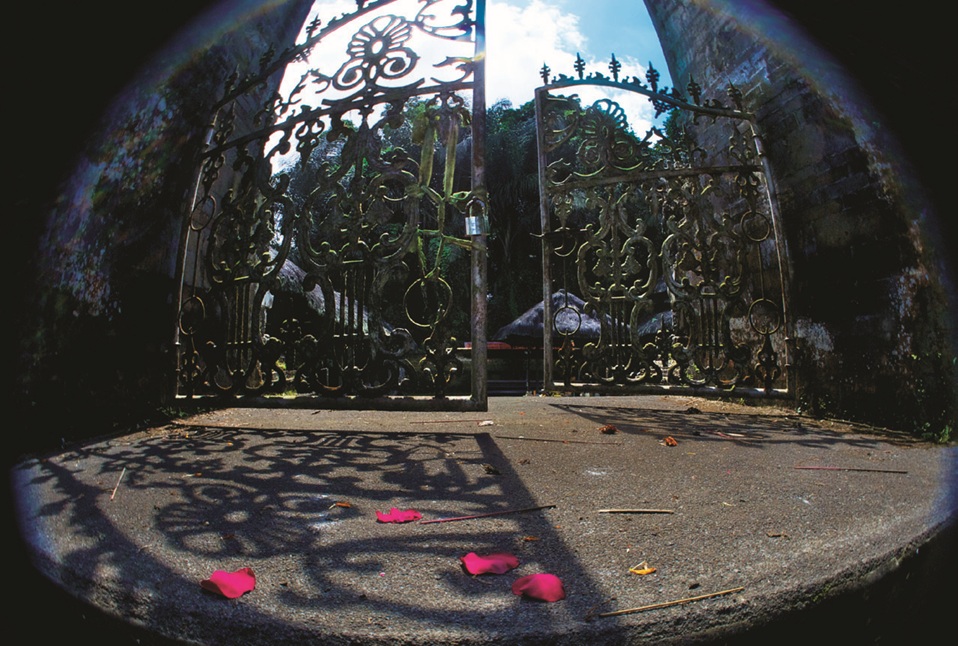
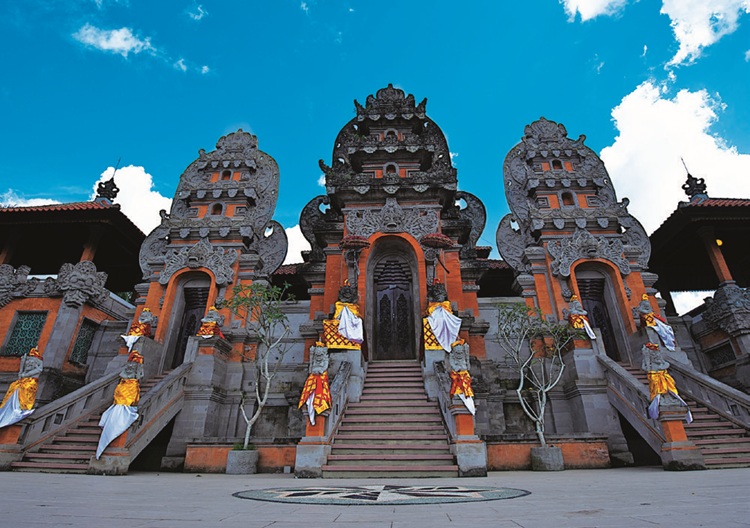
Rose petals scattered in-front of the wonderfully wrought temple gates.
You cannot savour all the delights of Bali over a weekend, so it’s best to allow yourself at least a week. In the south, for instance, are the Kuta, Legian or Seminyak Beaches, while up north are the fine-dining restaurants, hotels, and amazing happening night life.
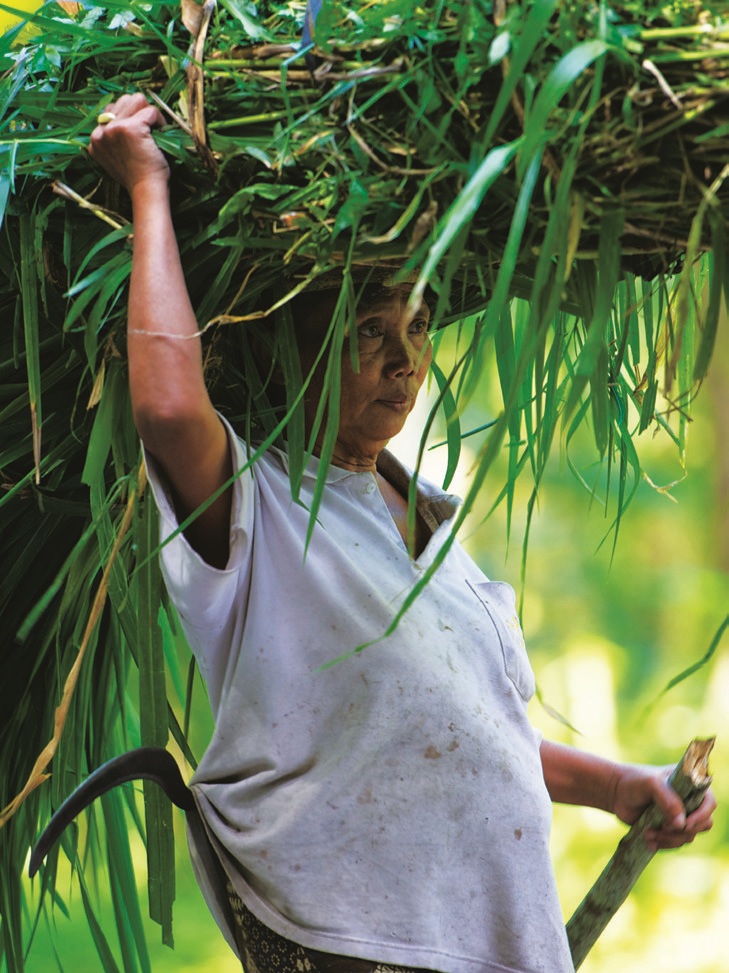
A farmer carries freshly-sickled grass back to the house.
A bit further north on the remote coastline is the Tugu Hotel run by a Dutch millionaire, a place known for its artsy, soulful and romantic ambiance. Yoga classes, a spa, restaurants, Balinese cooking lessons, and water sports are available here, and there is a nearby golf course at the Pan Pacific Nirwana Bali Resort, with another option for accommodation being the Golf Hotel.
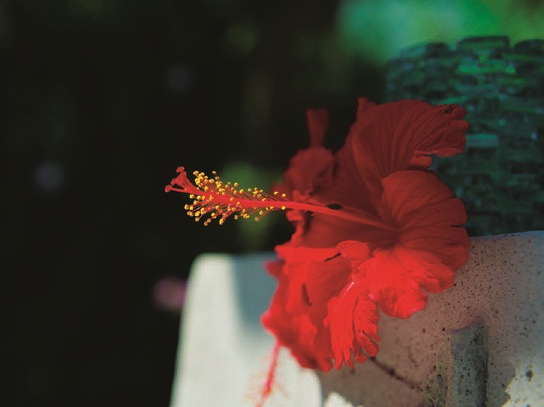
The bright-red Frangipani blossom with its protuding stamen, a flower associated with Balinese culture, and known locally as Kamboja.
The Morning Calm
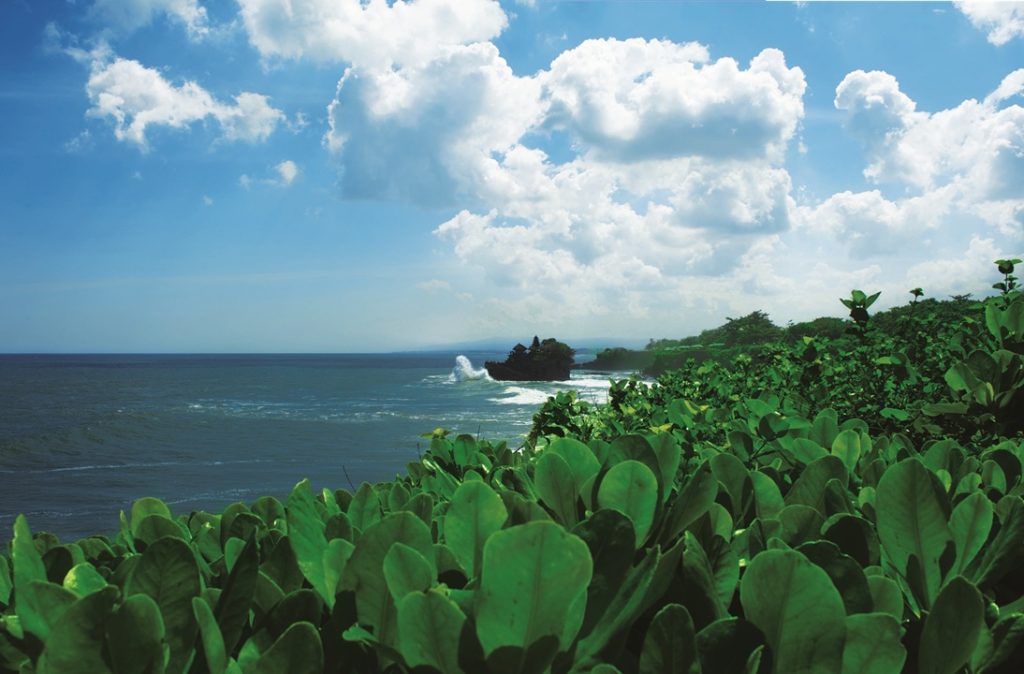
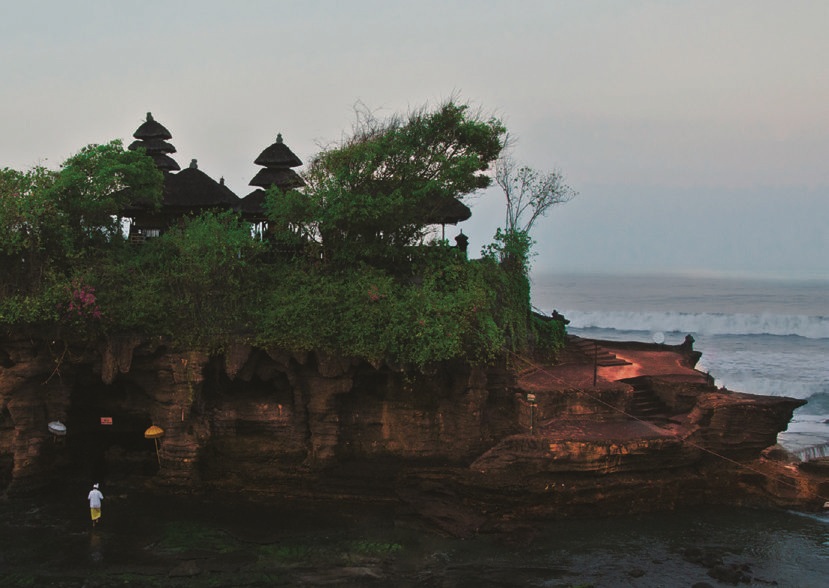
On this coastline is also Tanah Lot, the iconic temple accessible only during the low tide. It is one of Bali’s best sunset points, but early risers would doubtless also enjoy the pristine mornings at Tanah Lot, when there are hardly any tourists around. You may even see a priest there making his first offerings and prayers at dawn. North of Tanah Lot is a cliff with a steep stairway on the side leading to little sandy bays and rice fields.
The pagoda of the Ulan Danu temple is built upon a lake.
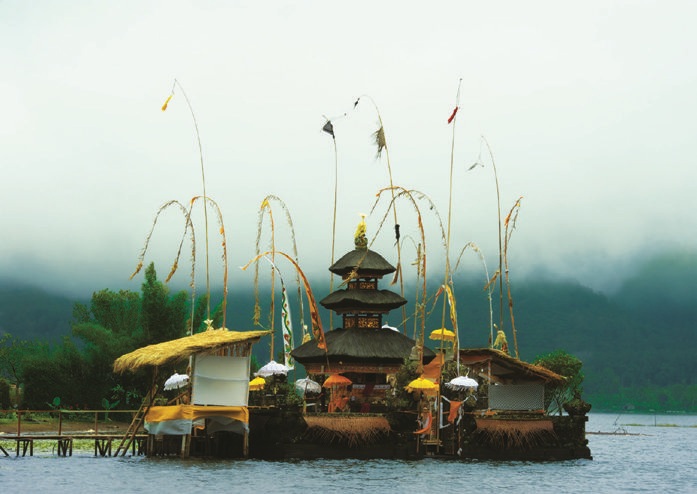
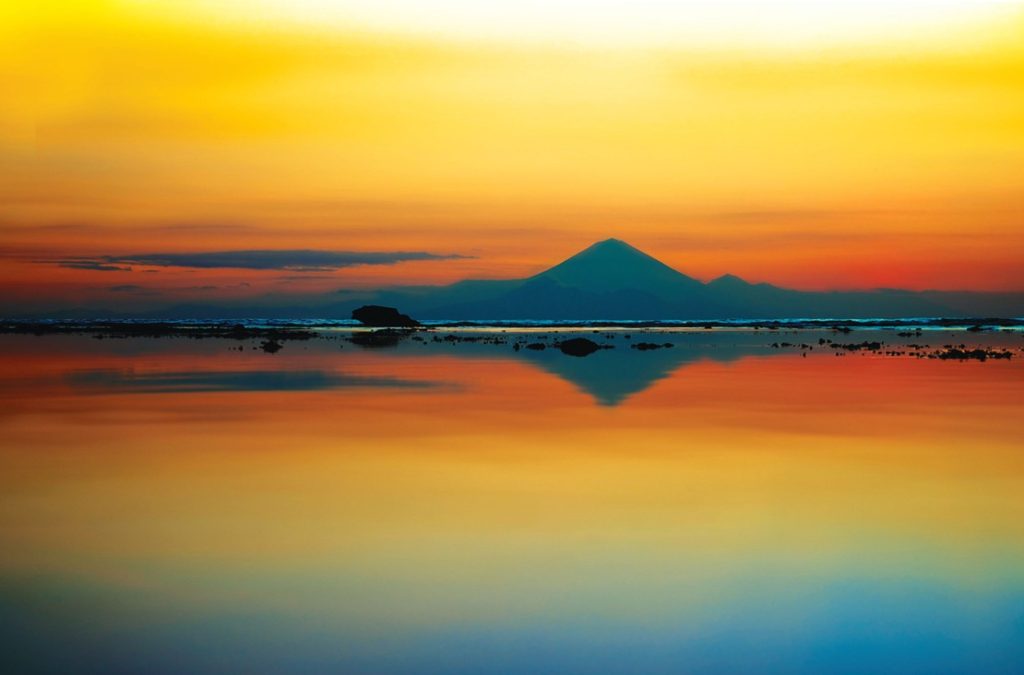
For a break from the beach life, Bali’s central mountains – or volcanoes – include several peaks elevated at over 3,000 metres, as another option to enjoy the landscape. The highest and easternmost peak is Mount Agung at 3,031 metres, known as the ‘mother mountain’ and still an active volcano. Bali’s volcanoes have contributed to the exceptional fertility of the land, and the tall mountain ranges bring rainfall to support a highly productive agricultural sector. South of the mountains is a broad, steadily descending area where most of Bali’s rice crops are grown.
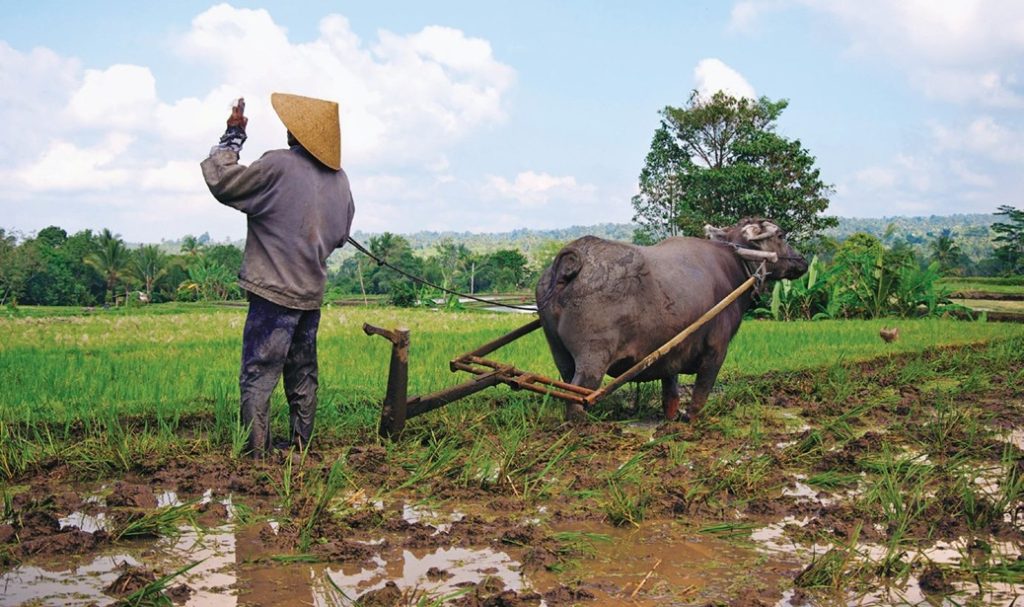
A farmer gives his buffalo a much-deserved breather as he pauses to search for a signal on his mobile phone.
On the way to the northern parts of Bali is Ulan Danu Temple, another of the island’s iconic temples, built right on Lake Beratan. A tourist attraction with its beautiful view of a mountain range, the whole scenery can change within minutes when the cloud mist descends. Balinese ceremonies are held at this temple, and the Balinese devotion, humility, and respect for mother nature is evident and touching.
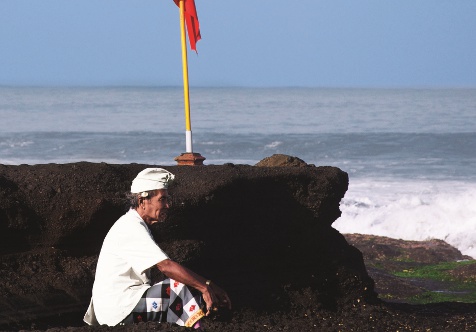
In Bali temples are often situated atop rocks, looking out over the sea.
An hour away from Ulan Danu Temple is Ubud, recently popular and a tourist favourite for being the setting for best-selling author Elizabeth Gilbert’s Eat, Pray, Love. This hill town adjacent to rice fields is a cultural centre for arts and crafts, laid-back restaurants, guest houses, and little spas. It has a market ideal for bargain hunting, and is also known for being the best place to buy vanilla pods and enjoy homemade food in banana leaves, sold by market women.
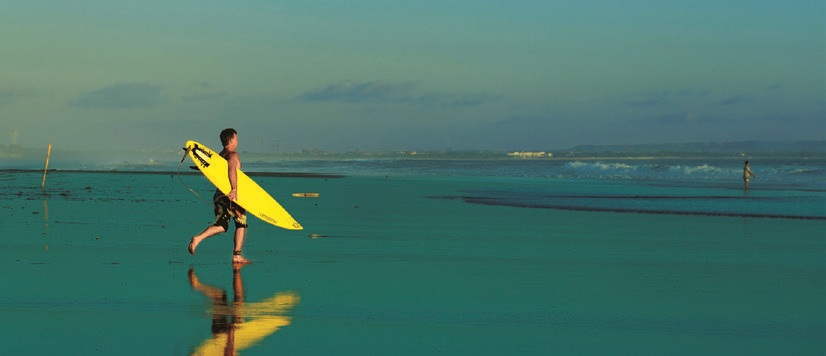
Another tradition in Bali – surfing!
Ubud’s best entertainment is the Monkey Forest, where the crab-eating Macaque, known locally as ‘kera’, is an attraction. The extremely curious monkeys are accustomed to being fed by humans, and at times, jump onto tourists, some who tolerate them and some who don’t. The Monkey Forest is sacred, and well-known for its hundreds of diverse tree species. Some of these trees are considered holy, with temples built next to them to renew contact with the spiritual world.
This temple in the Gianyar province of Bali provides quiet repose.
Bali’s beautiful flora and fauna are used by the resourceful Balinese as decorations – little baskets of flowers and rice called canang sari are seen along the streets, at house entrances, temples, and even on cars for good luck to see the driver safely back home. Canang sari is offered three times a day to the gods as a symbol of giving back what had been received from them. The offering also symbolises sharing and gratitude for the richness and beauty of life.
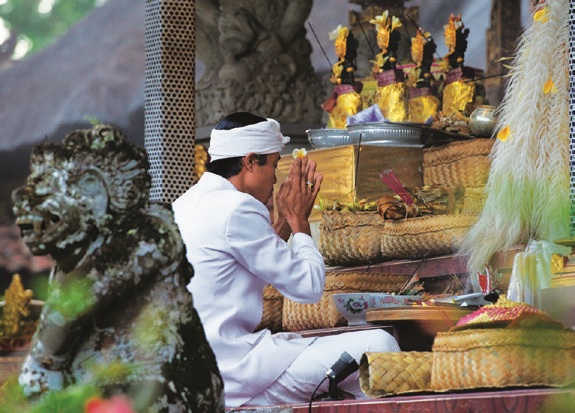
A devotee offers prayers at a temple in Ubud.
Balinese artisans are famous for producing a vast array of handicrafts, batik and ikat cloth, clothing, wooden carvings, stone carvings, paintings, and painted silverware. Individual villages typically adopt a single product, such as wind chimes or wooden furniture, and these handicrafts are seen all over the island.
A Celebration of Life
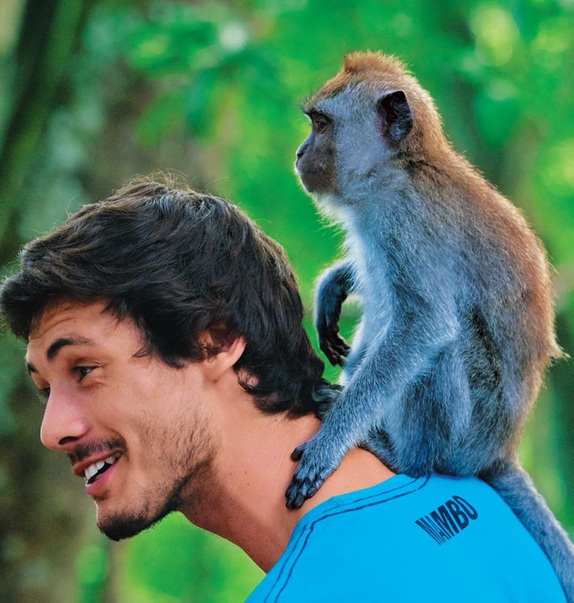
A long-tailed Macaque acquaints himself with a tourist.
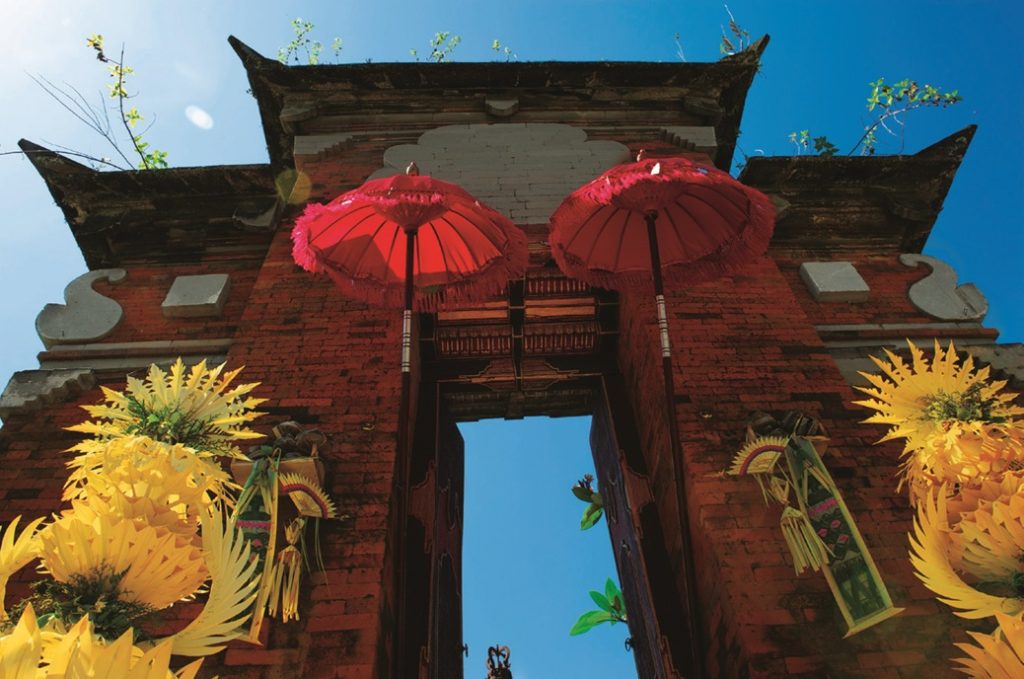
Galungan is one of the festivals celebrated during the 11th week of the 210-day Balinese calendar. It is believed that the spirits of deceased relatives who have died and were cremated, return to visit their former homes, and so the current inhabitants have to be hospitable through prayers and offerings. Marking the celebration are eye-catching signs called penjors, seen along the roads and in front of the temples. They are made of bamboo poles weighed down by offerings.
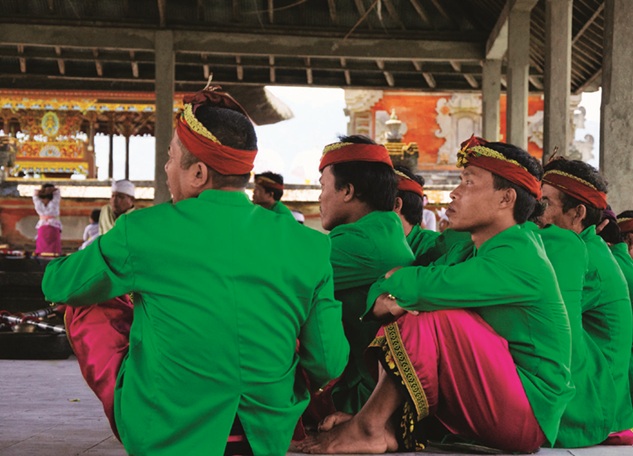
These Balinese men wait patiently for their turn to perform during one of the many Balinese festivals.
Balinese Hinduism is deeply interwoven with art and rituals, and traditional music is heard all over the island. Children are trained at a young age to contribute to traditional activities and develop their talents. Probably the secret behind the exotic and peaceful Balinese lifestyle is the fact that young and old alike treat each other respectfully. Self-control is a big part of their religious expression. The Hindu influence on their culture has only strengthened their belief that the gods and goddesses are present in all things, and that every element of nature possesses its own power. Literally anything can be a home for spirits whose energies may either be good or evil, depending on who directs them.
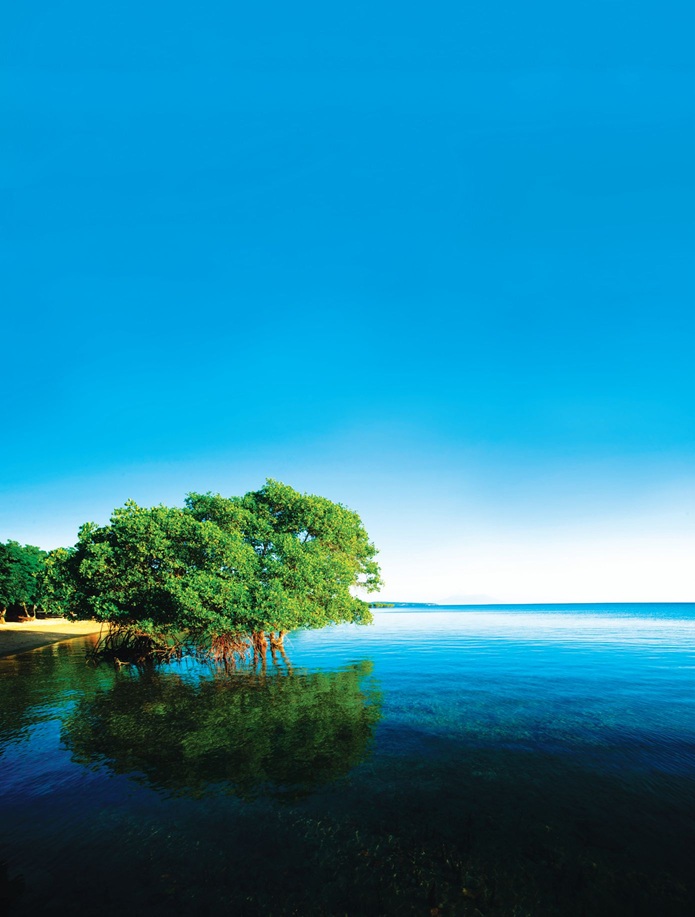
Mangroves near Menjangan Jungle and Beach Resort in Northwestern Bali.
A temple entrance decorated for Galungan a Balinese holiday that marks the time when ancestoral spirits visited the Earth.
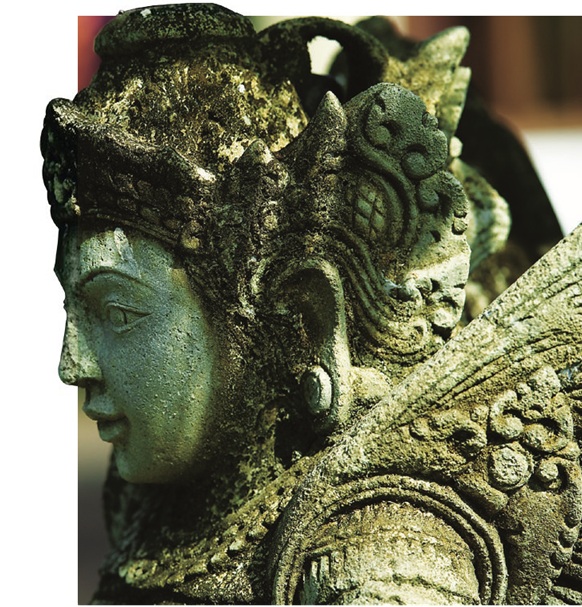
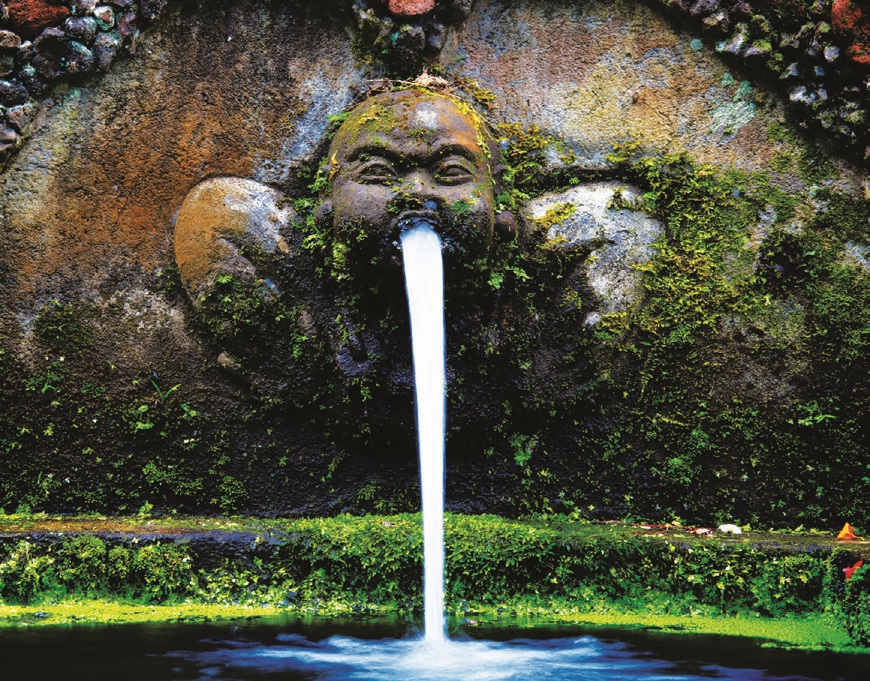
This stone guardian stands outside ‘The Mansion’, in Ubud.
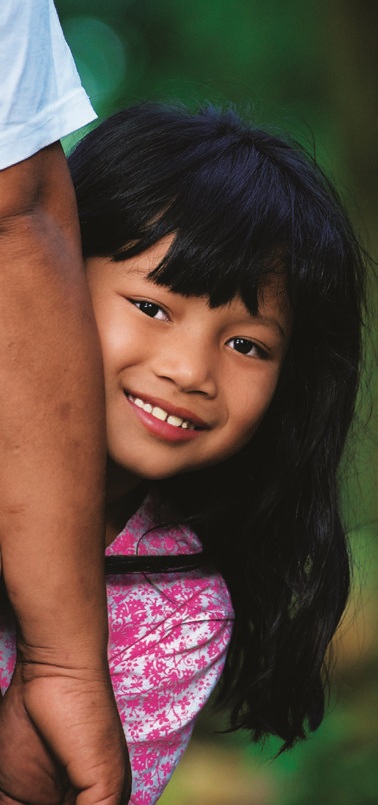
Hide and seek – a local girl gives a cheeky grin.
Ngaben is a fascinating ritual where a group ceremony for cremation is performed. Higher caste members who can afford it have individual ceremonies performed over the span of 3 days. The ritual is performed to send the deceased to the next life. The deceased is laid to rest as if asleep, and no tears are shed as it is believed that the deceased is merely not present and will reincarnate or find a final rest in Moksha, a state of being free from reincarnation or the death cycle. A specialist is consulted to pick the ritual ceremony day when the body of the deceased is placed inside a coffin, and that coffin inside a sarcophagus resembling a buffalo, or in a temple structure made of paper and wood, or Wadah. These are then carried to the cremation site where the structure is burned along with the body of the deceased, a necessary ritual to free the spirit from its physical form and finally enable reincarnation.
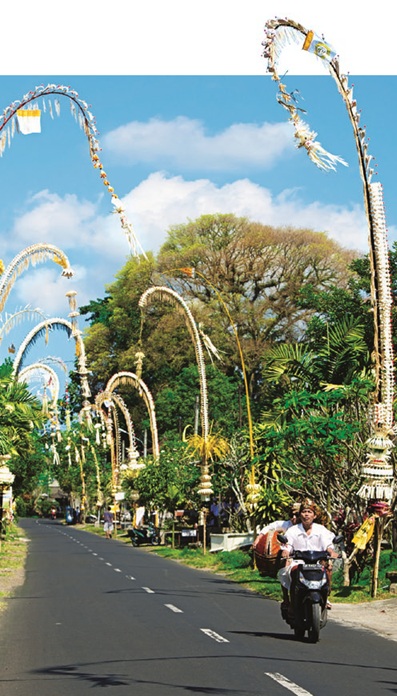
Penjor – tall, curved bamboo poles decorated with coconut leaves and with an offering at the base – line the streets for the Galungan festivities.
Many other ceremonies in Bali are loud and boisterous, with plenty of activity. However, during the spring, the Hindu New Year called Nyepi is celebrated in silence. Everyone is encouraged to stay at home or in their hotels to observe this day. As a visitor, I was overwhelmed by this lovely Balinese way of looking at life.
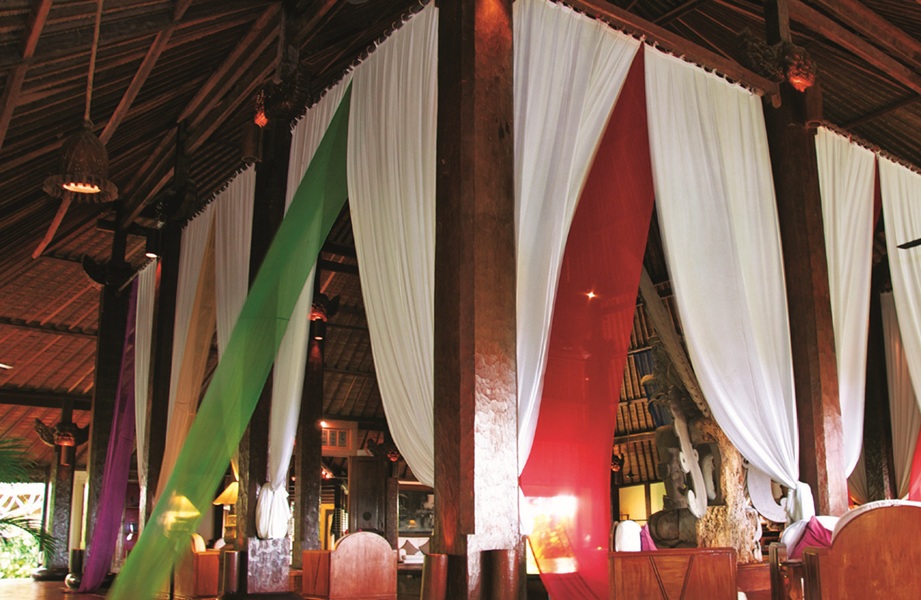
The lobby of Tugu Bali Hotel in Canggu.
Bali has become one of the wealthiest regions of Indonesia, thanks largely to the tourist boom in the last few decades. There is a price to pay, however, as the island feels the effects of tourism over-exploitation, with water shortages and 200 of the 400 rivers drying up.
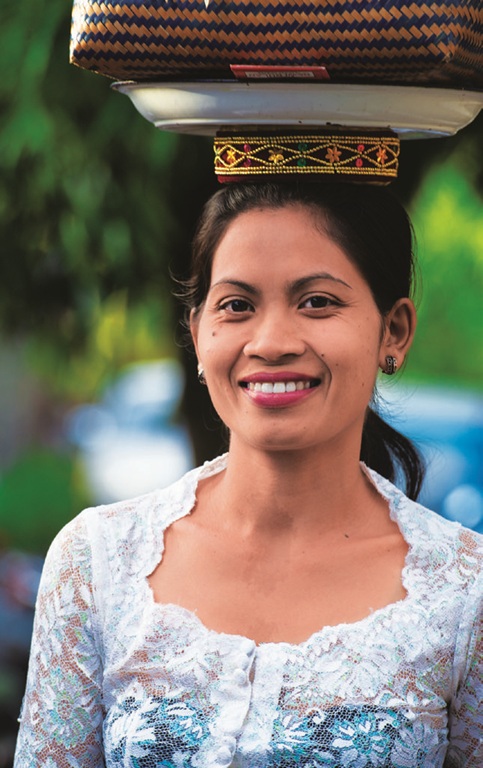
A balanced view – in Bali, many women carry goods on their head.
The tourist areas of Kuta, Legian, Seminyak and Oberoi have seen rapid development in real estate as more and more high-end 5-star projects are being constructed on the Bukit peninsula. Million-dollar villas are appearing along the sides of south Bali, and active foreign and domestic investments into other areas continue to grow.
It is no wonder that tourism is an economic factor in this mystical island with its impressive tourist figures. In 2012 alone, 2.88 million foreign tourists and 5 million domestic ones came to vacation in the island. There are also many prestigious events held in Bali, and 2013 is turning out to be no exception. The World Hindu Summit was held there in June, while the World Pageant will be hosted there in September. In October, the island will host the Asia-Pacific Economic Cooperation (APEC) Summit, when US President Barack Obama and several other international dignitaries are expected, and scheduled for December to close the year is the Bali Democracy Forum.
I believe Bali owes its beauty to the mountain and coastal areas, the excellent local and international restaurants, and the friendliness and warmth of the locals. I can only hope that they conserve their paradise island, and retain the beauty of their surroundings and their calm, peaceful demeanour.

