

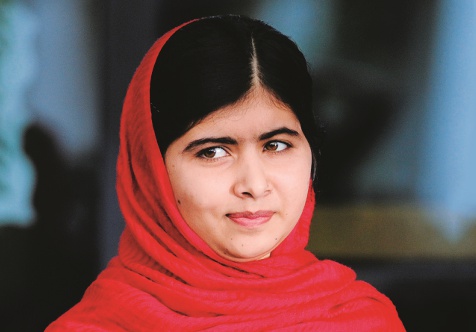
In collaboration with PASSIONS, VOICE OF ASIA is proud to present timeless articles from the archives, reproduced digitally for your reading pleasure. Originally published in PASSIONS Volume 54 in 2013, we present this story on Malala Yousafzai, the girl who seemingly went through it all in her pursuit for knowledge.
Driven out of her home with guns and bombs, forced to halt her education, and then an attempt on her life with a shot in the head for asserting her right to go back to school and continue her education – none of these traumatic events are typical for any human being, let alone a very young girl. PASSIONS follows Malala Yousafzai’s horrifying ordeal and how it has inspired a whole generation to look into what we can all do to stop this from happening again, to Malala, or to anyone in the world.
Sixteen-year-old Malala Yousafzai is currently studying in the UK, living a relatively normal teenage life and enjoying her favourite school subjects. Except she is not like your normal teenage girl. Barely a year ago, in October 2012, she was shot in the head in an assassination attempt by the Taliban, a fundamentalist political group in Afghanistan, who objected to her public statements about not being able to go to school as a result of the Taliban occupation in her town. The bullet hit her left brow, travelled underneath the skin down the side of her head, and then finally lodged in her shoulder. She was lucky to survive. After initial treatment at a local hospital, she was flown to the UK where she is continuing to undergo treatment.
A Stolen Childhood
Growing up in her family’s house in Swat Valley near the Pakistan-Afghanistan border, Malala was raised in an intellectual environment by her educational activist father Ziauddin Yousafzai, a poet and school owner. He encouraged political discussions with his very young daughter, allowing her to stay up late for debates when her siblings were sent to bed. Elsewhere in the world, this would have been an optimal environment to raise a child to think for herself, to stand up for her beliefs, and to critically analyse her surroundings. But this is a different place, where being outspoken can cost you your life.
In 2008, Taliban militants took over Swat Valley and banned television, music and girls’ education. Infuriated and only 11 years of age, Malala spoke at a local press club of her outrage. “How dare the Taliban take away my basic right to education?” she famously asked. Her speech caught the interest of the region’s newspapers and media. Here was a girl not afraid to speak her mind, who wanted to pursue her studies, and who said out loud what everyone else was deathly afraid to do so.
Writing for Rights
The following year, BBC Urdu Service editors started covering the politics and violence in Swat, but wanted to find out how ordinary people lived under Taliban rule. The editors approached Ziauddin Yousafzai to ask one of the students in his school to write a diary for the BBC website. As no one would agree for fear of reprisals from the Taliban, it fell to Malala, who had turned 12 then, to start writing a journal following her own life.
The journal was a hit, developed into a blog with its own section on the website. Malala had to write under a pseudonym – Gul Makai, Urdu for ‘corn flower’ – for her own safety, but it was nonetheless very popular, with thousands of views every day. It was essentially a diary, as she wrote about her thoughts, what happened during the day, and her hopes and dreams. It was the innocence in her written voice that captivated her readers.
Detailing the abuse of the Taliban, Malala wrote about being told not to wear colourful clothes as they were offensive and immoral, about her fears of not being able to go back to school, and then later, about her fear of being killed by the Taliban. The blog entries were handwritten, then passed on to a BBC reporter to scan and email for posting. The blog continued until a few months later, when the Taliban withdrew and schools opened again. Her last entry spoke of a science paper that she did well on.
Taking the Risk
Both Malala and her father agree that writing the blog was a big risk, but they also both believe that it was worth it as “it was a greater risk to give in to the slavery and subjugation of ruthless terrorism and extremism.” Even though she wrote under a pseudonym, it wasn’t long before her real identity was known, perhaps through her proud father, or because she herself was very vocal about promoting education rights. Eventually, her name would be revealed in news stories and articles.
After her BBC stint, she began giving interviews and appearing on television and in documentaries as an advocate for female education. The courage of the girl who spoke out, on pain of death but who defied it, amazed the world. That year, she was awarded Pakistan’s first National Youth Peace Prize, and as she became more popular, Prime Minister Yousuf Raza Gilani set up an IT campus in the Swat Degree College for Women at her request. By 2012, she had started organising the Malala Education Foundation to help poor girls go to school.
But this popularity also meant that she was firmly put in the crosshairs of the Taliban. Her father began receiving death threats slipped under their door or published in newspapers. She was harassed on Facebook and received threats there, too. Finally, a Taliban spokesman declared that they were “forced” to act as she did not cease her activism.
The Cost of Education
Then it happened, the event in that fateful October that changed her life. The 15-year-old was in a school bus with her classmates when a masked gunman climbed aboard and threatened to shoot everyone inside if Malala did not identify herself. As soon as she did, the gunman shot at her, and one bullet went through her head, neck and shoulder. Two other girls were wounded along with her.
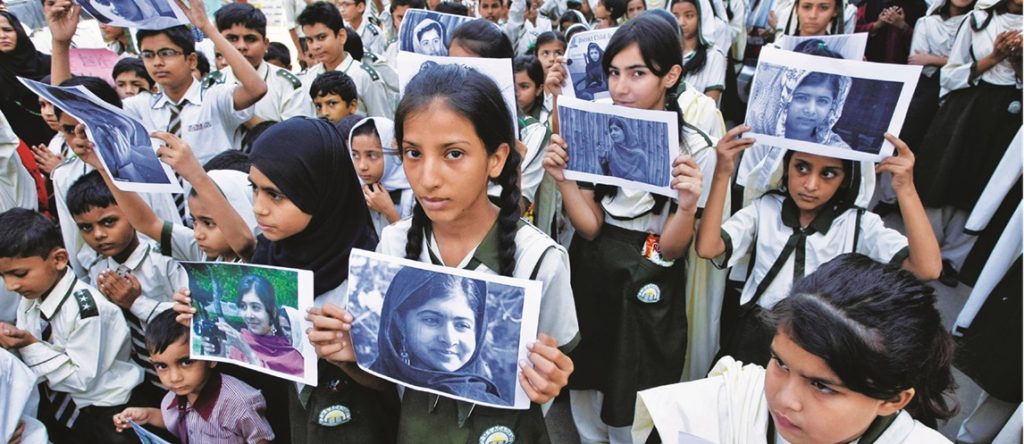
At the hospital, Malala was in critical condition and excruciating pain. Doctors operated to remove a bullet from her neck, and she was unconscious for three days. Fortunately, she did not suffer brain or nerve damage, and her recovery was swift. Within four weeks, she went from being unconscious to walking, writing and reading again. In Birmingham, England, she was discharged from the hospital three months later, and is now awaiting surgery to repair her skull.
In an effort to clear up some misconceptions, a senior member of the Taliban, Adnan Rasheed, later wrote a letter to Malala on behalf of the Taliban, where he stated that she was targeted for running a smear campaign against the group, and not because she was promoting education.
A Voice Among Many
Despite all her suffering, Malala is unfazed. She continues to do what she can to bring more attention to her cause. She was nominated for the Nobel Peace Prize in March 2013, and has been offered a US$3m book contract for her life story by London publishing house Weidenfeld and Nicolson. Her memoirs will be titled “I Am Malala” and are due for publication in late 2013. A feature-length documentary about her life also be produced by Hollywood moguls Walter Parkes and Laurie MacDonald.
In July this year, on her 16th birthday, Malala delivered a speech at the United Nations Youth Assembly in New York, calling on world leaders to pay more attention to providing free schooling for all children.
“Thousands of people have been killed by the terrorists, and millions have been injured. I am just one of them. So here I stand, one girl among many. I speak not for myself but for those without voice.”
Malala’s story is a haunting reminder of what to many of us is a nightmare, but to some a reality. Her courage to stand up for her rights and the rights of every girl, despite the threat to her life, is a wake-up call not to stand idle in the face of evil, and a reminder that for as long as we are right, no matter how powerful evil is, good will always prevail.

