

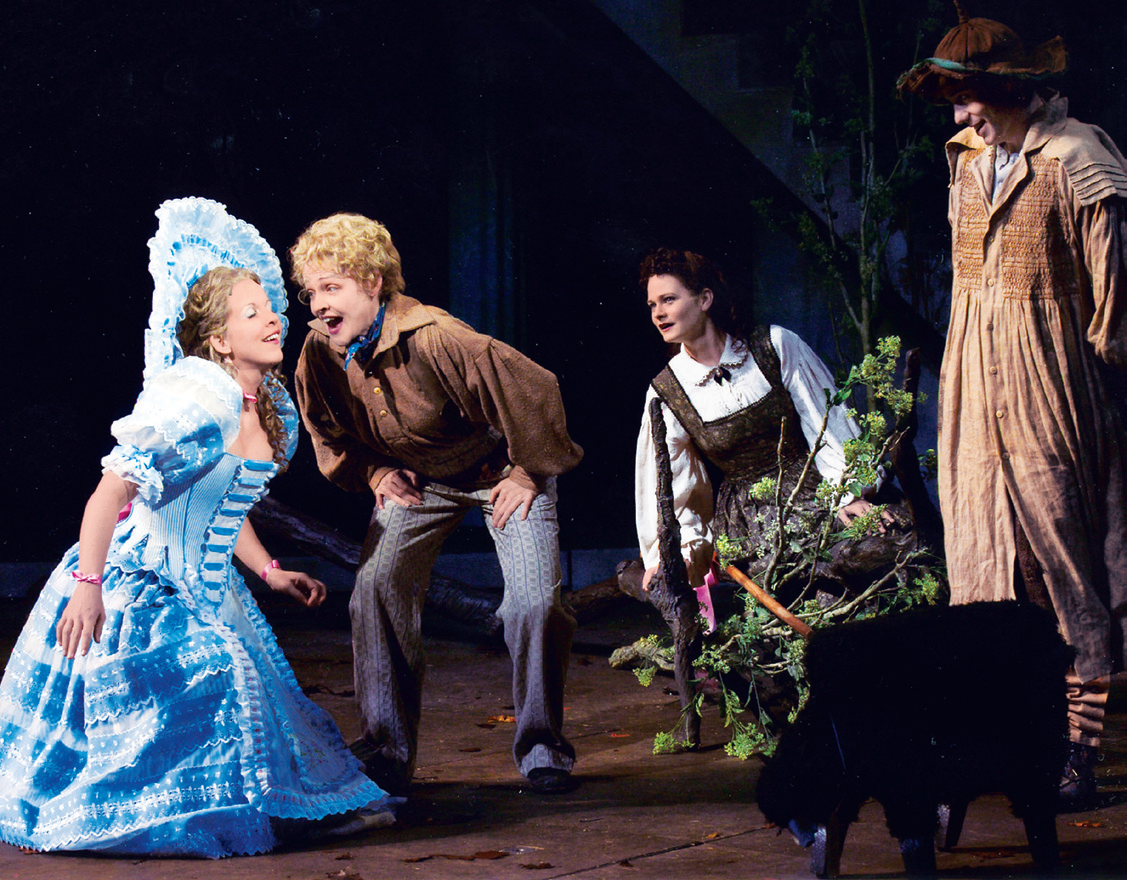
In collaboration with PASSIONS, VOICE OF ASIA is proud to present timeless articles from the archives, reproduced digitally for your reading pleasure. Originally published in PASSIONS Volume 52 in 2014, we present this story on William Shakespeare, and how he gripped, and continues to grip, the world with the wit of his work.
William Shakespeare is widely considered the world’s greatest writer in English and its foremost dramatist. His bibliography includes thirty-eight plays, 154 sonnets and a host of other poems, works which have inspired numerous spinoffs and reimagining, an overwhelming amount of English-language literature, and formed the subject of seemingly endless literary analysis and criticism. Shakespeare’s use of the language helped shape modern English, and many phrases from his plays are still used today in common speech.
The Comical Bard
In the first decade of his career in the 1580s to ‘90s, Shakespeare drew primarily upon two intertwining dramatic traditions – the previously common Tudor morality plays, and the classical aesthetic theory originating with Aristotle – that saw synthesis during the Elizabethan period. During this period, he produced his first comedies, characterised by tight double plots and precise comic sequences. Among them are the famous The Taming of the Shrew, as well as The Comedy of Errors and The Two Gentlemen of Verona. His first histories, including Richard III, the second longest play in the canon, also belong to this period, as does the violent tragedy Titus Andronicus.
As Shakespeare’s experience grew, his earlier work gave way in the mid-1590s to comedies with a romantic atmosphere; it is during this period that the Bard’s talent and adaptability begins to truly shine. A Midsummer Night’s Dream is a skilled combination of romance, fairy magic and even low-brow comic scenes, while Much Ado about Nothing’s witty wordplays run from the very title to the closing act. Twelfth Night sets a tale of love to the backdrop of comedic conflict and lively merrymaking. Where As You Like It is set in the charming, pastoral setting of a rural estate, the tragic-comic Merchant of Venice brings legal and financial drama to a bustling merchant city-state. Comedy also found its way into Shakespeare’s history plays, including Henry V and Henry VI during this time.
Problems and Tragedies
But while Shakespeare’s best comedies date to this period, it actually begins and ends with two of his greatest tragedies. The first is the immortal Romeo and Juliet, a tale of adolescent love, vendetta, and death. The second, Julius Caesar, is a harrowing fictionalisation of the famous Roman dictator’s assassination, betrayed by his close friend Brutus in the name of service to the Republic.
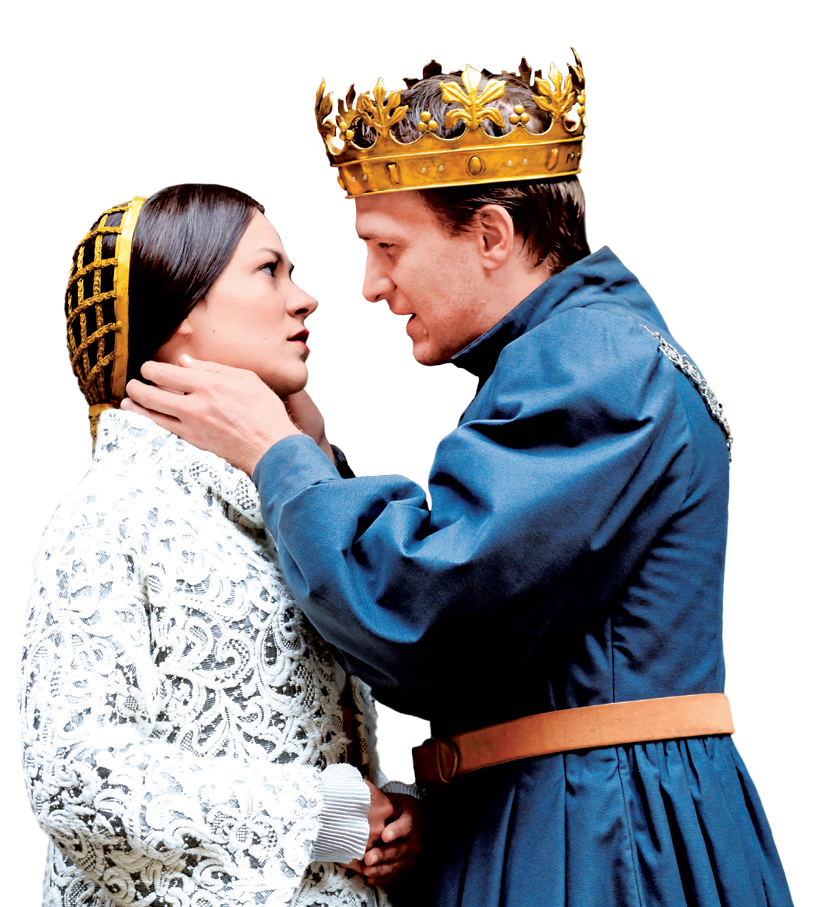
During the Jacobean era (named for King James I) with its rise of dramatic satire, the Bard’s tragedies, generally considered to be the peak of his art, were further developed; his magnum opus, Hamlet, dates back to this period. Here, too, Shakespeare shows a remarkable breadth of characterisation; where Hamlet‘s fatal flaw is hesitation, the titular protagonists of Othello and King Lear are instead undone by their rash decisions. In Macbeth, it is uncontrolled ambition which drives the Macbeths to usurp the Scottish throne, until their own guilt destroys them.
Predating the tragic trend of such plays as Hamlet are the so-called “problem plays,” a label that can refer both to the subject matter and to the difficulty of classifying the plays themselves. The three plays commonly placed in this category are All That’s Well Ends Well, a ribald story of a woman’s unrequited love for an unfit man, Measure for Measure, an alternately dark and light-hearted tale of a judge’s abuse of power, and Troilus and Cressida, a Trojan War story known for its ambiguous characters and cynical view on such values as hierarchy, honour and love.
The Bard’s final period covers the tragic-comedies, the foremost of which is The Tempest. Though generally darker in mood than his comedies, they end with reconciliation and forgiveness, in contrast to the generally fatal endings of his tragedies. He also produced his most well-known historical play, the collaboration Henry VIII with John Fletcher.
Poetry in Motion
Shakespeare is also renowned for his poetry, a good amount of which is contained within his plays (many of which are written in iambic pentameter), with the finest generally held to be within his last major tragedies, Antony and Cleopatra and Coriolanus. Various other poems, including the sensual Venus and Adonis and the sorrowful The Lover’s Complaint, have also been published in a number of collections.
Perhaps the best-known collection of Shakespearean poetry, however, are his Sonnets, which deal with such themes as passage of time, love, beauty and mortality. Much controversy has occurred in academic circles over the attribution of the collection (as was the case with many of his plays), the manner of its publication, and the identity of several involved figures, particularly the mysterious “Mr W.H.” to which the collection is dedicated and the “Fair Youth” to whom 126 of the 154 sonnets are directed.
An Enduring Legacy
Throughout his career, Shakespeare raised the bar in theatre with his skill for characterisation, plot, language and genre. It was he who created the romantic tragedy genre with Romeo and Juliet, and introduced the use of soliloquies to explore a character’s inner thoughts. Literary scholar Roland Fyre described Hamlet and other plays as “integrating characterisation with plot,” such that the character could not be changed without changing the entire plot.
Shakespeare has been cited as an inspiration for many esteemed authors, including Herman Melville, Charles Dickens, Thomas Hardy and William Faulkner. Along with his contemporaries, he also introduced a huge number of words from other languages to English. And how often do you realise that when you use such common turns of phrase as “with bated breath,” “a foregone conclusion,” and “too much of a good thing,” you are in fact quoting Shakespeare?
The Globe Reborn
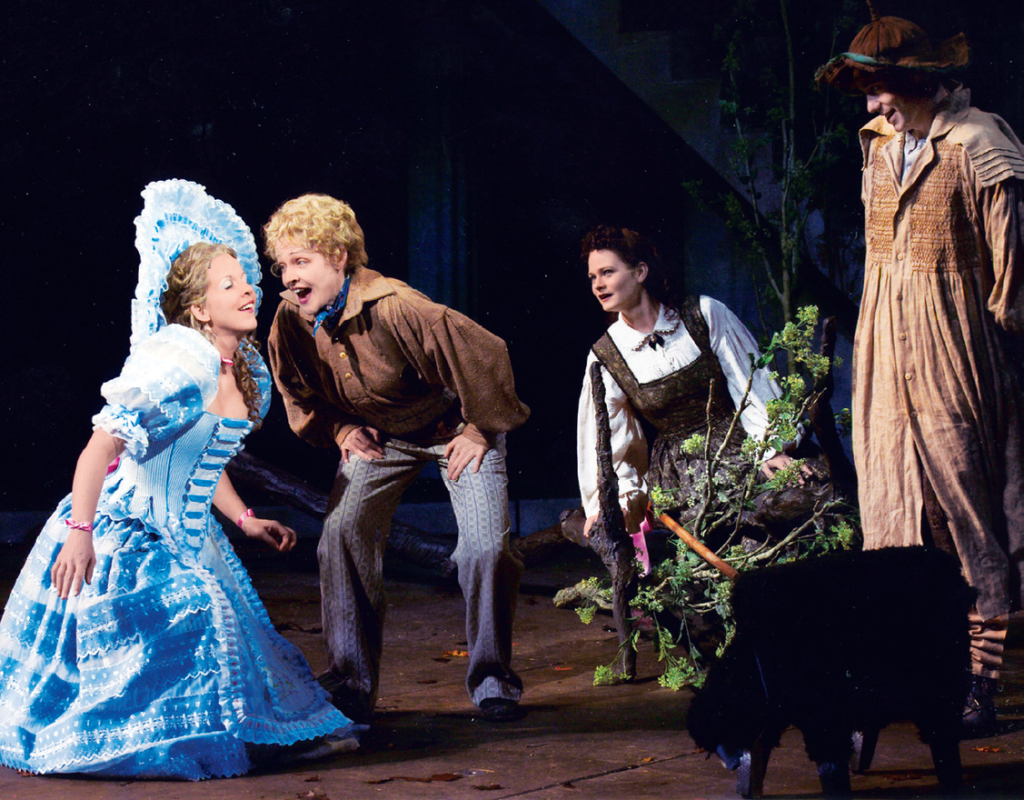
The name “Globe Theatre” is inextricably linked with Shakespeare. It was in built in 1599 by his playing company, the Lord Chamberlain’s Men, and held its first performance in the summer or autumn of that year. The theatre was accidentally burned down during a performance of Henry VIII in 1613, but only one person was hurt, and the theatre was rebuilt the following year. The Globe remained open until all of London’s theatres were closed by the Puritans in 1642, but was torn down two years later.
Fast forward to 1970, when American actor and director Sam Wanamaker founded the Shakespeare Globe Trust and the International Shakespeare Globe Centre with the objective of building a faithful recreation of the Globe Theatre close to its original location at Bankside, Southwark. Starting from the original design for The Theatre, an older building which was disassembled to supply timber for the Globe, Wanamaker’s team examined other surviving London buildings from the late 16th century, comparisons with contemporary theatres, and historical drawings and descriptions of the first Globe.
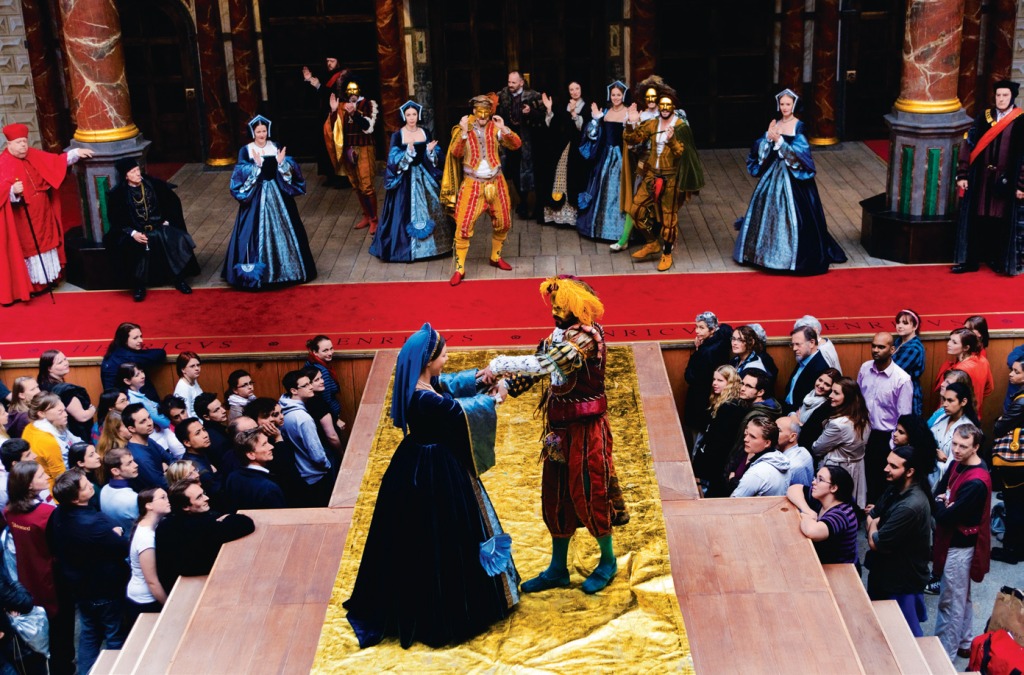
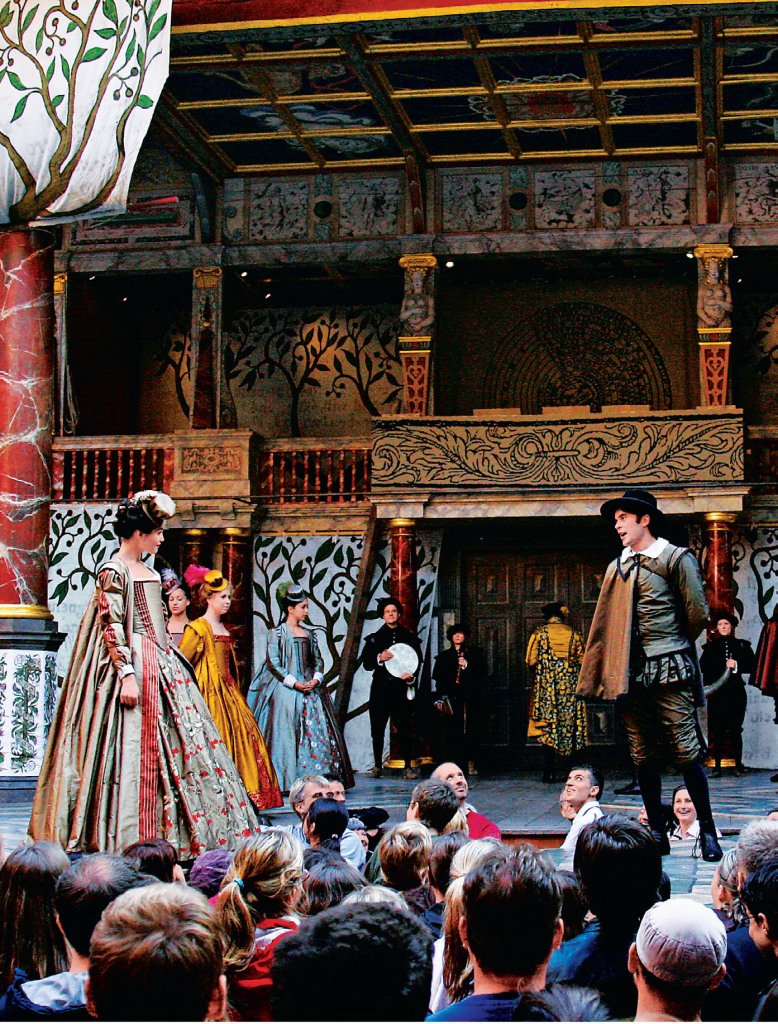
The new theatre, opened in 1997, retains historical authenticity in performance as well as in construction. No structural steel was used in the building, which also possesses the only thatched roof permitted in London since the Great Fire of 1666. There are no spotlights, speakers, microphones or any other form of amplification, and all music is performed live on period instruments.
Every summer, the Shakespeare Globe Theatre in London brings the Bard’s genius to the stage once more, enthralling audiences with some of the his finest plays. Daily performances of As You Like It, King Lear and The Tempest run through May, with June seeing the addition of A Midsummer Night’s Dream and The Taming of the Shrew. The experience, which strives to be as authentic and true to Shakespeare’s originals as humanly possible, promises to be an unforgettable experience.

