
GHP Law Firm, Gani.AI, and Marunouchi Sogo Law Office bring together legal, investment, and technology voices to map out how Japanese companies should time, structure, and govern their entry into Indonesia
TOKYO,
Japan – August 5, 2026 – As Japanese companies increasingly look to Indonesia
for growth, a seminar held today in Shibuya tackled the question many of them
get stuck on: not whether to enter Southeast Asia’s largest economy, but
when, how, and through what structure.
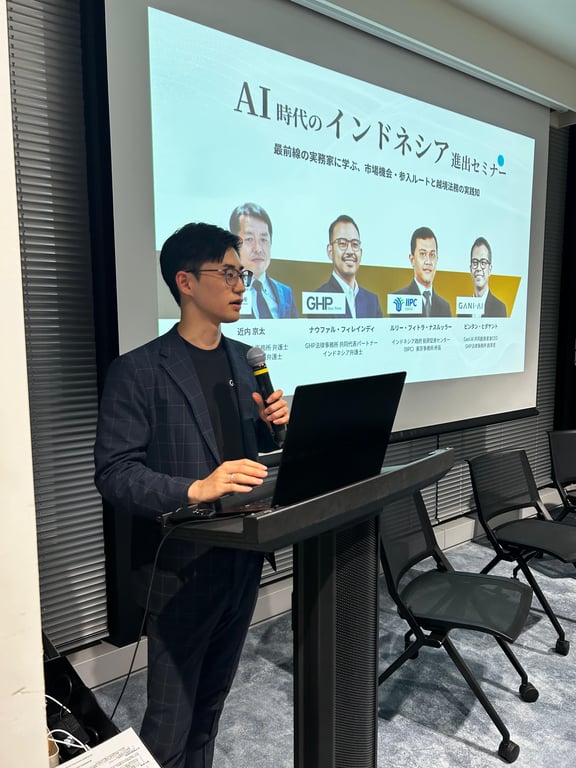
The “Indonesia Market Entry Strategy Seminar in the Age of AI,” held at
Shibuya Scramble Square, was jointly hosted by GHP Law Firm, Gani.AI, and
Marunouchi Sogo Law Office. It drew practitioners from law, cross-border
investment, and legal technology to discuss the practical mechanics of entering
the Indonesian market – and the growing role artificial intelligence is playing
in how that cross-border legal work gets done.
The panel
featured Ruly Fitrah Nasrullah, Director of the Indonesia Investment Promotion
Center (IIPC) Tokyo Office; Bintang Hidayanto, Co-Founder and CEO of Gani.AI
and Founder of GHP Law Firm; Naufal Fileindi, Co-Managing Partner of GHP Law
Firm; and Kyota Konnai, Attorney-at-Law at Marunouchi Sogo Law Office. The
session was moderated by Ayuki Kamata.
Beyond Market Size: A Structure-First Approach
Rather than
pitching Indonesia on the strength of its economic growth or population size – a case most Japanese executives have already heard – the panel focused on the
decisions companies face once they’ve decided to move forward: choosing between
local partnerships, distribution arrangements, joint ventures, or wholly-owned
entities; governing an Indonesian subsidiary from a Japanese headquarters; and
navigating the regulatory terrain that comes with operating across two legal
systems.
Topics
addressed included:
– Investment and market opportunities available to Japanese companies in Indonesia.
– Selecting the right market-entry structure for a given business model and risk profile.
– Governance and coordination between Indonesian operations and Japanese headquarters.
– Considerations specific to manufacturers evaluating local production.
– Regulatory and compliance issues arising from cross-border operations.
– Emerging opportunities in Indonesia beyond traditional investment sectors
“The
automotive industry has been key to Japanese players, however, F&B,
e-commerce industries have not been as progressive despite the Indonesian market
being welcoming of them” — Naufal Fileindi, Co-managing Partner at GHP Law
Firm
AI’s Growing – and Complicated – Role in Cross-Border Legal Work
A second
thread of the seminar examined how artificial intelligence is reshaping
cross-border legal and business operations. Panelists weighed AI’s potential to
improve efficiency in legal work against the practical risks it introduces – particularly around client confidentiality, human oversight, and traceability
in legal and public-sector contexts.
Drawing on
Gani.AI’s work in legal technology, the discussion focused on how businesses
and professional service providers can adopt AI tools without compromising the
safeguards and human judgment that cross-border legal work requires.
There’s no
disputing that AI is important, humanity will be able to progress beyond our capabilities”
— Bintang Hidayanto, Co Founder and CEO of GANI.AI
A Company-Specific Lens, Not a One-Size-Fits-All Pitch
The
seminar’s organizers were explicit that there is no single playbook for
Indonesia market entry. The panel’s consistent message: a company’s approach
should be shaped by its business model, stage of expansion, risk appetite,
organizational structure, and long-term objectives – not by generic market-size
arguments.
GHP Law
Firm, Gani.AI, and Marunouchi Sogo Law Office said they intend to continue
hosting dialogue between Japanese businesses and their counterparts in
Indonesia and across Southeast Asia, as interest from Japanese companies in
Indonesian investment, manufacturing, technology, and consumer markets
continues to grow.