

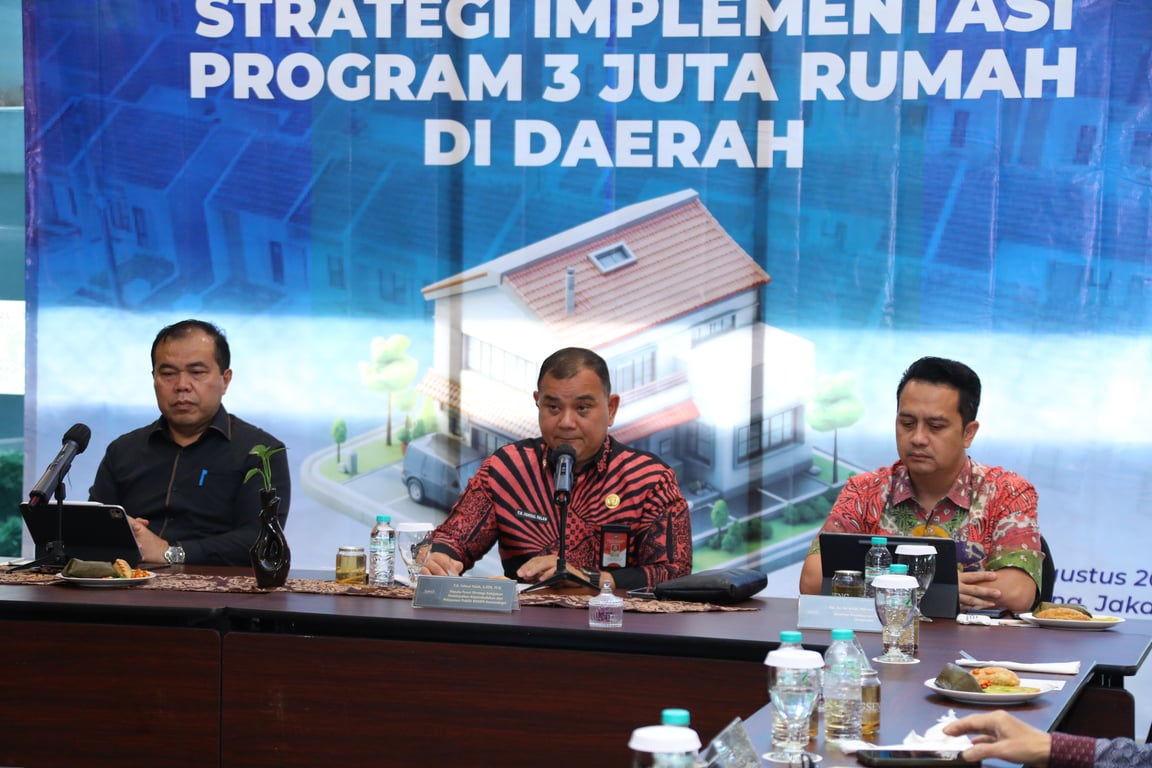
Jakarta, Indonesia August 20, 2026 – The Agency for Domestic Policy Strategy (BSKDN) of the Indonesian Ministry of Home Affairs held an Actual Discussion Forum titled “Implementation Strategy of the 3 Million Houses Program in Regions” on Thursday (20/8/2026) at Hotel Horison Ultima Menteng, Jakarta. The forum, conducted in a hybrid format (in-person and online via Zoom Meeting and YouTube Live), formulated breakthrough steps to accelerate the provision of decent and affordable housing for Low-Income Communities (MBR) across Indonesia.
Head of the Center for Policy Strategy on Regional, Population, and Public Services at BSKDN, Dr. T.R. Fahsul Falah, S.Sos., M.Si., stated that housing provision is a national agenda requiring close synergy and collaboration among all stakeholders at both central and regional levels.
“Housing provision is a shared responsibility requiring synergy among the central government, local governments, the community, the business sector, developers, banking institutions, and the media dissemination ecosystem. With strong collaboration, various regional housing issues can be handled much more effectively,” emphasized Fahsul Falah.
In this forum, BSKDN formulated 5 (five) strategic key takeaways serving as crucial notes for local governments in executing the 3 Million Houses Program:
1. Cross-Sector Synergy and Collaboration: Addressing housing challenges in the regions cannot be done in isolation; it requires an integrated role among central and regional governments, banks, developers, and the private sector.
2. Strengthening Inclusive Financing: Housing programs focus not only on physical construction, but also on ownership accessibility and sustainability. Easier financing, renovation assistance, and credit schemes tailored to informal-sector and variable-income workers are essential.
3. Strategic Role of Local Government Regulations: Local governments play a key role in facilitating access for low-income communities (MBR), including through the acceleration of Building Approvals (PBG), adjustments to Duties on the Acquisition of Land and Building Rights (BPHTB), and the harmonization of local regulations.
4. Strengthening Data & Integrated Information Dissemination: Data accuracy regarding housing needs from regional levels to the central government must be improved. Furthermore, utilizing information systems and digital publication platforms is necessary to ensure policies and incentives from the central government are thoroughly communicated to the public without information asymmetry.
5. Commitment to Concrete Actions in Regions: All discussion points are expected to be acted upon promptly through the drafting of regulations, program allocations, and field execution in each region.
The Actual Discussion Forum featured various keynote speakers and leaders from ministries/agencies, academia, and policy practitioners, including:
– Brig. Gen. Pol. (Ret.) Prof. Dr. Hoidruddin Hasibuan, S.H., M.Hum. (Rector of Universitas Harapan Medan)
– Raden An’An Andri Hikmat SR, Ap, MM (Director of Rural Housing Financing, Ministry of PKP)
– Alen Ermanita, S.Sos., M.Sc (Director of Control and Evaluation of Strategic Policies I, Bappenas)
– Sastrodirjo (Central and Regional Financial Analyst, DJPK Ministry of Finance)
– Luthfi Firdaus, S.T., M.Si. (Head of the Department of Housing, Settlement, and Land Services of Bandung City)
– Ferry Bayu Nirwono (CEO of VRITIMES)
– Gatot Tri Laksono (Indonesian Public Policy Society)
The involvement of VRITIMES in this forum provided insights into the importance of digital information dissemination technology infrastructure, ensuring that national housing policies and local government incentives are transparently socialized and reach the public down to the grassroots level.
Enthusiastically attended by over 200 in-person and online participants from BAPPERIDA, BRIDA, and Local Housing Departments across Indonesia, this event is expected to serve as a primary benchmark for local governments to accelerate the realization of decent, affordable, and sustainable settlements.

