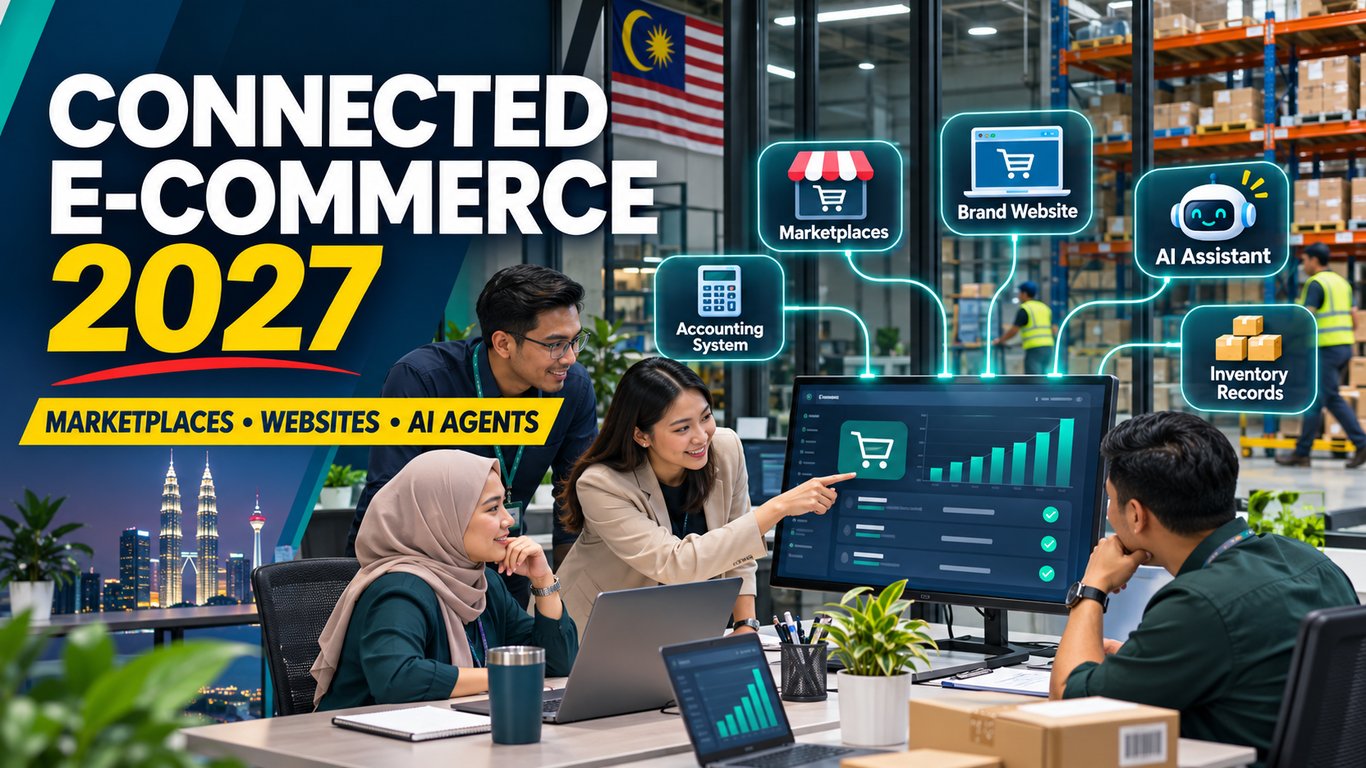
Malaysian ecommerce businesses increasingly operate across marketplaces, brand websites, accounting platforms and AI tools. As teams prepare for 2027, they need to define how orders, inventory and business data should move between systems before selecting an API, website or AI integration approach.
Malaysian ecommerce businesses increasingly operate beyond a single marketplace account. A team may manage Shopee, Lazada or TikTok Shop stores alongside a brand website, accounting software, warehouse tools and internal reports. AI agents are also entering workflows for reviewing orders, profit and inventory risks.
Adding systems does not automatically create connected operations. Orders, SKUs, warehouse quantities, settlements and financial definitions can remain separated across Seller Centres, spreadsheets and software. For 2027, the central decision is how trusted data should move between existing tools.
Manual Exports Become Harder as Systems Multiply
Spreadsheet exports can work for an occasional check, but recurring cross-system work introduces additional questions. Different systems may use different SKU identifiers, order statuses, currencies and transaction dates. Sales revenue, marketplace settlement and profit may also refer to different amounts.
Repeated manual handling makes it harder to trace a number or confirm that a file covers the complete period. The same problem affects AI analysis: an incomplete spreadsheet can produce a confident explanation from partial data unless the workflow identifies missing records and calculation rules.
Three Integration Patterns Are Emerging
System-to-system API integration applies when an ecommerce operation exchanges selected data with accounting software, an ERP, a warehouse system or a BI platform. The project must define fields, direction, frequency and reconciliation rules rather than assume that every system uses the same definitions.
Self-built website coordination serves a different purpose. Website orders may enter a central fulfilment workflow while the site receives inventory information from agreed warehouses. This requires reliable SKU and warehouse mapping, duplicate-order controls, cancellation handling and rules for inventory reservation and release.
AI agent access is a third pattern. Instead of repeated uploads, an authorized AI client can retrieve permitted data for questions or analysis. Recurring reports still require access controls, time-zone handling, calculation definitions and human review.
Integration Should Begin with Business Rules
Before selecting an interface, teams should identify the business outcome, target system, required shops and warehouses, historical period, data direction and acceptable delay. They should also agree on how SKUs, currencies, refunds, fees and order statuses map between systems.
A successful connection is not defined by one completed API call. It should deliver complete fields, handle pagination, prevent duplicate records, recover visibly from errors and remain traceable to the source. Projects that create orders or accounting records require stronger testing than read-only reporting connections.
How BigSeller Is Formalising These Connection Paths
BigSeller has recently expanded its public integration resources for teams evaluating these workflows. Its API Integration Onboarding Guide, updated on 21 October 2026, explains application preparation, requirement confirmation, testing and activation for connections involving accounting systems, brand websites, internal tools, BI platforms or AI agents.
The API integration service is assessed according to the requested business scenario. Interfaces, fields, permissions and pricing are confirmed through the formal documentation, agreement and quotation. Illustrative use cases in the guide are planning references rather than ready-made integrations or delivered customer cases.
For AI analysis, the BigSeller MCP User Guide was updated on 18 November 2026. The current MCP capabilities include querying orders, return inbound orders, purchase orders, profit reports by order and SKU, and wallet transactions. The guide provides connection examples for AI clients including Codex, Claude and WorkBuddy.
The current Malaysian price listed for the MCP API integration service is MYR2,400 per year, separate from regular subscriptions, with a default QPS of 1/s. Customers receive an APP ID and APP KEY and must keep them out of public code, repositories and shared screenshots. The published capabilities cover authorized queries and analysis, not autonomous order editing, shipping or store operation.
Businesses operating their own brand website can also review the self-built website integration guide. In the documented workflow, website orders are pushed into BigSeller as manual orders, BigSeller reserves inventory and manages fulfilment, and the website periodically queries available inventory from the specified warehouse. The approach can help reduce overselling risk, but scheduled queries may still involve delays and do not guarantee zero overselling.
What Malaysian Teams Can Prepare Before 2027
Teams do not need to connect every system at once. A practical starting point is one defined workflow, such as sending website orders into fulfilment, preparing accounting data or allowing an AI agent to query selected reports. The project can then be tested with agreed shops, warehouses and acceptance criteria before its scope expands.
Documenting the target system, data fields, update direction, responsible contacts and error-handling rules makes the first conversation more productive. Whether the eventual route uses an API, MCP or a website integration, connected operations depend on clear business definitions and controlled access as much as they depend on the interface itself.