
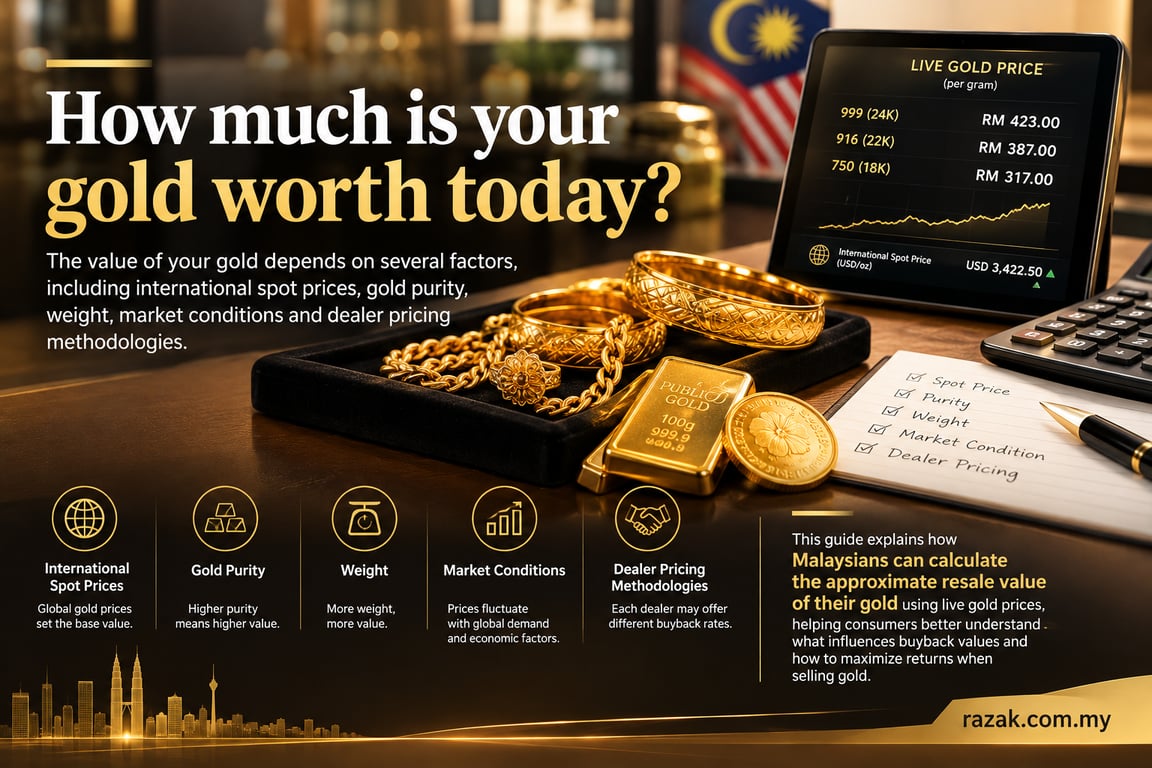
One of the most common questions among gold owners is: “How much is my gold worth today?”
The answer depends on several factors, including international spot prices, gold purity, weight, market conditions, and dealer pricing methodologies.
This guide explains how Malaysians can calculate the approximate resale value of their gold using live gold prices, helping consumers better understand what influences buyback values and how to maximize returns when selling gold.
KUALA LUMPUR, Malaysia — “How much is my gold worth today?” It is one of the most frequently asked questions among Malaysian gold owners, whether they are holding a family heirloom, a set of investment bars, or jewellery bought decades ago. The answer is rarely a single number pulled from a headline gold price. It is the result of several variables working together, and understanding them is the difference between an informed sale and a guess.
Razalie Abdul Rasull, third-generation leader of Abdul Razak Gold House (M) Sdn Bhd, a Kuala Lumpur gold trading company operating since 1950, says this confusion is one of the most consistent themes he sees at the counter.
“Customers often quote us a price they saw online and assume that’s exactly what their item is worth,” Razalie said. “The live gold price is the starting point, not the final number. What matters is how that price is applied to the specific item in front of you.”
What “Live Gold Price” Actually Means
The live gold price refers to the real-time international spot price of gold, typically quoted in US dollars per troy ounce, which is then converted into Malaysian ringgit and adjusted to local units of measurement, most commonly price per gram.
This spot price moves throughout the trading day based on global supply and demand, currency movements, interest rate expectations, and broader economic sentiment. Because of this, the gold price displayed on a dealer’s website at 9am may differ from the price at 3pm on the same day.
“Live pricing isn’t a marketing term, it should genuinely reflect the market at that moment,” Razalie said. “That’s why we display our gold prices in real time on our website rather than updating them once a day.”
The Core Formula: Weight, Purity, and Price
For most gold owners, resale value calculation follows a straightforward structure, though the details matter:
Weight. Gold is typically weighed in grams, though older jewellery may be described in older units such as tael or bahara depending on regional custom. An accurate digital scale reading is the starting point for any valuation.
Purity. Malaysian gold is most commonly available in 916 (22-karat, approximately 91.6 percent pure) and 999 (24-karat, approximately 99.9 percent pure) standards. Purity is usually stamped on the item, though dealers may verify this through testing.
Live price per gram. This is the current spot price converted to ringgit and adjusted for purity, since 916 gold is priced differently from 999 gold due to its lower gold content.
A simplified approximation looks like this: resale value equals the item’s weight in grams, multiplied by the live price per gram for its specific purity level.
“That formula is the foundation,” Razalie explained. “But it doesn’t yet account for craftsmanship, item condition, or whether there are stones or other materials attached, which is why professional valuation still matters.”
Why Jewellery and Bullion Are Valued Differently
Investment-grade gold bars and coins are generally valued close to their pure gold content, since there is little to no additional craftsmanship cost built into the price. Jewellery, by contrast, often includes design work, gemstones, or mixed metals, which are not part of the gold value itself.
“When someone sells jewellery back, they’re being paid for the gold content, not the craftsmanship or the emotional value,” Razalie said. “That distinction is one of the most important things to understand before selling.”
This is also why buyback prices for jewellery are typically lower than the price the same item was originally purchased at, since the original price included design, labour, and retail margin that are not part of the gold’s resale value.
Factors That Influence Buyback Pricing
Several additional factors shape the final price a dealer offers:
Current market conditions, since spot gold prices shift daily based on global economic data
Purity verification, particularly for older or unmarked items
Item condition, including wear, damage, or missing stones
Dealer margin and overheads, which vary between operators
Transparency of the weighing process, which affects buyer confidence in the final figure
“A trustworthy dealer should be able to show you the weight on the scale, explain the purity, and walk you through how the live price was applied,” Razalie said. “If a customer can’t see how the number was reached, that’s a red flag, not just for us, but for the industry as a whole.
Industry Context: Gold as Wealth Preservation
Interest in gold as a long-term store of value has grown steadily among Malaysian consumers, particularly during periods of currency fluctuation or broader economic uncertainty. Unlike cash savings, gold is not tied to a single currency’s performance, which is part of why it is commonly discussed alongside wealth preservation strategies rather than short-term speculation.
Malaysians increasingly hold a mix of gold investment products, including gold bars, gold coins, and gold savings schemes, alongside traditional jewellery. This shift has also increased demand for accurate, real-time pricing information, since gold owners want to understand not just what they paid, but what their holdings are worth at any given moment.
“Gold has always been part of Malaysian household wealth, especially through jewellery,” Razalie said. “What’s changed is that more people now think of it in investment terms too, and that means they want the same pricing transparency they’d expect from any other financial asset.”
Digital Tools and Transparent Pricing
As part of its approach to customer education, Abdul Razak Gold House publishes live gold prices on its website, allowing customers to check indicative values before visiting in person. Combined with digital weighing scales used during in-store transactions, the company frames this as part of a broader effort to remove guesswork from the valuation process.
“We want customers to walk in already knowing roughly what to expect,” Razalie said. “Then the in-person weighing and purity check simply confirms the specifics of their item.”
Looking Ahead
Razalie said the company plans to continue expanding its consumer education content around gold pricing, purity standards, and valuation methodology, framing this as part of its long-term role as a heritage business built on transparency.
“My grandfather built this business at a time when gold pricing was far less accessible to ordinary people,” Razalie said. “Today, anyone can check a live gold price from their phone. Our job is to help people understand what that number actually means for the gold they own.”
For Malaysian gold owners wondering what their jewellery, coins, or bars are worth today, the underlying principle remains straightforward: know the weight, know the purity, check the live price, and seek a transparent, professional valuation before making a decision to sell.