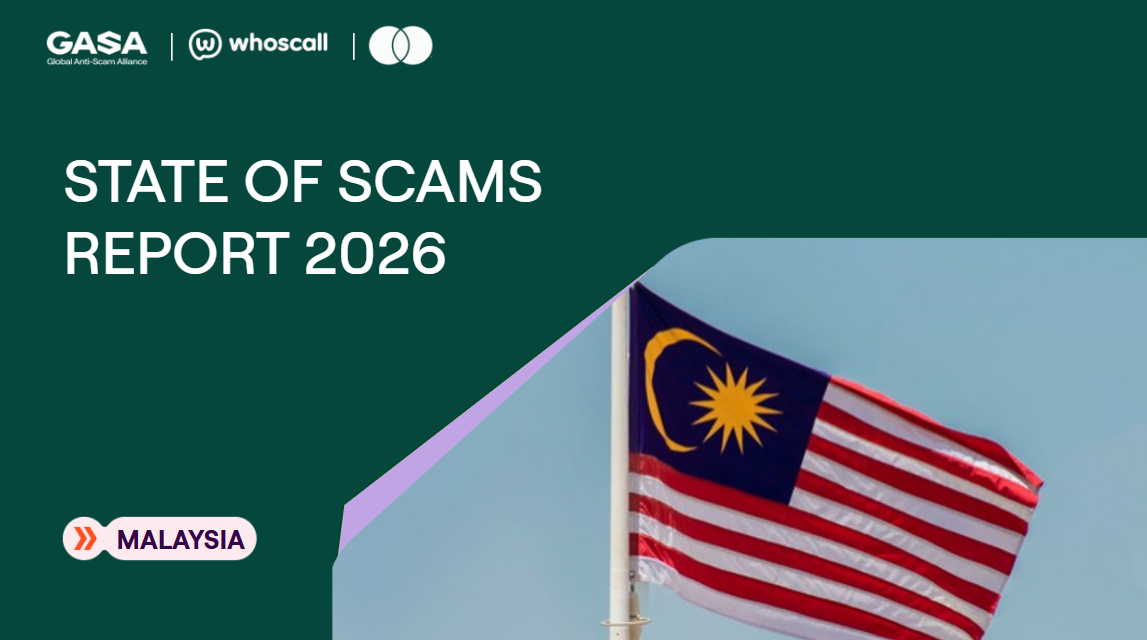
Global Anti-Scam Alliance, Mastercard and Whoscall release new report finding that 83% of Malaysian adults encountered a scam in the past year, with 14% losing money.
MALAYSIA, 25th November 2026 The Global Anti-Scam Alliance (GASA), in collaboration with Mastercard and Whoscall, today released the State of Scams in Malaysia 2026 report, setting out 13 recommendations to strengthen Malaysia’s collective response to scams.
Based on a nationally representative survey of 1,930 adults, the report examines how scams reach people in Malaysia, how they respond, and the financial and emotional impact on those affected.
Presented to YB Dato’ Fahmi Fadzil, Minister of Communications, at MCMC’s NEXSEC 2026 in Kuala Lumpur, the report calls stronger intelligence sharing, earlier detection, faster coordinated intervention and improved victim support through closer cooperation among government, law enforcement, financial institutions, telecommunications providers and digital platforms.
YB Dato’ Fahmi Fadzil, Minister of Communications, said, “The findings of this report underscore the need for a more coordinated and proactive approach to combating scams, particularly as digital threats continue to evolve in scale and sophistication. The Government remains committed to strengthening preventive measures, enhancing early detection capabilities and fostering closer cooperation among regulators, law enforcement agencies, financial institutions, telecommunications providers and digital platforms.
Safeguarding Malaysians against scams remains a national priority, and sustained collaboration across all sectors is essential to ensuring a safer, more secure and trusted digital ecosystem.”
Understanding the impact on Malaysians
In the past 12 months, 83% of Malaysian adults encountered a scam and 14% lost money. Impersonation, investment and shopping scams were among the most common, with nearly one in three people who interacted with a scam, or 31%, going on to lose money. Among those who lost money, 47% used account transfers, significantly above the Asia average of 36%.
The impact extended beyond financial loss. Among those who lost money, 78% reported a significant or moderate impact on their mental wellbeing, while 53% had lost money to scams more than once.
Although 73% of adults were confident that they could recognise a scam, 45% interacted with a scammer during the past year, reinforcing the need for safeguards alongside consumer awareness.
Reporting remains an opportunity to improve outcomes. Only 7% of adults reported a scam to authorities, while 28% of those who lost money and reported the incident to an organisation recovered or were reimbursed some or all of their money.
Brian D. Hanley, APAC Director of GASA, said:
“More than half of scam victims in Malaysia lost money more than once, and 78% reported a significant or moderate impact on their mental wellbeing. That makes the response after a scam especially important. People need clear guidance, compassionate support, and practical help to reduce the risk of being targeted again.”
Strengthening prevention through collective action
The report calls for stronger preventive measures, including greater signal sharing across institutions and industries, the use of cyber threat intelligence to detect scam infrastructure and mule networks, and closer operational coordination to accelerate intervention, tracing and restitution.
Assoc Prof. Rajat Maheshwari, Inaugural GASA Chapter chair and Senior Vice President, Strategic Growth, Mastercard, said: “We cannot win the fight against scams by focusing only on what happens after the money is gone. Scams undermine the trust people need to participate confidently in Malaysia’s digital economy, and protecting that trust cannot rest on consumers alone. We need to move upstream and bring together capabilities across the public and private sectors to make it harder for scam networks to succeed. The GASA Chapter in Malaysia will help turn fragmented efforts into collective action. Our goal is simple: intervene earlier, together.”
Manwoo Joo, Chief Operating Officer of Gogolook, said: “Scam calls and text messages remain a major challenge across Asia, and AI is making them increasingly convincing. Awareness alone is no longer enough. Building on our participation in Malaysia’s cross-sector roundtables, we are committed to strengthening local partnerships through Whoscall. By connecting intelligence and coordinating action across government, telecommunications providers, financial institutions and digital platforms, we can better protect people before trust is exploited and money is lost.”
The State of Scams in Malaysia 2026 report points to the need for closer cooperation between government, law enforcement, financial institutions, telecommunications providers, and digital platforms. Earlier detection, coordinated intervention, and clearer routes to reporting and support can help protect people and improve the response when scams occur.
Download the full State of Scams in Malaysia 2026 report at https://gasa.org/knowledge-base/reports/state-of-scams-in-malaysia-2026[KQ2]