
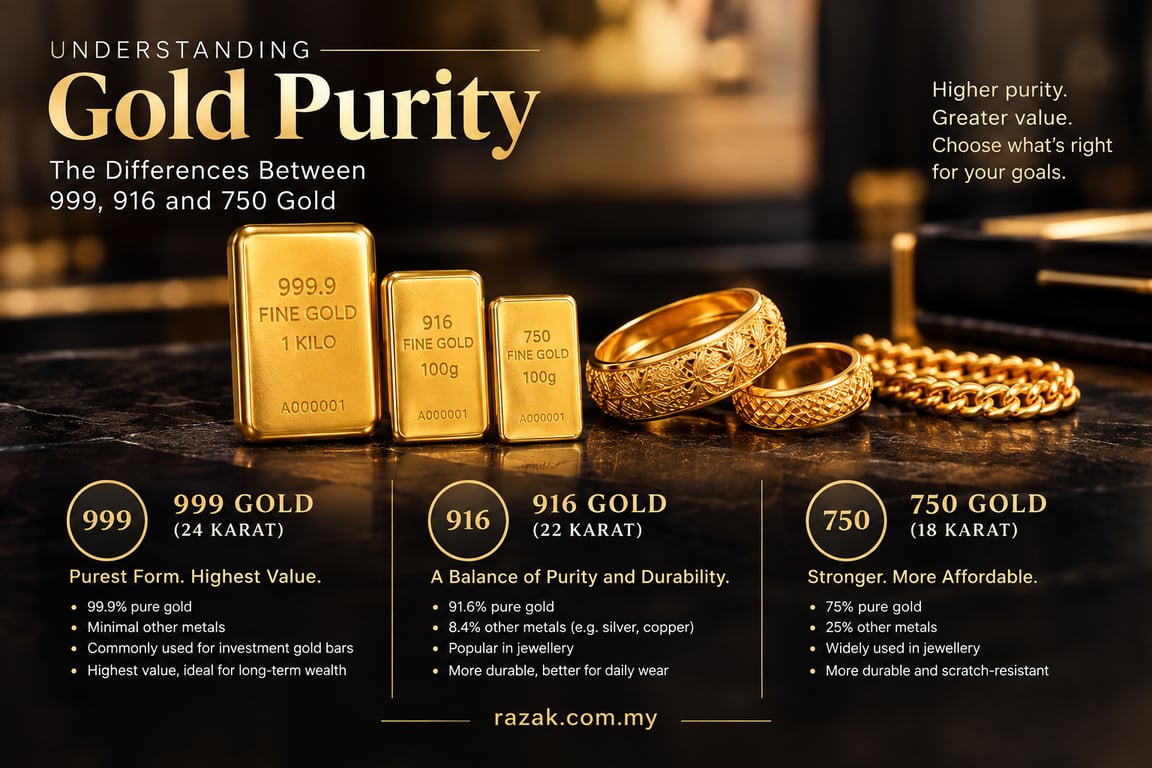
Gold jewelry and bullion products are commonly categorized according to purity levels, yet many consumers remain unclear about what these numbers actually mean.
This educational guide explains the differences between 999 gold, 916 gold, and 750 gold, including their composition, durability, investment suitability, and resale considerations. Understanding gold purity allows consumers to make better purchasing decisions and accurately evaluate the value of their gold assets.
Whether buying, selling, or investing, knowing the purity of your gold is one of the most important factors in determining its true market value.
Razalie Abdul Rasull of Abdul Razak Gold House Shares Insights on Gold Purity, Investment Value, and Resale Considerations for Malaysian Consumers
Every piece of gold sold in Malaysia carries a number, 999, 916, or 750, stamped somewhere on it. Most buyers know these numbers relate to quality, but far fewer can explain what they actually measure or why it matters when it’s time to sell. This guide answers that directly.
What Do 999, 916, and 750 Gold Mean?
These numbers describe the percentage of pure gold in an item, measured out of 1,000 parts. It’s called the fineness system, and it exists alongside the older karat system, which measures purity out of 24 parts instead
So when a piece is stamped “916,” it means 91.6% of its weight is pure gold, with the remaining 8.4% made up of other metals, usually silver, copper, or zinc, added to change the metal’s properties.
Why Isn’t All Gold Just 999?
Pure gold is soft. 24K gold is too soft for jewellery because it scratches and bends easily, which is exactly why almost no jewellery is sold at 999 fineness. Alloying gold with other metals hardens it, changes its colour, and makes it durable enough for daily wear.
This is the core trade-off behind every purity level: the higher the fineness, the purer and more valuable the gold by weight, but the softer and less durable it is. The lower the fineness, the more durable and workable it is, but the lower its gold content and resale value.
999 Gold: Maximum Purity, Minimum Durability
999 gold, often written as 999.9 for extra-fine bullion, is nearly pure gold. 999 means 24K pure gold, the highest purity commonly sold. Because it’s too soft to wear, 999 gold is almost exclusively used for:
Investment bars and wafers
Bullion coins (including gold dinars)
Collectible pieces valued for purity rather than wearability
People storing wealth long-term who won’t wear their gold, and buyers seeking maximum international resale flexibility, are the ones best suited to 999 gold. It carries the least workmanship markup of any purity level and trades closest to the global spot price.
916 Gold: Malaysia’s Everyday Standard
916 gold, 22K, is the purity most Malaysians associate with the word “gold jewellery.” When someone in Malaysia says “gold jewellery,” they almost always mean 916.
It sits at what many jewellers describe as a practical sweet spot: high enough purity to hold its value well, but with just enough alloy content, the remaining percentage made up of other metals that enhance strength and durability, to survive being worn as rings, bracelets, pendants, and necklaces without warping or scratching easily.
916 gold is common across Malaysia, Singapore, and the Middle East, and Malaysian jewellers have refined 916 craftsmanship for generations, which also means it resells easily within the region, even if it carries a slightly higher workmanship premium than plain investment bars.
750 Gold: Built for Design, Not Weight
750 gold, 18K, contains 75% pure gold and 25% alloy, the highest alloy content of the three. That extra alloy does real work: it’s what allows for white gold, rose gold, and colour variations that pure yellow gold can’t achieve, and it produces a harder metal that holds gemstone settings securely.
This is why premium jewellery houses and fine jewellery internationally lean on 750 gold. It’s the standard for engagement rings, gem-set pieces, and intricate designs where strength and precision matter more than maximum gold content. The trade-off is straightforward: 750 gold has less intrinsic gold value per gram than 916 or 999, so it’s priced more for craftsmanship and design than for its metal content alone.
How Purity Affects Resale Value
When you sell gold back to a dealer, three things determine what you’re paid: the current spot price, the item’s weight, and its verified purity. A 916 necklace and a 750 ring of the same weight will not fetch the same price, because the 916 piece contains meaningfully more actual gold.
This is also why professional buyers test purity rather than relying on the stamp alone. A hallmark is a useful starting signal, but it is not proof by itself, and testing is treated as a layered process that starts with easy checks and moves toward stronger confirmation for higher-value items.
Common verification methods, in order of how commonly they’re used:
Hallmark and weight check — the fastest first step, but treated as a screening clue rather than final proof
Magnet test — pure gold is not magnetic, so an item that sticks to a magnet likely contains non-gold metals
Acid testing — widely used by smaller jewellers for a quick estimate, though it has lower precision than XRF or fire assay and can mark the item’s surface
XRF (X-ray fluorescence) — a non-destructive method that produces results within seconds and is considered one of the most accurate ways to verify gold without damaging the item
Fire assay — the most precise method available, but it destroys a small sample of the item, so it’s reserved for refinery-level or disputed transactions rather than everyday retail checks
Buyers should be aware that purity fraud does happen. Some items are gold-plated over a cheaper base metal, and in more sophisticated cases, dense metals like tungsten have been used to mimic the weight of a genuine gold bar. This is precisely why reputable dealers verify purity with instruments rather than trusting a stamp alone, especially for larger transactions.
Quick Answers
Is 999 gold better than 916 gold? Neither is “better” in absolute terms. 999 gold has more pure gold content and is better suited to investment; 916 gold is more durable and better suited to jewellery worn daily.
Can 916 gold be melted down to 999? Yes, refining can remove the alloy content, though this typically involves a processing cost and is usually only worthwhile for larger quantities.
Does higher purity always mean higher price per gram? Generally yes for the gold content itself, though workmanship, design complexity, and brand can add cost to lower-purity pieces independent of their gold weight.
Is 750 gold considered “real gold”? Yes. At 75% pure gold, 750 (18K) is genuine gold, just alloyed more heavily than 916 or 999 for strength and design flexibility.
How can I check my gold’s purity before selling it? Start with the hallmark and a weight check, then have it verified by a licensed dealer using acid testing or XRF before agreeing on a price, particularly for higher-value pieces.
Where This Matters in Practice
Understanding these three purity levels helps with two very different decisions: what to buy, and what to expect when you sell. Someone building a long-term investment position generally wants 999 gold bars or coins for maximum gold content per ringgit. Someone buying jewellery to wear wants 916 for durability and easy resale, or 750 if design and gemstone settings matter more than gold weight. And anyone selling gold, regardless of purity, should expect a licensed dealer to verify that purity with proper instruments rather than taking a stamp at face value.
Malaysian gold buyers and sellers can check current purity-based pricing and have items professionally verified at licensed dealers such as Abdul Razak Gold House, which publishes live gold prices for different purity levels at razak.com.my and offers gold buyback and jewellery buyback with transparent digital weighing and valuation.
This article is provided for general educational purposes and does not constitute financial or investment advice. Gold prices and purity valuations fluctuate with market conditions; readers should confirm purity and pricing directly with a licensed dealer before buying or selling.