
Every digital payment begins with an interaction people can see: a tap of a card, a transfer through a mobile application or a salary credited to an account. Behind each transaction is a regulated infrastructure that most users will never see.
Across ASEAN, banks, telecommunications companies, employers, cooperatives, government agencies and other organizations already serve millions of customers, workers and communities. Many want to extend financial services to these groups, but building the regulated payment infrastructure behind those services requires time, capital, technology and specialist expertise.
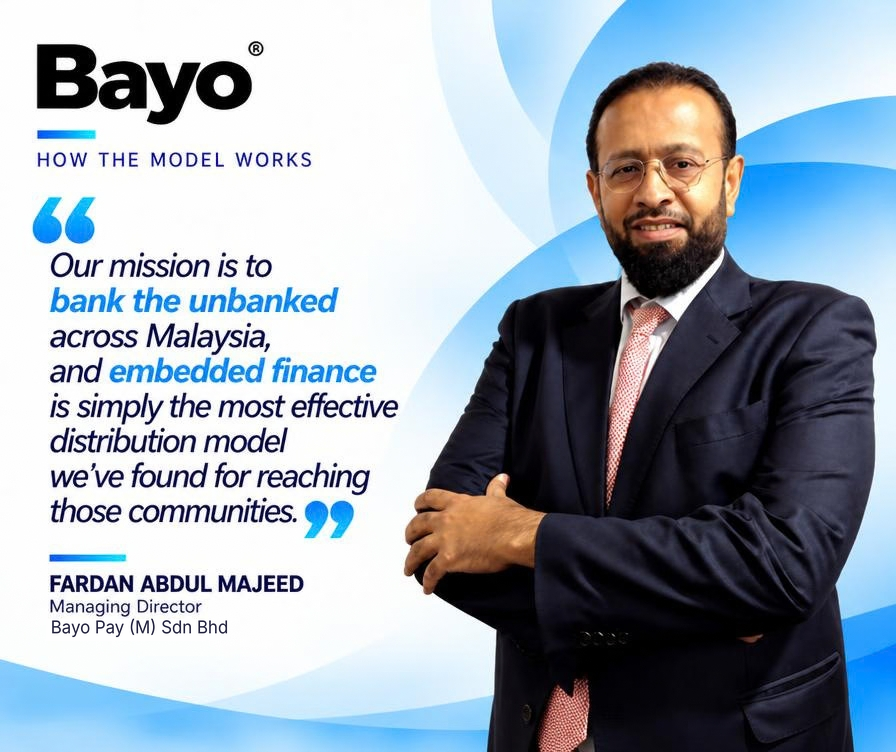
Bayo Pay offers another route: enabling organisations to embed payment and financial services into ecosystems they already own, under brands their users already know and trust.
Bayo Pay began as a Mastercard prepaid card provider and has since evolved into a Bank Negara Malaysia regulated e-money issuer and Payment-as-a-Service (PaaS) platform. Rather than competing as another consumer-facing wallet, Bayo Pay focuses on the infrastructure behind it – providing the payment rails that enable partners to move money, disburse funds and deliver financial services without having to build the entire system themselves.
For a region where large communities are already connected to employers, industry bodies and other organisations, the model creates an opportunity to bring financial services into relationships that already exist.
Building the Foundation
A defining milestone came in 2018, when Bayo Pay was appointed as the official strategic partner of the Construction Industry Development Board Malaysia (CIDB) for the Construction Personnel Registration Card. The appointment prompted the development of institution-grade infrastructure for Malaysia’s construction workforce, including migrant workers who have traditionally faced barriers to mainstream banking services.
The collaboration subsequently gave rise to Construx, an integrated suite of digital payment solutions developed for Malaysia’s construction ecosystem. Construx brings together the CIDB Construction Personnel Registration Card, Construx Wallet, Construx Portal and Construx Payroll, connecting registered construction personnel and employers through a single ecosystem.
More than a sector-specific solution, Construx became a real-world demonstration of Bayo Pay’s broader approach to embedded finance: using established industry ecosystem as the channel through which financial services can be delivered.
Another important milestone came when Bayo Pay obtained regulatory approval to issue a designated payment instrument under Section 11 of Malaysia’s Financial Services Act 2013, strengthening its credentials as a regulated payment infrastructure provider in Malaysia.
Together with its long-standing relationship with CIDB and experience serving a diverse user base, this regulatory foundation has given Bayo Pay practical experience in building and managing payment infrastructure at scale.
Its approach is deliberately partner-led. Bayo Pay operates behind its partners’ brands, allowing them to retain their customer relationships while accessing the payment capabilities required to deliver financial services.
The Infrastructure Behind the Wallet
Bayo Pay’s white-label PaaS model provides the common infrastructure for e-money issuance, disbursement, compliance and settlement, while allowing solutions to be configured around the requirements of different partners and sectors.
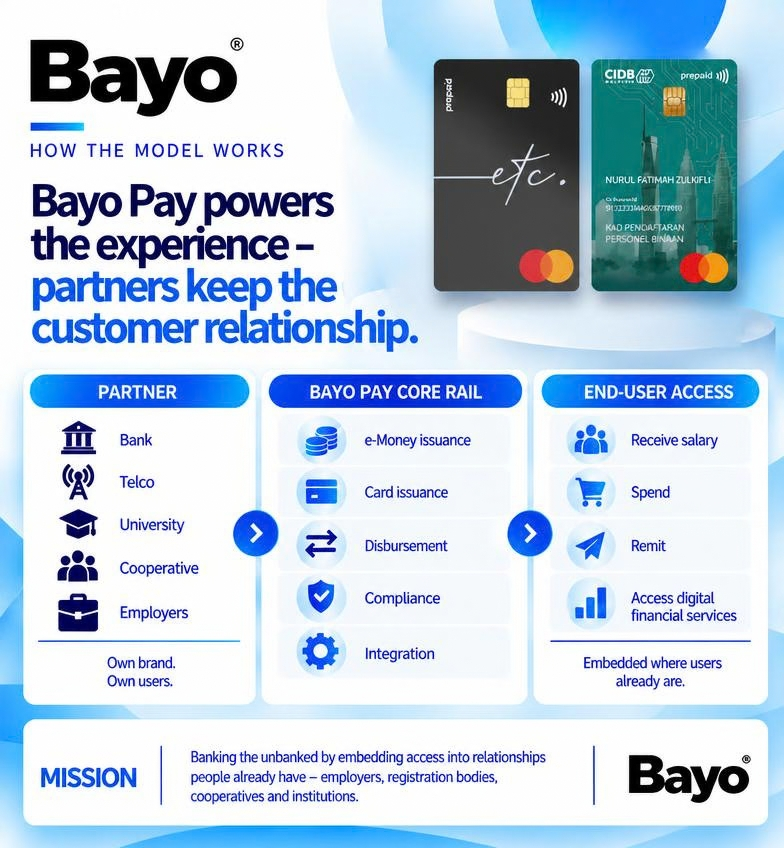
This means the underlying infrastructure does not need to be rebuilt for every deployment. Application Programming Interfaces (APIs), card formats, partner branding and integration requirements can be adapted around a common core.
Construx is one application of that model. It addresses the needs of Malaysia’s construction ecosystem, through capabilities such as salary disbursement, cross-border remittances and integration with the CIDB Construction Personnel Registration Card. Bayo Pay’ salary disbursement capabilities also support human resources (HR), and payroll integration as well as bulk payments through virtual accounts.
For organisations handling salaries, disbursements and customer funds, however, technology is only part of the requirement. The infrastructure must also remain reliable during periods of peak demand while maintaining the safeguarding, regulatory and Anti-Money Laundering and Countering the Financing of Terrorism (AML/CFT) controls expected of regulated financial services.
Bayo Pay has built these controls into its transaction processes as volumes grow. Its systems are designed around peak periods, such as payroll dates and festive remittance seasons, while modular partner integrations help prevent disruption in one program from affecting others.
Financial Inclusion in Practice
The value of payment infrastructure ultimately lies in how effectively it reaches and serves people.
Malaysia’s construction workforce provides a particularly relevant example. Many migrant workers have limited access to conventional banking services, while also needing reliable and affordable ways to receive salaries, make payments and send money to their families across borders.
Through Construx, payment capabilities are integrated into an established industry ecosystem serving the construction workforce. By embedding financial services into a familiar platform, Construx enables workers to access these services without having to establish a separate financial relationship.
The results demonstrate growing adoption. Between October 2025 and August 2026, Bayo Pay recorded a 36% increase in total users and an approximately 780% increase in active remittance users. The conversion rate for the CIDB remittance product also increased more than sixfold.
The same principle extends beyond construction. Bayo Pay also serves foreign workers in sectors such as manufacturing, food and beverage, and security, enabling them to receive salaries, make payments and send money home through an embedded financial-service relationship.
The experience points to a broader lesson to ASEAN: reaching underserved communities does not always require creating a new platform or customer relationship. In some cases, the more effective route is to bring financial services into ecosystems where those communities are already connected.
Strategic Capital as a Growth Enabler
As Bayo Pay moved from establishing its core payment infrastructure to scaling its operations, its priorities expanded to accelerating product development, growing its merchant and institutional partner network, strengthening operational and compliance capabilities, and extending its reach to more users and underserved communities.
VentureTECH, a Malaysian government-linked impact investment company focused on accelerating the growth of high-potential companies in high-growth and high-value industries, has supported Bayo Pay in this next phase of growth.
VentureTECH’s investment provided the growth capital to advance these priorities concurrently, enabling Bayo Pay to scale its platform and strengthen the capabilities required to support a growing ecosystem of partners and users.
With VentureTECH’s support, Bayo Pay has doubled the rate at which it onboards new merchants and partners, introduced new products and features across its ecosystem, and continued to expand its end-user base.
The partnership extends beyond capital. VentureTECH has facilitated industry connections, provided access to relevant networks and peers navigating similar regulatory and scaling challenges, and contributed sector knowledge to support Bayo Pay’s strategic growth.
This combination of capital and strategic support has strengthened Bayo Pay’s foundation for its next phase of growth – enabling the company to scale its Malaysian-built payment infrastructure and preparing the business to serve a wider range of partners and markets.
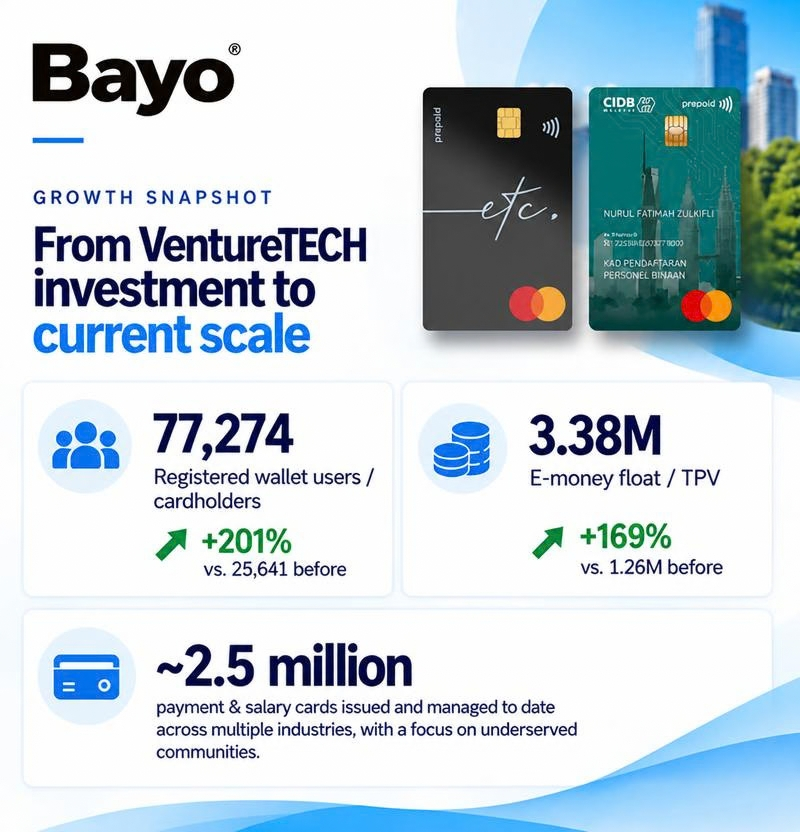
Today, approximately 2.5 million payment and salary cards have been issued and managed across several industries, providing an indication of the scale the infrastructure is already supporting.
For VentureTECH, Bayo Pay also demonstrates multiplier effect of strategic capital: supporting the growth of a Malaysian technology company while enabling its solutions to reach more businesses, industries and ultimately more users.
From Malaysia to ASEAN
The next opportunity is not simply to take a Malaysian product overseas, but to apply Bayo Pay’s infrastructure experience to challenges that exist across ASEAN.
Large migrant-workers corridors connect countries and industries throughout the region. Workers from Indonesia, the Philippines, Myanmar, Bangladesh and Nepal into markets such as Malaysia, Singapore and Thailand, creating financial needs at both ends of the journey. Payment providers must support workers in their destination markets while connecting them to secure remittance channels in their home countries.
But the opportunity is broader than migrant-worker payments.
A telecommunications company looking to embed financial services into its customer ecosystem, an employer seeking more integrated salary-disbursement capabilities, cooperative serving member outside conventional banking channels, or an industry body managing a large workforce may face different challenges. Yet they share a
common question: how can financial services be introduced efficiently without having to build the entire payment infrastructure from the ground up?
Bayo Pay’s experience in Malaysia offers one possible model. Through its PaaS approach, organizations can build on existing customer, employee or member relationships while leveraging Bayo Pay’s payment infrastructure and capabilities behind the experience. This allows them to focus on understanding and serving their communities rather than building every component of a financial-service platform themselves.
The Malaysian model, however, cannot simply be exported unchanged. Licensing requirements differ across ASEAN, as do remittance corridors, identity-verification standards, preferred payment methods and levels of digital access. Some markets rely heavily on QR payments and real-time transfer systems, while device ownership and connectivity also vary between urban and rural communities.
The regional opportunity therefore lies not in replicating a Malaysian product market by market, but in adapting Bayo Pay’s infrastructure and operating experience to local regulatory, commercial and consumer environments.
Its core PaaS architecture including e-money issuance, card issuance, disbursement, compliance monitoring and partnership-led distribution, provides the foundation. How that foundation is deployed would be shaped around the regulatory requirements, payment ecosystem and needs of each market and its local partners.
The Infrastructure You May Never See
Bayo Pay measures long-term success in an unusual way for a fintech company: within the next five to ten years, people may use services powered by its infrastructure without necessarily knowing its name.
That is perhaps the clearest expression of Bayo Pay’s business model. It does not need to own every customer interface. Its role to provide the infrastructure that enables other organisations to deliver financial services through relationships they have already built.
In Malaysia, Bayo Pay aims to become a preferred embedded finance infrastructure provider for organisations that would otherwise have to build their own systems. Its technology can operate behind salary disbursement, worker-registration programs and other embedded financial services, regardless of the brand presented to the end user.
Across ASEAN, the challenge will differ from market to market, but the underlying question may be familiar: how can an organisation offer more financial services to the people it already serves without building the entire infrastructure itself?
Bayo Pay’s journey in Malaysia provides one answer – and a model that can be adapted rather than simply replicated.
From a card provider to regulated payment infrastructure, Bayo Pay’s journey demonstrates how home-grown technology can address challenges shared across ASEAN.
The wallet may carry someone else’s name. The card may carry someone else’s brand.
But behind the transaction is the infrastructure that makes the experience possible.