
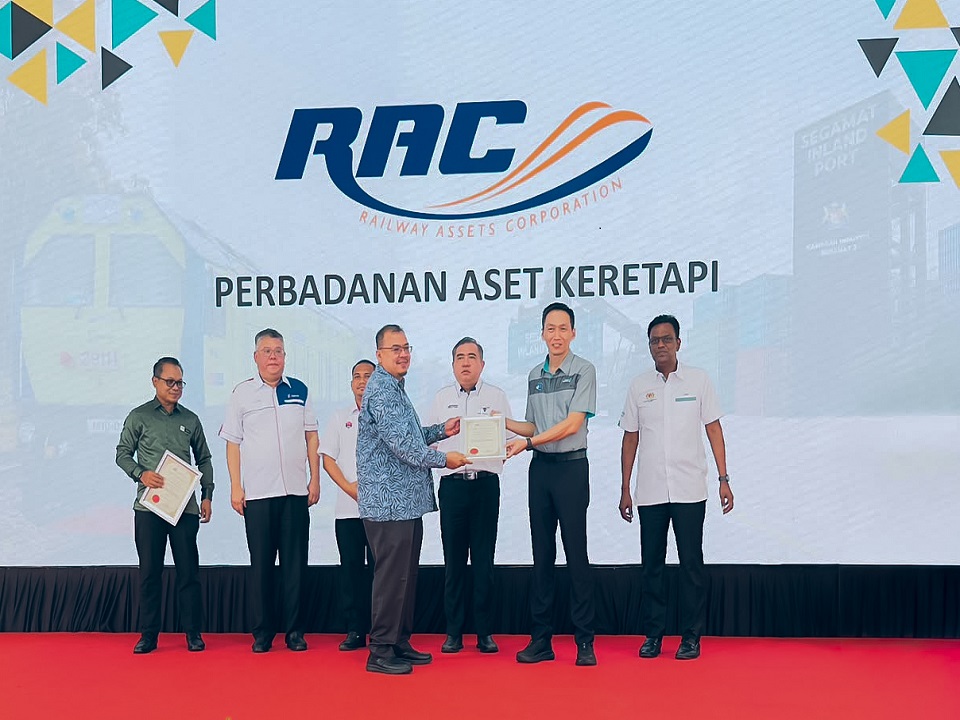
Railway Assets Corporation (RAC) has been shortlisted as a finalist for the Minister’s Laureate for National Transport Leadership at the Transport Expo Asia (TXA) Awards 2026, recognising its role in shaping the long-term development of Malaysia’s railway network. By changing how freight rolling stock is funded and maintained, unlocking railway land for development and building international partnerships, RAC is taking a more active role in strengthening the country’s transport infrastructure.
Making the Shift from Road to Rail
Moving more goods by rail is one way to ease pressure on Malaysia’s roads, but the transition depends on reliable trains, suitable equipment and better connections between transport modes.
As part of the Ministry of Transport’s Road to Rail initiative, RAC is implementing its Rolling Stock Strategy to improve freight capacity and reliability. Under a 25-year leasing arrangement, RAC’s fleet of 44 locomotives has been sold to Malaysian manufacturer SMH Rail Sdn. Bhd. for refurbishment and is being leased back. Meanwhile, 246 older wagons are being replaced with new units built locally. RAC is also developing six cargo hub terminals to improve connections between road and rail freight services.
The arrangement spreads fleet costs over time while giving local manufacturers and maintenance providers a role in supporting the network. It is a practical example of how RAC’s railway assets can contribute to logistics efficiency without relying entirely on large upfront government purchases.
Turning Underused Land into Economic Activity
Railway land can serve a purpose beyond tracks and stations. In Batu Tiga, Selangor, RAC completed a RM197.9 million land deal in July 2026 involving 17.4 acres. The planned development, with an estimated gross development value (GDV) of RM1.91 billion, will combine residential, retail and commercial spaces.
RAC intends to reinvest the sale proceeds into the railway network. Further plans for Seremban Sentral and Ipoh Sentral could bring thousands of jobs and more business activity around existing transport connections.
This approach gives RAC’s railway assets a wider economic role: supporting urban growth while creating opportunities to fund future improvements to the network.
Connecting Global Experience with Local Needs
RAC has also signed memoranda of understanding (MOUs) with Germany’s Deutsche Bahn and Japan’s East Japan Railway Company (JR East). The agreements cover railway freight, station revitalisation and transit-oriented development, bringing international experience into Malaysia’s own development plans.
At the same time, RAC’s work reaches beyond commercial development. It is preserving historic railway buildings, including Kuala Lumpur Railway Station, while plans for the Malayan Railway Building in George Town aim to give another heritage property a new use.
In Perai, Penang, its Kampung Manis development is providing affordable housing for long-term residents, with 177 homes in the first phase. These projects show how railway land can remain relevant to communities as transport needs and urban areas change.
A Railway Network with a Longer-Term Purpose
From modernising freight operations to developing station land and preserving heritage, RAC’s work reflects a shift towards managing railway infrastructure as a long-term national resource. Its reported RM1.8 billion in reinvestment into railway and public-service outcomes further illustrates the link between asset management and public benefit.
As a finalist for the Minister’s Laureate for National Transport Leadership at the TXA Awards 2026, RAC brings this wider perspective to the national transport conversation. RAC’s railway assets strategy is not simply about making existing infrastructure more productive; it is about ensuring that the value created today can help support Malaysia’s railway network, local industries and communities in the years ahead.